
Tailoring Data Quality: Why Your Social Network Defines "Good" Data
Tailoring Data Quality Models Using Social Network Preferences
This paper introduces a collaborative framework for tailoring data quality (DQ) models by leveraging Social Network Preferences. It proposes the Data Quality Social Network (DQSN) model and utilizes the Influence-biased Majority Induced Ordered Weighted Averaging (MIOWA) operator to synthesize stakeholder preferences into a weighted DQ assessment.
TL;DR
In the world of big data, "quality" is rarely a fixed target. This paper argues that data quality models should be dynamic social constructs. By introducing the Data Quality Social Network (DQSN) and a novel Influence-biased MIOWA operator, the authors provide a mathematical and ontological framework to aggregate subjective stakeholder preferences while correcting for the bias introduced by social hierarchies.
Background Positioning: This work bridges the gap between Information Quality (IQ) theory and Social Network Analysis (SNA), moving beyond static metric-based assessments to a stakeholder-centric, fuzzy-logic-driven approach.
Problem & Motivation: The Myth of Equal Importance
Most data quality (DQ) assessments rely on a simple weighted average of dimensions like Accuracy, Completeness, and Timeliness. However, two major problems persist:
- Subjectivity: Stakeholders don't think in numbers (e.g., "0.8 importance"); they think in words ("Very High").
- Social Bias: In a team, the CTO's opinion might subconsciously (or explicitly) influence a junior developer's perception. Original aggregation methods assume opinions are independent, which leads to a "biased consensus."
The authors' insight is that if we can model the social graph of stakeholders, we can weight their opinions more accurately and detect when a "consensus" is actually just social pressure.
Methodology: The DQSN Framework
The framework is built on two pillars: a semantic data model and a soft-computing operator.
1. The DQSN Ontology
The authors utilize OWL (Web Ontology Language) to define a shared vocabulary. It integrates:
- FOAF (Friend of a Friend): To define social links.
- DQMO (Data Quality Measurement Ontology): To define dimensions.
- dqsn:hasbeeninfluencedby: A critical relationship capturing the social pressure/hierarchy between users.
2. The Influence-biased MIOWA Operator
The core mathematical engine is an evolution of the Induced Ordered Weighted Averaging (IOWA) operator.
- Computing with Words: Users provide linguistic labels (e.g., "Normal," "Low").
- The Support Function: Traditionally, MIOWA looks at how much opinion A supports opinion B.
- The "Bias" Correction: The authors modify the support function: This essentially "penalizes" the similarity of two opinions if we know one person heavily influences the other, preventing the model from over-counting redundant, biased opinions.
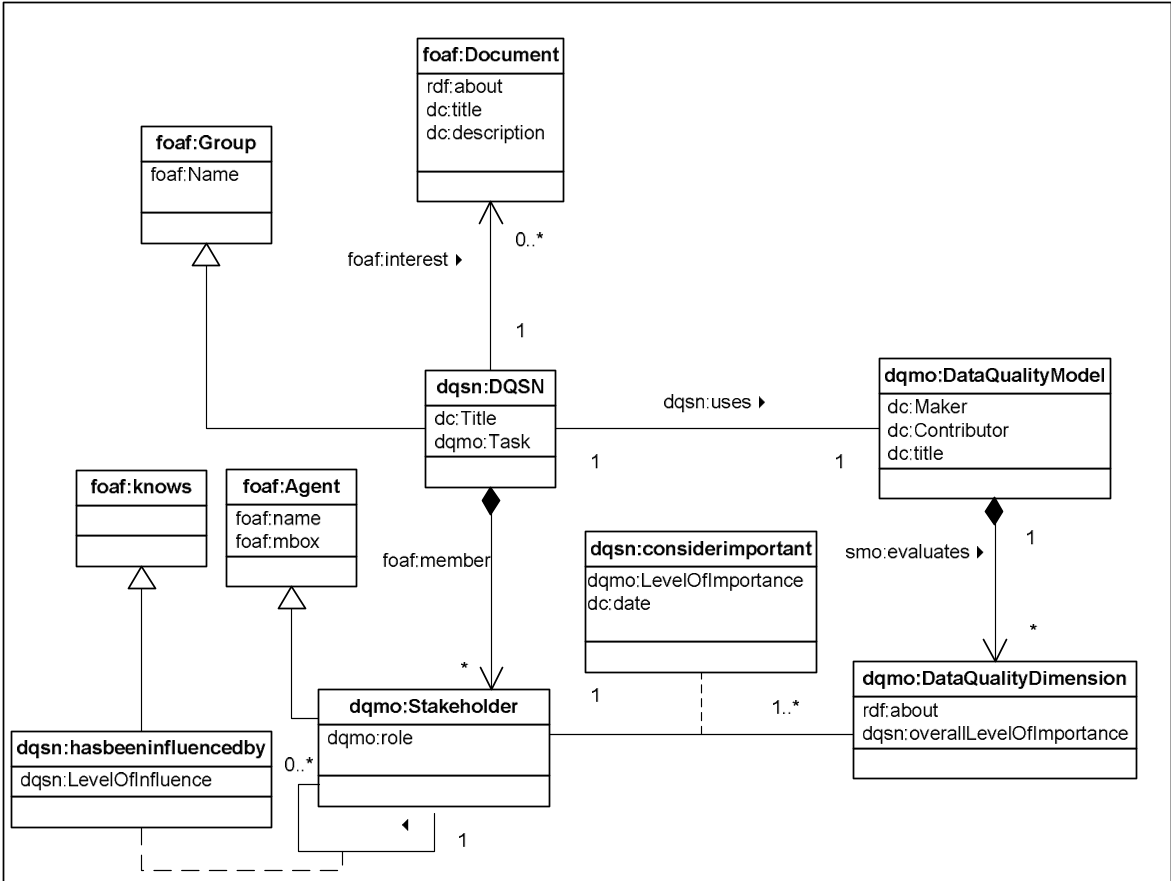 Caption: The DQSN Data Model integrating Stakeholders, Documents, and Dimensions.
Experiments & Results: Real-world Impact
The researchers applied this to a newspaper website's DQ model (Dimensions: Reliability, Completeness, Timeliness).
Key Findings:
- Consensus Shift: Without influence correction, "Reliability" was given an importance weight of 0.375. With the influence-biased operator, it shifted to 0.379.
- The Butterfly Effect: While a shift from a DQ score of 72.51 to 72.41 seems small, it confirms that social influence is a measurable variable in DQ assessment.
- Pattern Detection: The framework allows "DQSN Analyzers" to identify patterns where groups are merely echoing a leader rather than providing diverse quality assessments.
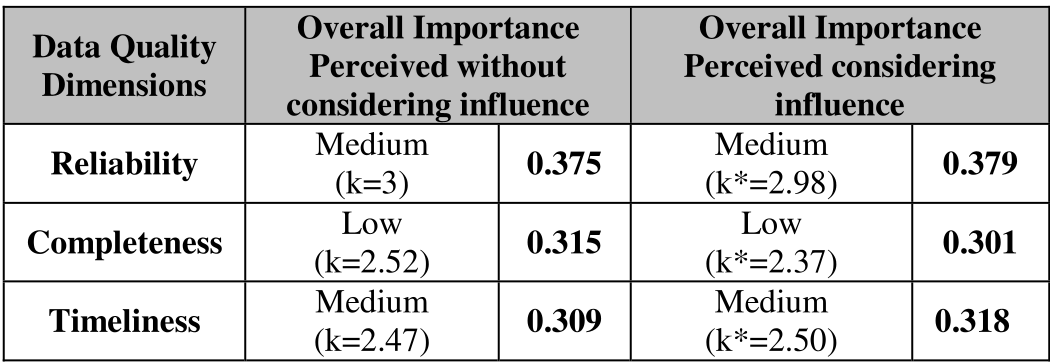 Caption: Comparison of Dimension Weights with and without Social Influence considerations.
Critical Analysis & Conclusion
Takeaway
The paper successfully demonstrates that Data Quality is a social agreement. By formalizing social influence into the math of aggregation, organizations can get a much more "honest" view of what their stakeholders truly value.
Limitations
- Dynamic Calibration: The values (0.2 for influence, 0.1 for semi-influence) are currently heuristics. In a real production environment, these would need to be derived from actual social interaction data (e.g., Slack interactions, git pull request reviews).
- Complexity: Implementing an OWL-based semantic network just for DQ weights might be overhead for smaller teams.
Future Work
The authors suggest moving toward Social Network Analysis (SNA) to automatically detect influence patterns and using these models to "filter or rank" the vast amounts of documents on the Semantic Web based on localized, socially-tailored quality standards.