
A Tale of the Social-side of ASD: Unpacking Neurodivergent Interactions on Reddit
A Tale of the Social-Side of ASD
The paper presents a systematic content and visual analysis of the "r/autism" and "r/aspergers" subreddits to understand how the Autism Spectrum Disorder (ASD) community utilizes online social networks. By examining user types and interaction patterns, the study identifies 15 core topic areas and highlights the critical role of anonymity in fostering supportive environments for neurodivergent individuals.
TL;DR
This study provides the first systematic content analysis of the "r/autism" and "r/aspergers" subreddits. By analyzing thousands of posts, the researchers discovered that these anonymous platforms serve as a vital "complexity-free" medium for individuals with ASD to connect. The findings reveal a stark difference in community needs: parents seek celebration and hope, while neurodivergent adults prioritize troubleshooting everyday life and diagnostic clarity.
Background: Why Reddit Matters for ASD
For many on the Autism Spectrum, real-world social interaction is a minefield of unpredictable non-verbal cues and emotional subtext. Online Social Networks (OSNs) offer a "buffer," yet mainstream platforms like Facebook often enforce "real-name" policies that can lead to social stigma. Reddit’s anonymity and "badge" system (e.g., "Parent of Autistic Child" or "Autistic Adult") provide a unique laboratory to study how this community truly interacts when the pressure of physical social performance is removed.
Problem & Motivation: The Gap in Inclusive Design
Current social media architectures are built with an Inductive Bias toward neurotypical communication—expecting users to intuitively navigate "social norms." Prior work on ASD and social media often focused on Twitter (limited by character count) or Facebook (limited by privacy concerns). The authors argue that to design truly inclusive systems, we must first understand the organic interaction patterns that emerge in anonymous, specialized communities.
Methodology: Topic Modeling and Visual Analytics
The researchers employed a multi-stage pipeline:
- Data Extraction: Massive scraping of subreddits using the PRAW wrapper.
- Topic Modeling: Using Latent Dirichlet Allocation (LDA) to distill thousands of posts into 15 interpretable themes.
- User Stratification: Leveraging Reddit "badges" to distinguish between the lived experiences of ASD individuals and the secondary experiences of their caregivers.
The Categorization of Discourse
The study identified 15 topics ranging from romantic relationships (Topic 7) to sensory sensitivities (Topic 11).
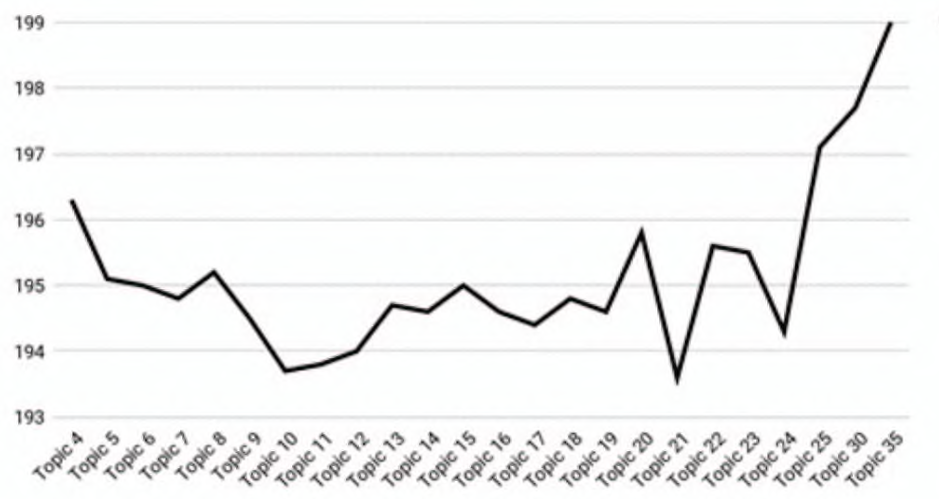 Key Finding: Topic 1 (Expressing Feelings) and Topic 6 (Daily Problems) dominate the discourse, highlighting the community's role as an emotional outlet.
Experiments & Results: A Discordance of Needs
One of the most profound insights was the divergence between the two subreddits:
- r/autism: High concentration of parents and "celebratory" content. Milestones (e.g., "My son said his first word") receive massive engagement (Karma).
- r/aspergers: Primarily individuals with ASD. The tone is more pragmatic, focusing on "systematizing" social errors and discussing diagnosis accuracy.
(Note: Visual analytics revealed that users with similar badges tend to cluster together, interacting significantly more with "peers" than with outside groups.)
Quantitative Snapshot:
- Topic 6 (Functional Problems): 161 posts, the highest volume of practical engagement.
- Engagement Dynamics: Celebratory posts in the "Autism" community act as a "hope mechanism" for caregivers, whereas the same posts might be ignored in the "Asperger's" community in favor of intellectual or technical discussion.
Critical Analysis & Future Outlook
Takeaway: Designing for ASD is not a "one-size-fits-all" endeavor. There is a clear need for "Similarity-Based Navigation"—allowing users to filter content based on their specific relationship to ASD (e.g., an adult looking for workplace tips vs. a parent looking for school advice).
Limitations: The study relied on Reddit's API, which limits historical data to the most recent 1,000 posts per query, potentially missing long-term seasonal trends or older community evolutions.
Future Work: The authors envision a future where social networks use these insights to suggest connections not just based on "friends of friends," but on shared neurodivergent experiences and challenges, effectively automating the support-group matching process.
Conclusion: This research validates that for the ASD community, the "social-side" of the internet is not just an alternative—it is a lifeline that requires unique architectural affordances to be truly effective.