
Tales of Emotion and Stock: How Weibo's Crowds Outperform Financial Data
Tales of emotion and stock in China: volatility, causality and prediction
The paper investigates the relationship between online social media emotions and the Chinese stock market, introducing a predictive model named SVM-ES. Utilizing over 10 million stock-related tweets from Weibo, it demonstrates that specific emotions—disgust, joy, sadness, and fear—can effectively forecast market attributes, achieving up to 64.15% accuracy for intra-day peaks.
TL;DR
Can a tweet predict a market crash? In the context of China, the answer is a resounding yes. This study analyzes 10 million Weibo tweets to prove that the Chinese stock market is "emotional." By tracking feelings like disgust, joy, and fear, researchers built a Support Vector Machine model (SVM-ES) that predicts market movements with over 60% accuracy, consistently outperforming traditional financial time-series models.
The Problem: The "Irrational" Chinese Market
Unlike Western markets dominated by institutional algorithms, the Chinese market is heavily influenced by a massive population of individual, often inexperienced, investors. This makes traditional efficient market hypotheses fail. Previous researchers found that US-based sentiment (Twitter) had zero predictive power for Shanghai indices. Why? Because the heart of the Chinese investor beats on Weibo.
The core challenge lies in quantifying this "heartbeat"—which emotions actually move the needle, and whose tweets should we listen to?
Methodology: Tiering the Crowd
The researchers didn't treat all users as equal. They categorized 3 million investors into three "F-levels" based on follower counts:
- F-level I (Newbies): Low followers, making up 98% of the sample.
- F-level III (Pros/Institutional): High influence, exhibiting much lower emotional volatility.
They introduced the RJF (Ratio of Joy to Fear) as a proxy for market greed vs. panic. By mapping these ratios against market attributes, they identified that "Inexperienced" investors react wildly to fluctuations, magnifying market signals.
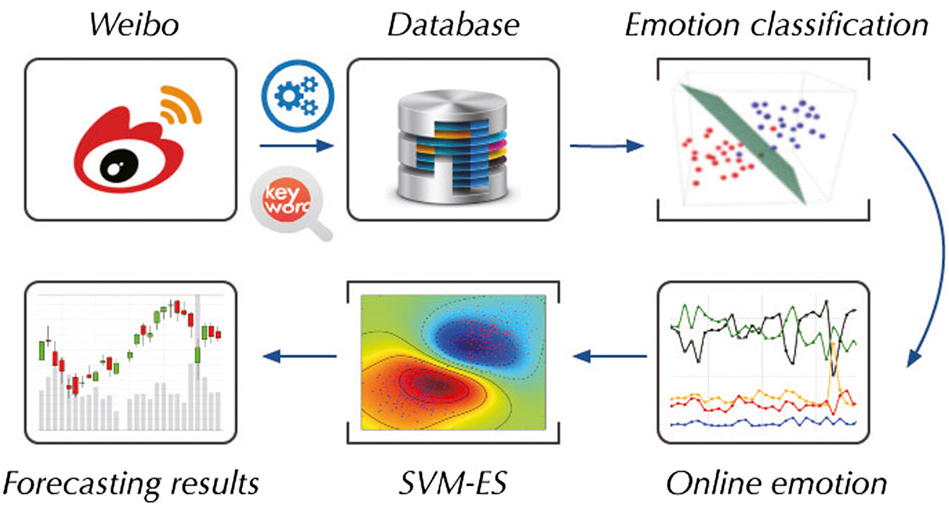 Above: The workflow from Weibo API collection to SVM-ES classification.
The "Why": Which Emotions Matter?
One of the most profound insights of this paper is the Granger Causality mapping. Not all emotions are equal:
- Joy and Fear: Strong causal links to the Opening Index.
- Disgust: A rare but potent predictor for the Closing Index.
- Sadness: Unexpectedly high correlation (ρ > 0.5) with Trading Volume.
- Anger: Interestingly, online anger showed almost no relation to market performance for the general public, though it mattered slightly for institutional experts.
Experimental Results: SVM-ES vs. The Market
The authors converted the prediction into a classification task (Bearish, Stable, Bullish) using K-means discretization.
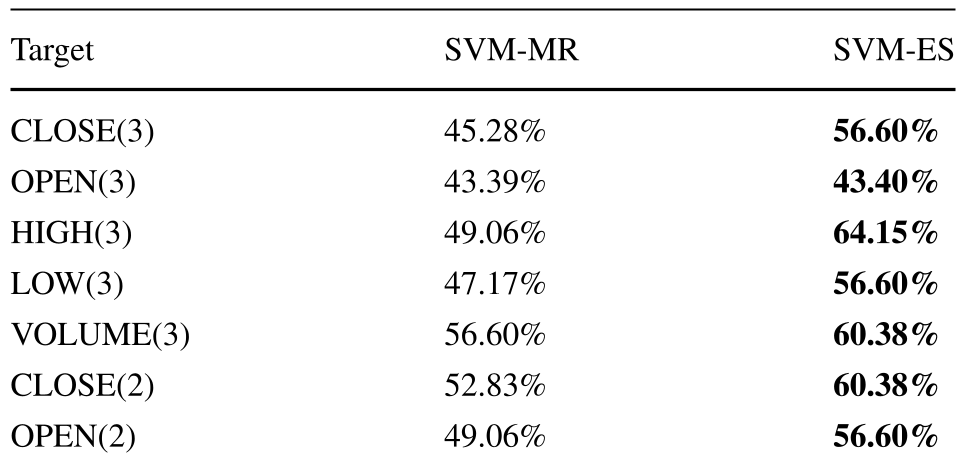 Table: SVM-ES (Emotional Sentiment) vs. SVM-MR (Market Return).
The results were clear:
- Sentiment beats Price: Using sentiments of the past 5 days (SVM-ES) yielded higher accuracy than using the past 5 days of price returns (SVM-MR).
- The High Point: The model was particularly good at predicting the Intra-day High (64.15% accuracy).
- Wisdom of the Crowd: Models using only professional (F-level III) sentiment failed (26.42% accuracy), whereas incorporating the "emotional" newbies was essential for success.
Critical Analysis & Conclusion
Takeaway
The Chinese stock market is a feedback loop of social media sentiment. Inexperienced investors act as "sentiment amplifiers." To predict the Shanghai index, one must monitor the aggregate "Disgust" and "Joy" of the masses rather than just the cold logic of institutional experts.
Limitations
- Time Sensitivity: The relationship between emotion and market is likely dynamic. A model trained in 2015 might need constant retraining to adapt to new social media slang or regulatory shifts.
- Platform Dependency: As users migrate from Weibo to platforms like WeChat or Douyin, the "source of truth" for sentiment may shift.
Future Outlook
This work paves the way for "Emotional Algorithmic Trading," where sentiment APIs are integrated directly into high-frequency trading stacks to hedge against retail-driven panics.