
Talk2Me: Bridging the Physical-Digital Gap with D2D Augmented Reality Social Networks
Talk2Me: A Framework for Device-to-Device Augmented Reality Social Network
Talk2Me is a novel Device-to-Device Augmented Reality Social Network (D2D-ARSN) framework that allows users to share digital messages with nearby people via face-signature matching. It combines lightweight Lightened-CNN face recognition with a custom D2D dissemination protocol to achieve real-time, infrastructure-independent social interaction.
TL;DR
Talk2Me is a decentralized framework that turns nearby people into "living profiles." By combining Device-to-Device (D2D) communication with AR-based face recognition, it allows you to see digital messages floating over strangers in your camera view—no central server or internet required. It solves the latency and battery drain issues of mobile vision through a lightweight CNN and a smart adaptive dissemination protocol.
The "Physical Proximity" Social Gap
We live in a hyper-connected world, yet we are often digitally isolated from the people standing three feet away. Current social networks require a "follow" or "friend" link. If you’re at a conference or a job fair, finding out who is a recruiter or a fellow developer requires awkward "poking" or manual searching.
The technical challenge is three-fold:
- Identity Association: How do you map a digital packet to a physical human face in real-time?
- Network Efficiency: How do you broadcast data to everyone nearby without killing the battery?
- Hardware Constraints: Can a smartphone handle deep-learning-based face recognition locally?
Methodology: The Core Engine
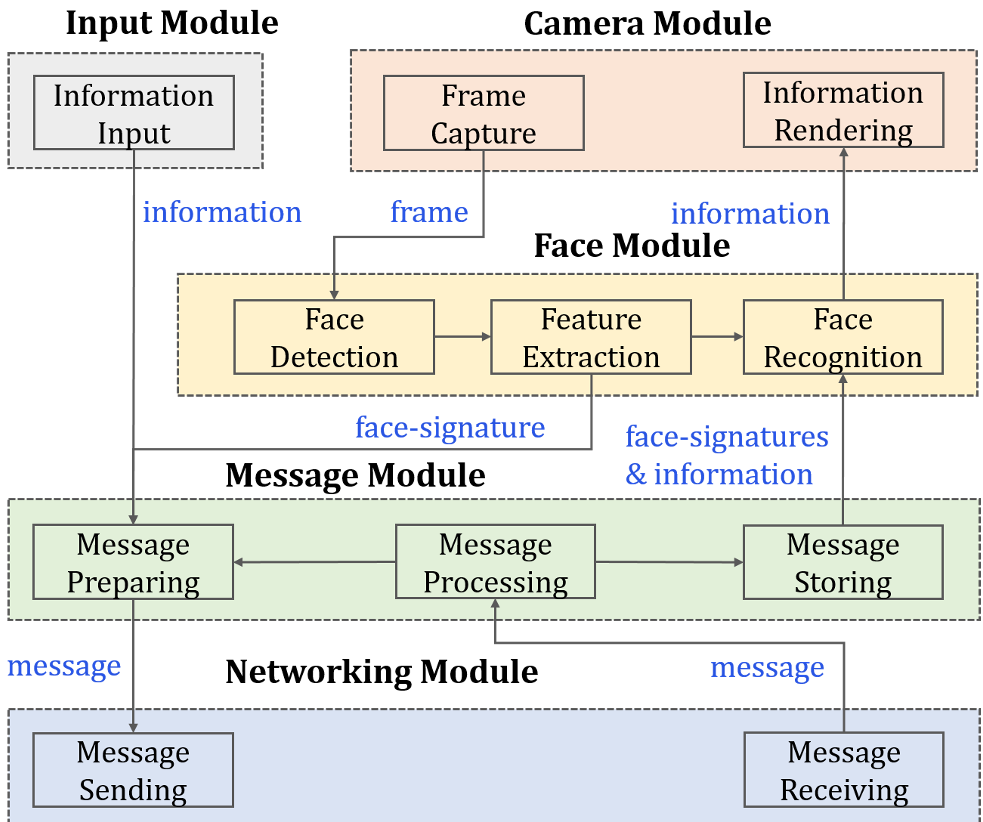
Talk2Me uses a modular architecture consisting of a Face Module and a Networking Module.
1. Lightweight Deep Learning
Instead of bulky models like VGG-16, the authors opted for a Lightened-CNN. This produces a 256-dimensional feature vector (1KB) compared to VGG’s 4096-dimensional vector (16KB). This 16x reduction in size is critical for the D2D "INFO" packets that must be transferred over shaky Wi-Fi/Bluetooth links.
2. The Dissemination Protocol (Adaptive Beacons)
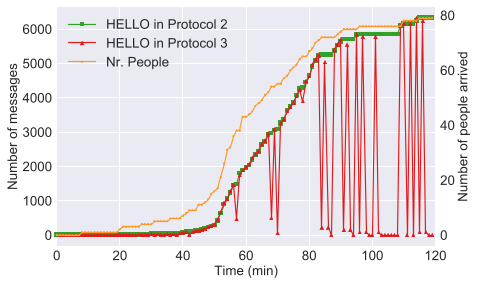
The real magic is in Protocol 3. In a typical D2D environment, devices "shout" (broadcast) constantly to find peers. Talk2Me uses a geometric progression strategy:
- If no new people are around, the device "shouts" less and less frequently (doubling the sleep interval).
- If a new "HELLO" packet is heard from a stranger, the device immediately resets and broadcasts its own ID.
- This prevents a "packet storm" while ensuring new arrivals get updated quickly.
Experiments and Results
The system was tested on real devices including the Galaxy Note 4 and Xiaomi Mi 5.
- Speed: Extraction takes ~303ms on a Mi 5, enabling a "point-and-see" user experience.
- Accuracy: Using Cosine Similarity, the system achieved high Precision-Recall curves, outperforming Euclidean and Manhattan distances for high-dimensional face features.
- Battery: The protocol consumed roughly 10-20 Joules over two hours—essentially negligible (0.05%) compared to the screen or camera power draw.
Critical Insights: Privacy and Social Etiquette
While technically impressive, Talk2Me touches on a sensitive nerve: Privacy. The authors argue that since face-signatures (embeddings) are one-way hashes, the original face cannot be reconstructed. However, the social friction of pointing a camera at a stranger remains a hurdle.
The framework’s success depends on the "Value-Transparency Trade-off." If the users perceive high value (e.g., getting a job at a career fair), they are more likely to accept the "always-on" camera paradigm.
Conclusion
Talk2Me is a pioneering blueprint for Infrastructure-less AR. It proves that the "Augmented World" doesn't have to live in the cloud—it can live in the opportunistic connections between the devices in our pockets. As smart glasses (Google Glass, Meta Ray-Bans) evolve, frameworks like Talk2Me will likely become the standard for how we interact with the "human layer" of the Metaverse.