
TalkBetter: Transforming Daily Conversations into Therapy for Children with Language Delay
TalkBeer: family-driven mobile intervention care for children with language delay
TalkBetter is a mobile-based, in-situ intervention system designed for children with language delay and their parents. It utilizes real-time meta-linguistic analysis of parent-child conversations to provide auditory reminders to parents when they deviate from clinical training guidelines, achieving a balance between speech-language pathology foundations and mobile social computing.
TL;DR
Language delay affects over 7% of children, yet therapy is often confined to short, weekly clinical sessions. TalkBetter is a breakthrough mobile system that moves therapy into the home. By analyzing the "rhythm" of parent-child talk—rather than the words themselves—it provides real-time, "in-situ" reminders to parents, helping them become more effective communication partners every single day.
Background: The Gap Between Clinic and Kitchen
The golden rule of speech-language pathology (SLP) is that parents are the primary agents of change. However, being a "therapeutic parent" is exhausting. Guidelines like "Wait for the child to lead" or "Speak in short sentences" sound simple but require overriding decades of subconscious communication habits.
Current solutions like LENA offer retrospective data (looking back at what happened), but they don't help parents in the moment when they are busy, tired, or distracted.
Problem & Motivation: The Meta-Linguistic Insight
Why is it so hard for parents to follow SLP guidelines? The authors found three killers of success:
- Momentary Negligence: Losing focus during household chores.
- Delayed Realization: Realizing you talked too much only after the child has shut down.
- Habitual Resistance: It takes roughly a year to change how one speaks naturally.
The technical breakthrough here is the Meta-Linguistic approach. You don't need a complex AI to understand what is being said to know if a parent is helping. By measuring when someone speaks (turn-taking), how long they speak, and how fast they speak, a system can mathematically identify when a parent is "crowding out" a child's opportunity to learn.
Methodology: How TalkBetter Works
TalkBetter operates as a background service on a smartphone, connected to two wearable microphones (one for the parent, one for the child).
1. The Architecture
The system performs "Meta-Linguistic Conversation Lineation." It segments audio into frames and identifies who is talking based on volume thresholds and proximity to the wearable mics.
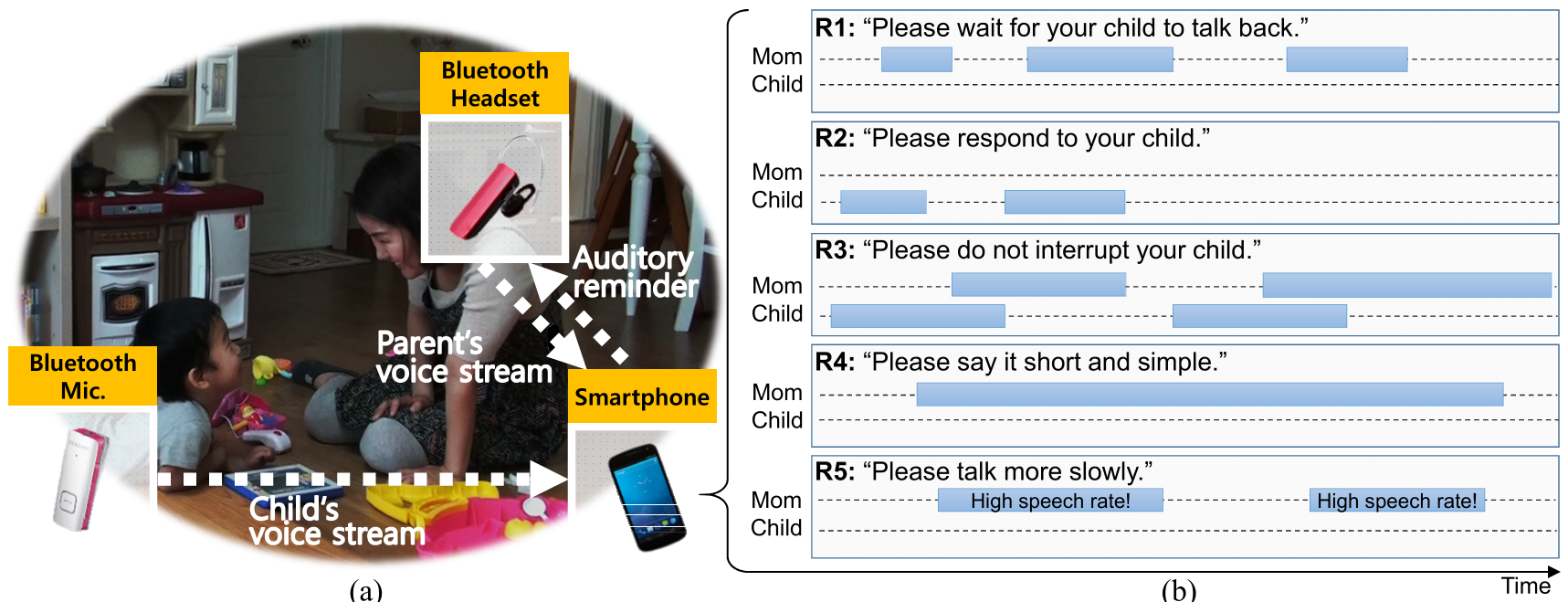
2. The Five Reminders (R1-R5)
The system monitors for five critical deviations:
- R1 (Dominance): Parent speaks repeatedly without giving the child a turn.
- R2 (Neglect): Child speaks, but the parent doesn't respond within a "grace period."
- R3 (Interruption): Parent cuts off the child's turn.
- R4 (Verbosity): Parent's sentence is too long for the child's developmental level.
- R5 (Speed): Parent is speaking too fast (measured by syllable rate).
Experiments & Results: Real-World Validation
The authors didn't just test in a lab; they took the system to clinical centers and tested it on real parent-child pairs during free-play sessions.
Performance Metrics
The turn-monitoring accuracy was high, particularly for parents (Precision ~82%). While children’s turns were harder to capture due to them "fidgeting" with the mics, the system successfully identified the specific "bad habits" of different parents.

Clinical Alignment
Crucially, when TalkBetter's automated reminders were compared against the manual coding of a professional Speech-Language Pathologist, they showed a high degree of correlation. For example, if an SLP noticed a parent tended to ignore a child (M15), TalkBetter's R2 (Neglect) reminder triggered with corresponding frequency.
Deep Insight: Beyond Just "Monitoring"
The most profound finding wasn't the code—it was the social psychology of the intervention. One father noted that he preferred a "machine" telling him he was wrong rather than his wife, as it reduced marital friction.
TalkBetter represents a shift from formative care (at the clinic) to life-immersive care (at the dinner table). It acknowledges that technology’s greatest role in health may not be "curing" the patient directly, but rather scaffolding the human relationships that drive recovery.
Limitations & Future Work
- Activity Noise: Clanging toys or "talking dolls" can still confuse the sensors.
- Non-Verbal Cues: The system currently misses smiles or gestures (non-verbal turns).
- Vocal Tone: Future versions could detect "parental temper" by tracking pitch spikes, providing a reminder to stay calm.
Conclusion
TalkBetter proves that mobile and social computing can provide a "safety net" for specialized therapies. By turning a smartphone into an in-situ coach, we can empower parents to turn every daily interaction into a building block for their child's future.