
DAC-VAE: Taming Audio VAEs via Target-KL Regularization for Superior Latent Diffusion
Taming Audio VAEs via Target-KL Regularization
The paper introduces "Target-KL Regularization," a framework for training continuous Audio Variational Autoencoders (VAEs) at specific, fixed bitrates. By establishing a direct link between KL divergence and coding cost, the authors develop "DAC-VAE," which establishes a new Pareto frontier in audio reconstruction and enhances downstream Latent Diffusion Models (LDM) for text-to-audio and text-to-speech tasks.
TL;DR
Researchers from Adobe Research have introduced a method to treat continuous VAE training like a traditional compression problem. By targeting specific KL divergence values as bitrates, they developed DAC-VAE, a model that outperforms current discrete and continuous audio codecs. Key finding: the highest quality reconstruction isn't always best for AI generation—finding the "Goldilocks" bitrate is essential for optimal Text-to-Audio performance.
The "Dark Art" of Latent Regularization
In the world of Latent Diffusion Models (LDMs), the VAE is the gatekeeper. It compresses raw audio into a "latent space" where the diffusion model does its work. However, tuning this compressor has historically been a headache:
- Over-regularized (High KL penalty): The latent space is easy for the AI to navigate, but the audio sounds muffled or "low-res."
- Under-regularized (Low KL penalty): The audio sounds perfect, but the latent space is so complex and "jagged" that the diffusion model fails to learn the patterns.
Previously, researchers balanced this via trial and error with a weight parameter (). This paper changes the game by treating the latent space as a communication channel with a fixed bitrate.
Methodology: Targeting the Sweet Spot
The core innovation is Target-KL Regularization. Instead of simply "penalizing" the KL divergence, the authors force the model to hit a specific "information budget."
By defining the bitrate as a function of the frame rate and KL divergence, they can train VAEs at specific speeds (e.g., 8 kbps, 20 kbps). This allows them to plot Rate-Distortion curves—a standard in data compression but rare in VAE research—to see exactly how much quality we gain for every bit added.
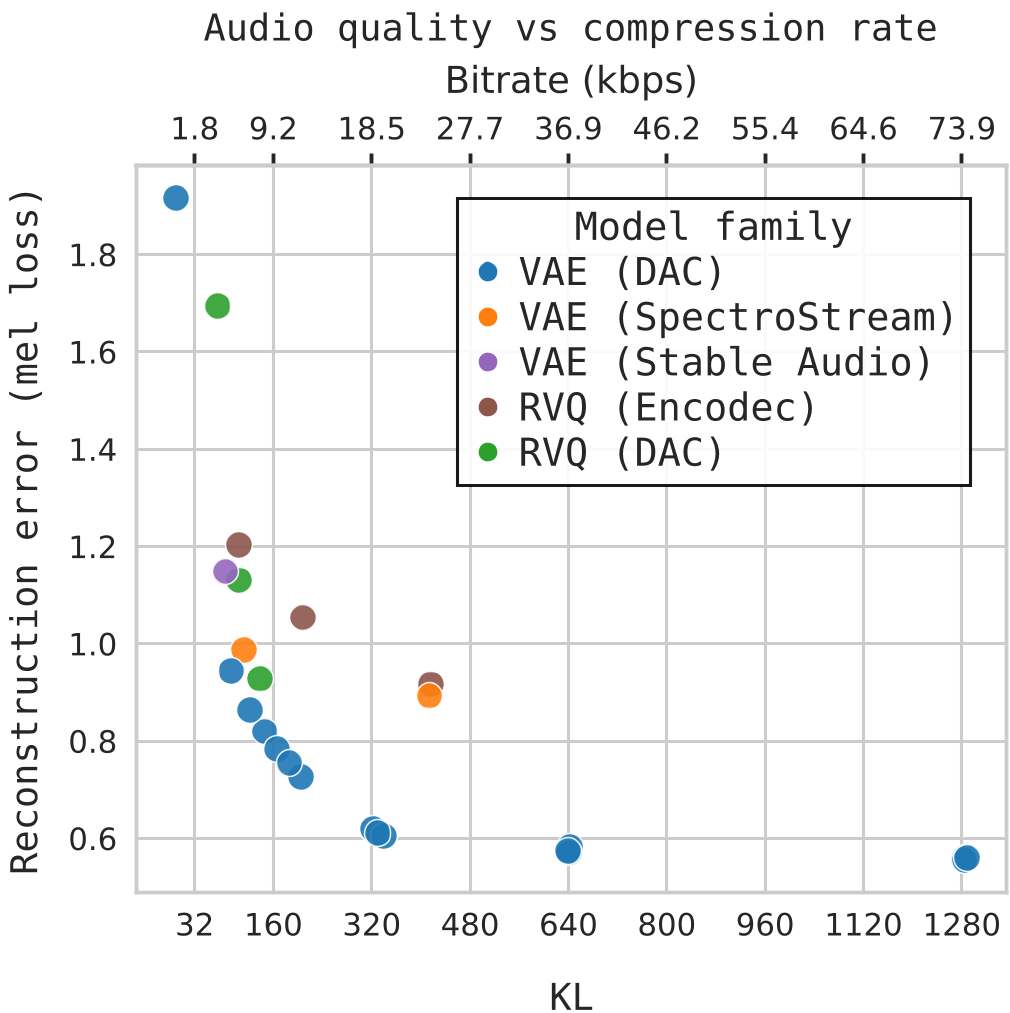 Fig 1: Notice how DAC-VAE (ours) stays at the top of the curve, providing better quality than EnCodec or Stable Audio at the same bitrates.
Technical Enhancements
Beyond the loss function, the authors improved the DAC (Descript Audio Codec) architecture by:
- CQT Discriminator: Using Constant-Q Transform to better capture the harmonic structure of music.
- Mel-Spectrogram Projection: Speeding up convergence by feeding spectral information directly into the encoder.
- Partial Batches: Training segments without any regularization to preserve high-frequency details.
Experiments: More Bits $
eq$ Better AI? The authors tested these VAEs in downstream Text-to-Audio and Text-to-Speech (TTS) tasks. The results revealed a fascinating insight:
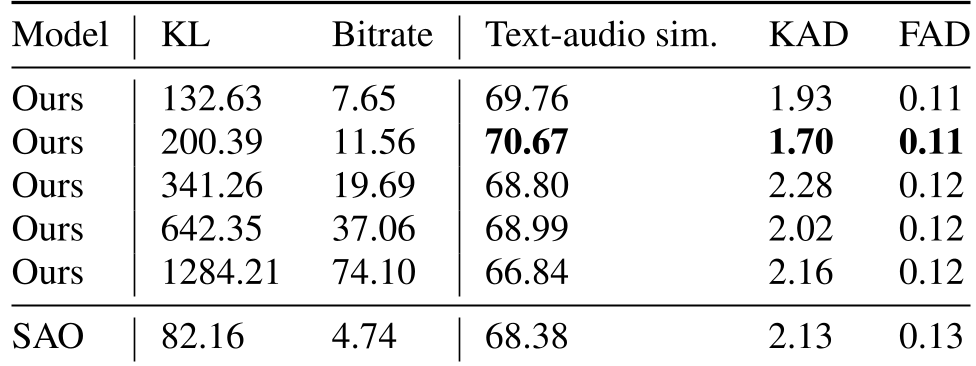
As shown in the table above, the 11.56 kbps model actually outperformed the much higher 74.10 kbps model in text-audio similarity (70.67 vs 66.84). This confirms the hypothesis: if a VAE is too "loose" (under-regularized), the diffusion model struggles to map text prompts to the complex latent space, leading to lower-quality generations despite the VAE technically being "better" at reconstruction.
Critical Analysis & Conclusion
This paper brings much-needed engineering discipline to the "black box" of VAE training. By allowing researchers to "dial in" a bitrate, it eliminates the guesswork of -tuning.
Takeaway: If you are building an Audio LDM, don't just aim for the lowest reconstruction loss. Use Target-KL to find the specific compression rate that your diffusion transformer can actually handle.
Limitations: The study focuses primarily on the DAC architecture. Future work will need to explore how scaling model parameters (making the VAE "deeper") interacts with these fixed bitrates to further push the Pareto frontier.
Future Outlook
This framework sets the stage for "Semantic Alignment," where VAEs aren't just optimized for sound quality, but for how well their "bits" correspond to human language and musical concepts.