
Beyond the Screen: How Tangible Interfaces Are Redefining Children's Creative Learning
Tangible Interaction for Children’s Creative Learning: A Review
This paper presents a systematic review of 53 recent studies (2015-2020) investigating how Tangible User Interfaces (TUIs) support children's creative learning. It synthesizes the advantages of physical manipulatives across five creativity dimensions and identifies critical design challenges.
TL;DR
This review paper analyzes the last five years of research into Tangible User Interfaces (TUIs)—physical objects enhanced by digital power—to understand their impact on children's creativity. The findings suggest that by moving interaction from 2D screens to the 3D physical world, we can lower the barrier to entry for complex subjects like programming and music, while fostering deep social collaboration. However, the field faces a "glitch" of its own: a lack of long-term classroom integration and teacher involvement.
Background: The Limits of the Graphical Interface
For decades, creativity in education has been funneled through Graphical User Interfaces (GUIs). While powerful, GUIs often lack the "playful friction" of the real world. The authors argue that traditional STEM tools fail to cultivate the open-ended, imaginative behavior essential for 21st-century skills.
Enter Tangible Interaction: an approach rooted in the pedagogical theories of Montessori and Froebel, which posits that haptic perception and physical manipulation are not just "extras" but are central to the constructive learning process.
Methodology: Mapping Creativity to Physicality
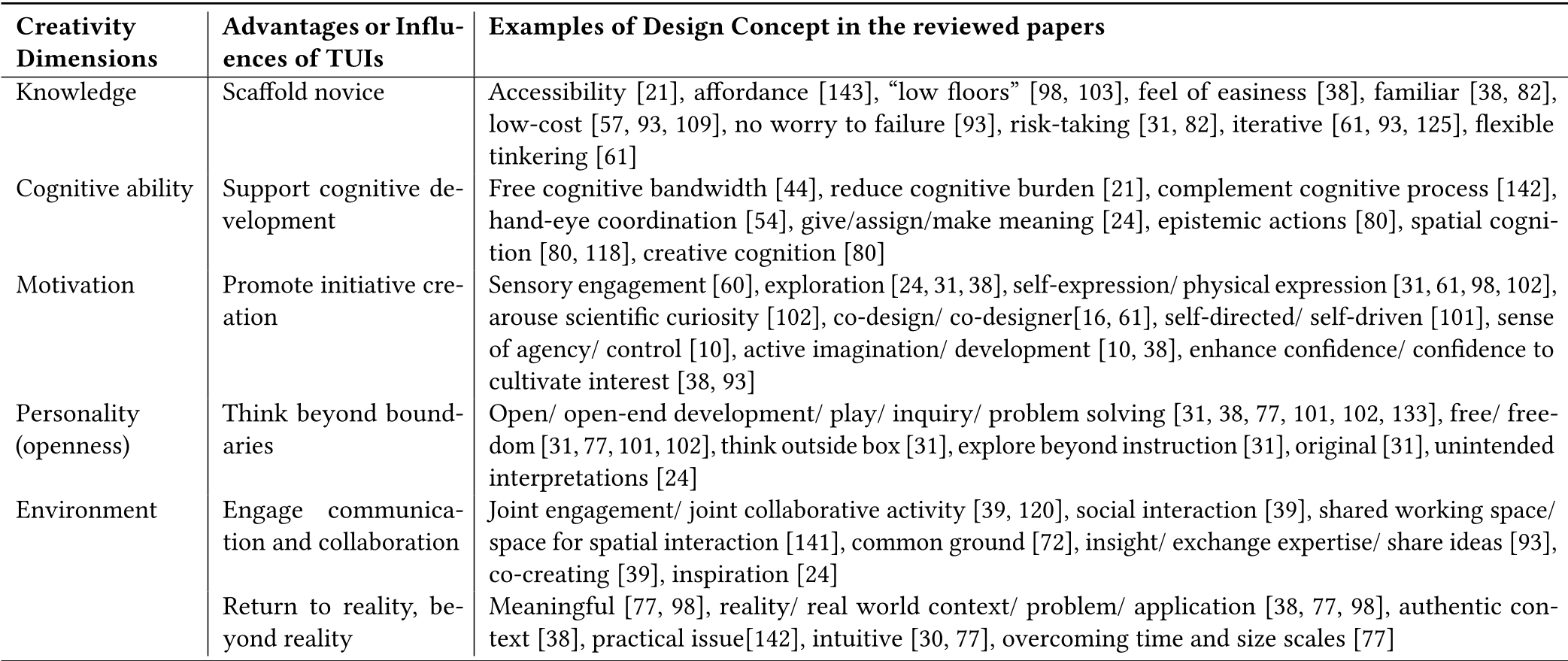
The researchers analyzed 53 papers to answer a fundamental question: How does touching and moving objects actually make a child more creative? They mapped TUI benefits to five key dimensions:
- Knowledge (Scaffolding Novices): TUIs encapsulate complex tech (like AI or bio-design) into simple blocks, creating "low floors" for beginners.
- Cognitive Ability: Physical interaction reduces the "cognitive load" of imagination, allowing children to use epistemic actions (physical movements to solve mental problems).
- Motivation: The "Maker" culture inherent in TUIs gives children a sense of agency, turning potential boredom into active exploration.
- Openness: TUIs encourage "thinking outside the box" by allowing unintended uses of materials.
- Environment: Unlike a single-user tablet, a physical table of blocks creates a shared workspace for natural collaboration.
Core Insights: The Design Paradox
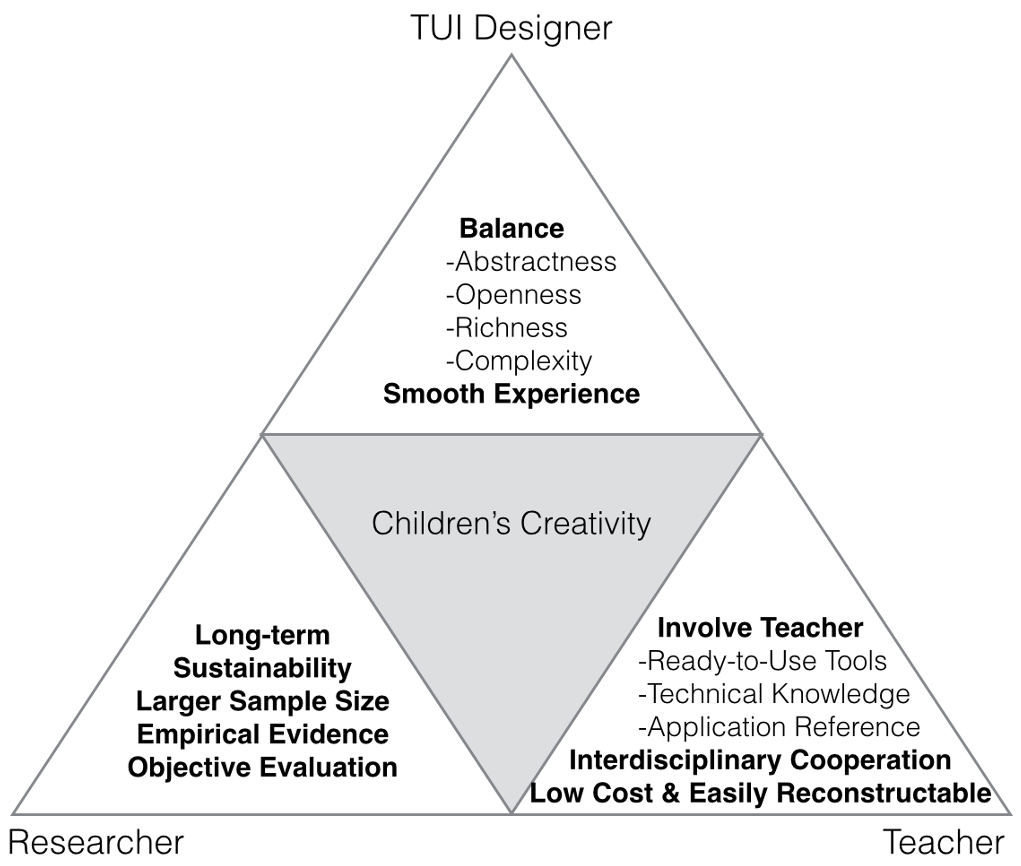
One of the most compelling parts of the review is the identification of the "Design Triangle" between Researchers, Designers, and Teachers.
1. Abstractness vs. Instruction
Should a TUI be an "ambiguous" object to spark imagination, or a clearly labeled tool to prevent frustration? For younger children (4-6), intuitive feedback (lights/sounds) is vital. Older children (10-12) crave "complexity" and "higher-level abstractions."
2. The Teacher Gap
A critical finding is that most TUI research is conducted by HCI experts in "one-day workshops." Because teachers are often left out of the design process, these tools rarely make it into the actual school culture. The paper calls for a shift toward involving teachers as stakeholders rather than just observers.
3. The "Smooth Experience" Mandate
The review warns that "glitchy" hardware isn't just a technical nuisance—it's a creativity killer. If a child's physical action doesn't yield an immediate digital response, they become cautious, refuse to take risks, and lose the courage to learn from mistakes.
Critical Analysis & Perspective
From a PhD-level perspective, this review is a vital "state-of-the-union" for the TUI community. Its true value lies in the Taxonomy of TUI Influences (Table 3), which provides a checklist for future designers.
However, a notable limitation—admitted by the authors—is the language barrier in research. By focusing on the keyword "Tangible," the review might have missed significant work in the "Embodied Cognition" and "Physical Computing" sectors within the Psychology and Pedagogy fields.
Conclusion: From Prototype to Pedagogy
The future of creative learning isn't just about more tech—it's about more intuitive tech. For TUIs to succeed, they must:
- Balance Openness and Scaffolding: Provide enough freedom to explore, but enough structure to prevent frustration.
- Prioritize Stability: Ensure the "magic" of tangibility isn't broken by technical failures.
- Empower Teachers: Create tools that fit into the existing classroom ecosystem, not just the research lab.
As we move toward a more digital future, this paper reminds us that the most powerful creative tool remains the human hand, guided by a physical world that responds to our touch.