
Photo Alive!: Bridging the Intergenerational Gap via Tangible Social Interfaces
Tangible Social Content Service System: Making Digital Technology Easier to Use by Elderly and Its Usability Evaluation
The paper introduces "Photo Alive!", a tangible social content service system designed to facilitate intergenerational communication for the elderly. It leverages familiar interfaces like TVs, remote controls, and voice tagging in photos, integrating these with social platforms like Facebook and KakaoTalk to reduce social isolation.
TL;DR
Digital technology evolves at a pace that often leaves the elderly behind, leading to social "disconnection." Photo Alive! is a research project that reframes social media (Facebook, KakaoTalk) into a format the elderly already trust: the television and the remote control. By allowing seniors to "attach" their voices to family photos, the system transforms static digital images into emotive, tangible communication tools.
Background: The Hidden Wall of Social Isolation
While the younger generation immerses itself in high-frequency digital interactions, the elderly often find themselves mentally and socially retired. The pain point isn't a lack of interest in family; it’s the interface friction. Complex app layouts, small buttons, and the abstract nature of "the cloud" create a barrier. This paper argues that instead of teaching the elderly new tricks, we should teach new technology to speak an old language: the language of the TV remote and the family photo album.
Methodology: The Architecture of Familiarity
The researchers developed a system that operates on three pillars:
- The TV-Remocon Environment: Using the TV as the primary display and the remote as the input device. This leverages decades of muscle memory.
- Voice Tagging (Photo Alive!): Using the Google Speech API, the system allows users to record messages that are geographically or contextually tagged to specific family photos.
- Cross-Platform Integration: To ensure the younger generation actually receives these messages, the system interacts with KakaoTalk (via Plus Friend API) and Facebook, bridging the gap between a senior's living room and a grandchild's smartphone.
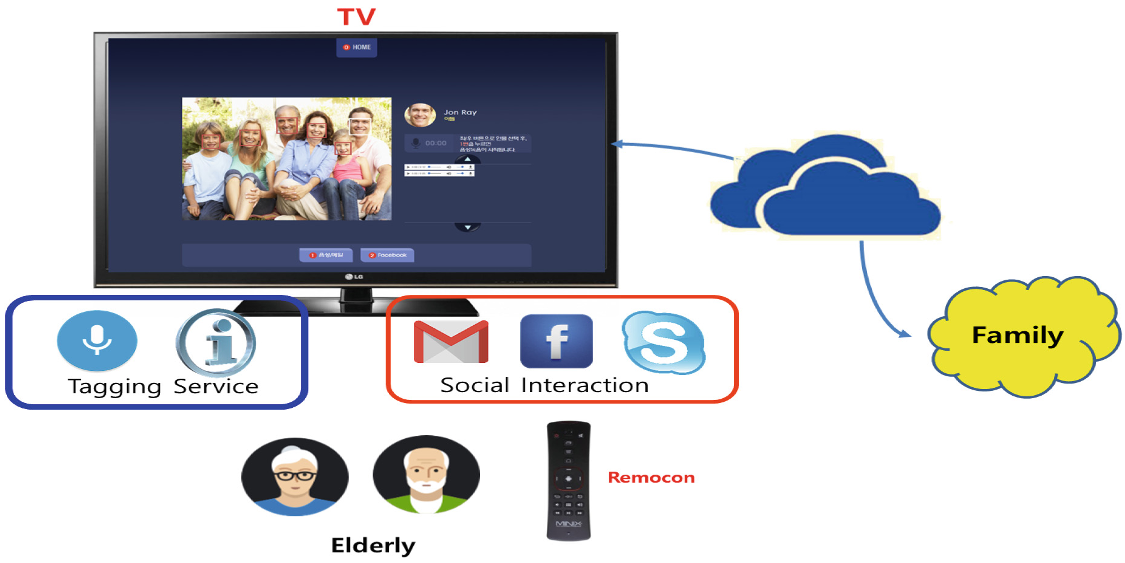 Fig 1: The architecture of the Photo Alive! service system, integrating TV, Smartphone, and Social Cloud.
The "EasyFace" Interface
Standard Facebook is cluttered. The authors' "EasyFace" implementation strips the social network down to its core—viewing photos and posting status updates via voice. By selecting a photo with a remote and speaking, the elderly can participate in the digital "Timeline" without ever touching a keyboard.
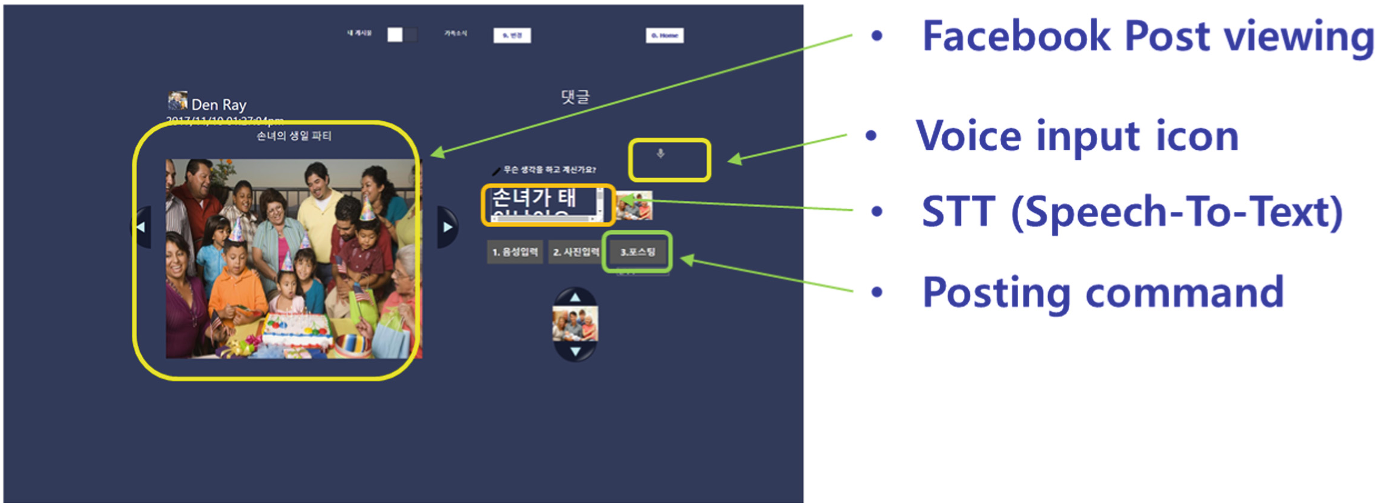 Fig 2: Simplified Facebook coordination allowing voice-to-text posting for seniors.
Experiments & User Validation
The study conducted usability testing with subjects over 60 (mostly female, as they are often the "social hubs" of families). The results were overwhelmingly positive:
- Ease of Understanding: The voice-tagged photo service earned an average score of 6.2/7.
- Emotional Resonance: 80% preferred this system over standard KakaoTalk voice notes because it allowed them to "interact with the face" in the photo, making the communication feel more person-to-person rather than device-to-device.
- Facebook Accessibility: Despite only 7.7% of the subjects being regular Facebook users prior to the study, 77% preferred the EasyFace interface over the standard mobile app, suggesting the barrier to social media is UI design, not the service itself.
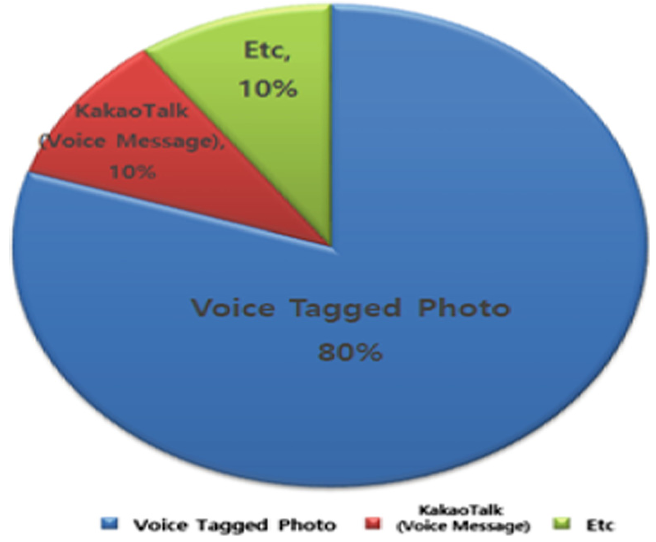 Fig 3: Comparative preference showing high senior adoption for Tangible UI over traditional apps.
Critical Insight: Why This Works
The "magic" of this system isn't in a new AI algorithm, but in its Inductive Bias toward the user's habitat. By treating the TV as a window rather than a screen, and the voice as a pointer rather than a data input, it respects the cognitive load limits of the elderly.
Limitations & Future Work
While successful in a controlled test of 10-13 subjects, the system's reliance on specific APIs (like KakaoTalk) makes it region-dependent (primarily South Korea). Future iterations need to explore how this "Tangible" layer can be generalized for Global Social Networks or integrated into proactive care-taker systems where the photo interaction also serves as a "wellness check" for the family.
Conclusion
Photo Alive! proves that the digital divide is not a generational intelligence gap, but a design gap. By embedding social connectivity into the tangible routines of the elderly, we can turn technology from a source of frustration into a bridge for family intimacy.