
TapSense: Decoding Emotions Through the Rhythm of Your Fingertips
TapSense: combining self-report patterns and typing characteristics for smartphone based emotion detection
The paper introduces TapSense, a personalized emotion detection system for smartphones that monitors typing characteristics (e.g., speed, errors) and models emotion persistence using a Markov Chain. By combining keystroke dynamics with historical emotion transitions, it achieves a SOTA average AUCROC of 84% in classifying four distinct emotion states: happy, sad, stressed, and relaxed.
TL;DR
Researchers have developed TapSense, an innovative Android-based framework that predicts your mood—Happy, Sad, Stressed, or Relaxed—simply by analyzing how you type on your smartphone. By combining typing speed and error rates with a mathematical model of how emotions "linger" (persistence), the system achieves a remarkable 84% accuracy without ever reading your private messages or draining your battery.
Background: Beyond Simple Keystrokes
While we’ve known for years that typing patterns on desktop computers reveal stress or joy, the smartphone context is different. We type in short bursts, switch apps constantly, and our emotions from a heated WhatsApp debate often spill over into our next email. TapSense moves past the "what" of typing to the "rhythm" and "flow," treating emotion as a continuous state rather than a series of isolated snapshots.
The "Linger" Effect: Why Motivation Matters
The core insight of this paper is Emotion Persistence. If you were stressed ten minutes ago, there is a high statistical probability you are still stressed now. The authors modeled this using a Markov Chain, but with a clever twist: Recency Weighting. The shorter the time between two typing sessions, the stronger the influence of the previous emotion on the current prediction.
Methodology: The Secret Sauce
The system relies on two pillars of data:
1. Refined Keystroke Dynamics
Instead of just looking at average typing speed, which can be noisy, the authors developed Refined Mean Session ITD (RMSI).
- The Intuition: Most typing sessions have a "dominant" speed and occasional outliers (distractions).
- The Fix: Using K-means clustering to identify the primary typing rhythm, ensuring the model isn't fooled by a single long pause.
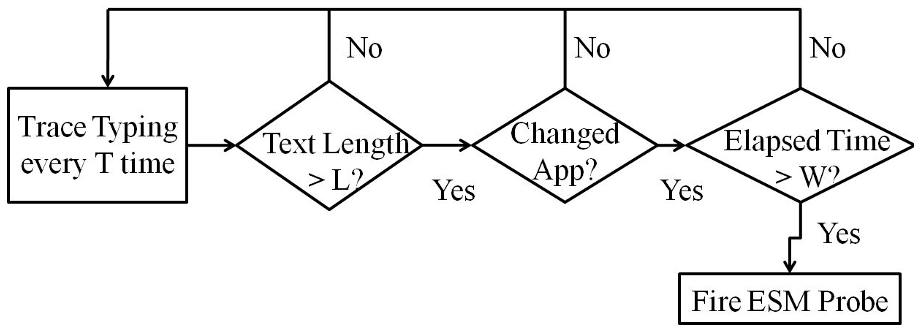 Figure 1: The Experience Sampling Method (ESM) ensures self-reports are collected close to typing events without annoying the user.
2. Modeling Persistence (PRE)
By analyzing transitions between states (e.g., how often "Stressed" leads to "Relaxed"), the model creates a personalized transition matrix.
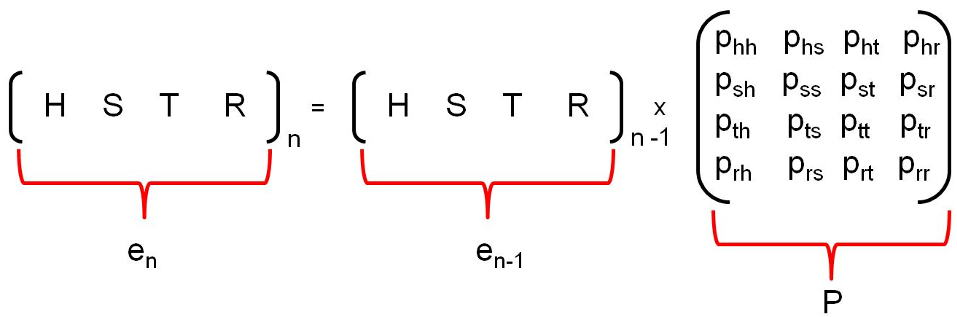 Figure 2: The PRE model calculates the probability of the next emotion state based on the previous state and the time elapsed.
Experimental Wins
The team deployed TapSense to 22 volunteers in-the-wild for three weeks. The results were compelling:
- High Accuracy: Mean AUCROC of 0.84.
- Feature Power: "Persistent Emotion" (PRE) and "Refined Typing Speed" (RMSI) were the most informative features, outperforming traditional metrics like session duration or special character usage.
- Data Balancing: Since people are "Relaxed" more often than "Sad," they used SMOTE (Synthetic Minority Over-sampling Technique) to ensure the model didn't become biased toward the majority class.
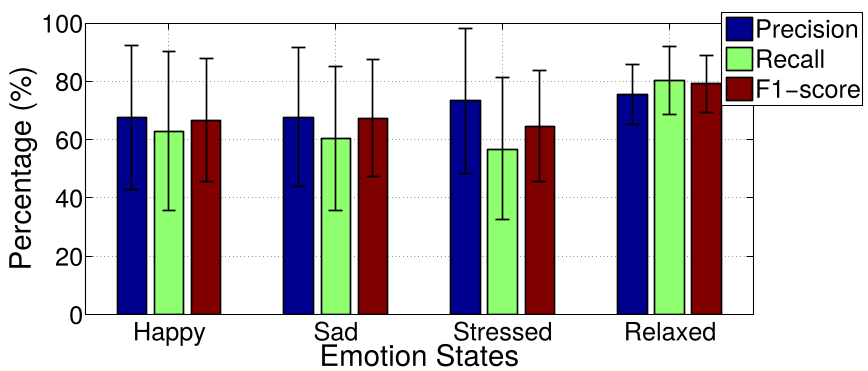 Figure 3: Performance metrics across the four emotion states, showing high precision for "Relaxed" and "Stressed."
Critical Insight & Future Outlook
The most impressive feat of TapSense is its non-invasiveness. It targets metadata only (timestamps and key types), meaning it doesn't need to know who you are messaging or what you are saying to know how you feel.
Limitations: The study currently lacks "Swype" support—a major inconvenience for many modern users. Additionally, while the model is personalized, it requires a "cold-start" period of about 12 days to reach stable accuracy.
The Future: Imagine your phone automatically enabling "Do Not Disturb" when it detects you are entering a "Stressed" typing pattern, or a mental health app that subtly suggests a breathing exercise when your typing speed suggests "Sadness" is persisting too long. TapSense proves the hardware we already carry is enough to make this a reality.
Conclusion
TapSense bridges the gap between laboratory emotion recognition and real-world utility. By proving that our typing rhythm is a "digital signature" of our internal state, it opens the door for truly empathetic technology that respects privacy while providing profound insights into human well-being.