
S-VDS: Reimagining Surveillance as a Target-Centric Social Network
A target-centric surveillance system based on localization and social networking
This paper introduces S-VDS (Surveillance Video Diary Service), a target-centric surveillance system that integrates localization, video processing, and social networking analysis. Unlike traditional area-focused CCTV systems, S-VDS tracks individual targets across multiple cameras and builds a "video diary" to provide comprehensive context, achieving a seamless transition between camera views and social relationship mapping.
TL;DR
Traditional CCTV is static and place-oriented. S-VDS (Surveillance Based on Video Diary Service) flips this script by centering the entire system around the target. By fusioning mobile localization data with distributed video feeds and social networking analysis, S-VDS provides a continuous, contextualized "Video Diary" of a moving target. It’s no longer about what happened in Room A; it’s about what happened to Person X as they moved from Room A to Building B.
Background: The "Gaps" in Modern Surveillance
In the current landscape, surveillance is often a jigsaw puzzle with missing pieces. When a child goes missing in a crowded mall, security guards must manually scrub through dozen of independent camera feeds, hoping to spot a specific face. The Inductive Bias of these systems is local—each camera is an island.
The authors argue that the limitation isn't just the hardware; it's the viewpoint. They suggest that by treating surveillance as a personal "diary blogging" service (VDS), we can create a chronologically and socially coherent narrative of a target's journey.
Methodology: The Target-Centric Architecture
The core innovation of S-VDS lies in its multi-layered server architecture that bridges the gap between physical location and digital identity.
1. The Video Diary Agent (VDA)
The VDA is the "editor" of the system. It receives location reports from a user’s mobile device (via GPS or WiFi RSSI) and queries the Location Management Server (LMS) to identify which camera's coverage the target was in at time T. It then extracts that specific 1-minute clip from the Video Server.
2. Social Networking Management (SNMS)
This is the "killer feature." By analyzing spatial-temporal overlaps, the system automatically builds a social graph. If Person A and Person B are consistently seen by the same cameras at the same time, the SNMS flags a relationship. In a crime scenario, this allows the system to distinguish between a "Normal" contact (a friend) and a "Warning" contact (a known offender near a victim).
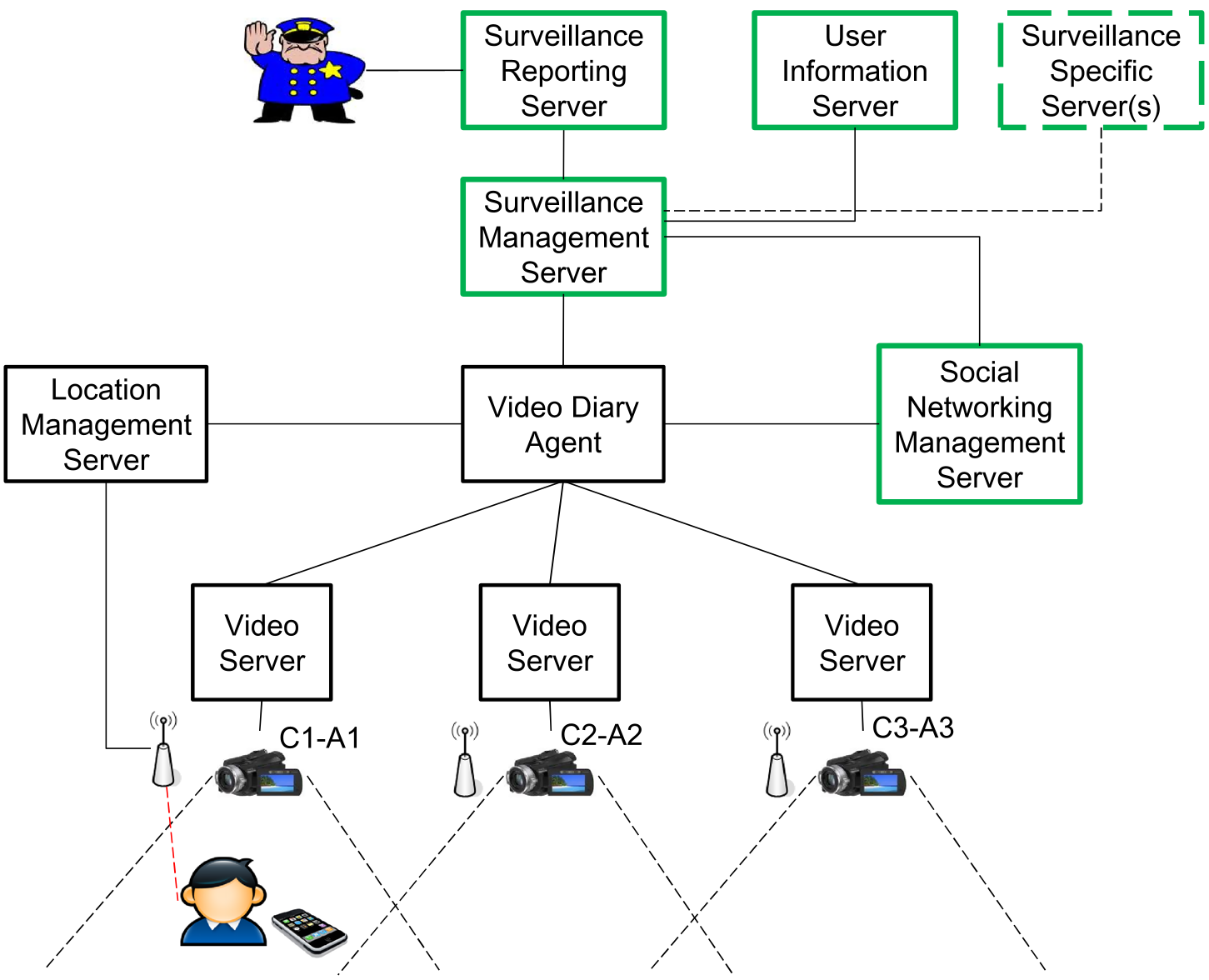 Figure 1: The detailed S-VDS architecture showing how User Information, Social Networking, and Surveillance Management servers interact.
Experiments & Real-World Feasibility
The authors didn't just stop at theory; they built a prototype using Galaxy S devices and megapixel IP cameras.
- Tracking Continuity: They demonstrated that as a target moves through an office, the dashboard automatically updates the video feed to the nearest camera based on the mobile device's location, effectively "following" the target.
- The COEX Mall Demo: In a simulated "stolen purse" scenario at a mega-mall, S-VDS was used to push alerts to "local witnesses"—other users who were determined by the system to be near the thief based on social and location data. This "human-in-the-loop" approach turned a passive recording into an active recovery mission.
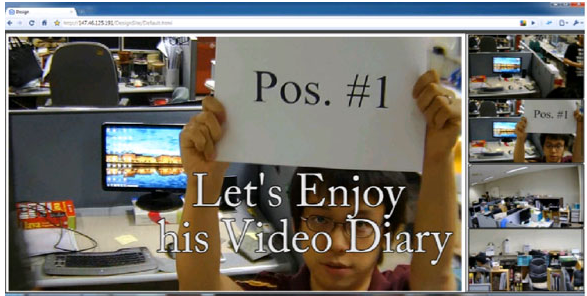 Figure 2: Feasibility test showing continuous tracking across multiple camera views.
Application Scenarios: Beyond Security
S-VDS has implications far beyond catching thieves:
- Remote Healthcare: Monitoring the handicapped or elderly. If a fall is detected via sensors, the system immediately identifies nearby "Helpers" or professional staff within the social network to provide rapid response.
- Anti-Crime: Electronic bracelets on offenders can be integrated into S-VDS to provide real-time alerts if they enter "warning" zones (like schools) or get close to past victims.
- Missing Children: Parents can "subscribe" to their child's video diary in real-time within a controlled environment like an amusement park.
Critical Analysis & Future Outlook
Acknowleging the Elephant in the Room: Privacy. The authors candidly discuss that S-VDS requires a high degree of trust and data sharing. For the system to work, targets must have a "trackable" device and consent to their video diary being compiled. While this is acceptable for prisoners or children in a supervised park, the broader deployment faces significant GDPR-like regulatory hurdles.
Technical Limitations: The current implementation relies heavily on mobile device signals. If a thief turns off their phone, the S-VDS reverts to a standard CCTV system. Future iterations would need to leverage Zero-shot Face Recognition and Re-Identification (Re-ID) algorithms to maintain the "Target-Centric" thread even when the device goes dark.
Conclusion
S-VDS represents a visionary step toward "Intelligent Surveillance." By transforming raw pixels into a structured social and temporal diary, it changes the role of surveillance from a passive historical record to an active, social, and life-saving utility.