
TONIC: Intelligent Lead Discovery in Social Networks via Heuristic Search
Target oriented network intelligence collection: effective exploration of social networks
The paper introduces Target Oriented Network Intelligence Collection (TONIC), a specialized crawling method designed to locate "leads" (social network profiles containing information about a specific target). It proposes a best-first search approach using topology-based heuristics, specifically achieving SOTA-level efficiency in lead discovery on Google+, Pokec, and LiveJournal datasets.
TL;DR
Locating specific individuals or information in massive Online Social Networks (OSNs) is a "needle in a haystack" problem. The TONIC (Target Oriented Network Intelligence Collection) framework transforms this into a heuristic search problem on an unknown graph. By leveraging topological markers like the Bayesian Promising (BysP) factor, the algorithm can find the majority of target-related profiles while minimizing the "noise" of irrelevant profile acquisitions.
Problem & Motivation: The Limits of Direct Access
In modern intelligence collection—whether for recruitment, law enforcement, or marketing—a target's profile is often locked behind privacy settings or entirely non-existent. However, the target's "leads" (friends or acquaintances who mention the target) often leave public breadcrumbs.
The challenge:
- Costly Acquisition: Fully downloading and parsing a profile (Acquire) is resource-intensive and risks detection.
- Unknown Topology: The social graph is revealed only as we crawl, making it impossible to plan the "perfect" route in advance.
- The Dead-End Trap: If we only crawl leads (Restricted Framework), we might miss clusters of leads that are only reachable through a "non-lead" intermediary.
Methodology: From RTF to ETF
The authors categorize the search into two paradigms:
- Restricted TONIC Framework (RTF): Only follow the friends of known leads.
- Extended TONIC Framework (ETF): Occasionally crawl non-leads to bridge the gap between isolated lead clusters. The study identifies ETF(1)—looking one step beyond known leads—as the "sweet spot" for exploration.
The Core Heuristic: Bayesian Promising (BysP)
Instead of simple degree counting, BysP calculates a Promising Factor (pf) for each lead: the ratio of its discovered neighbors that are leads. It then aggregates these using a Bayesian approach: This formula ensures that a profile connected to multiple "high-yield" leads is prioritized for the next crawl.
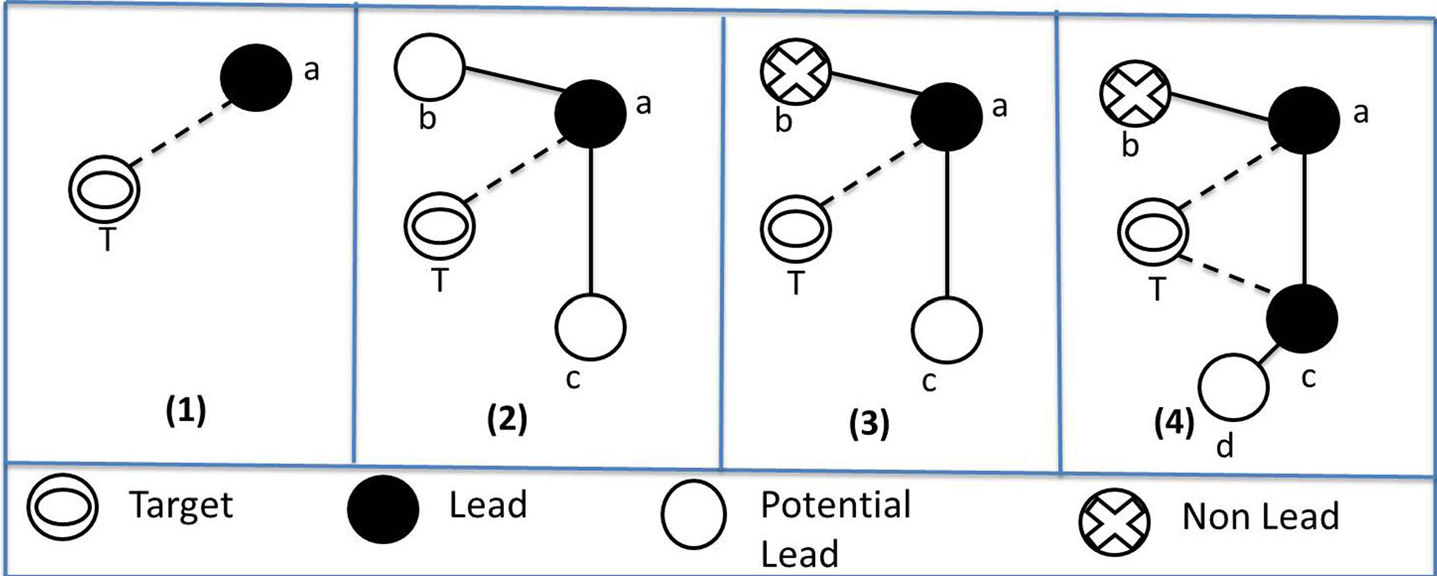 Figure 1: Illustration of the TONIC process, navigating from initial seeds to potential leads.
Experiments: Speed and Reach
The researchers tested their approach on Google+, Pokec, and LiveJournal.
Key Findings:
- Efficiency: The EBysP (Extended Bayesian Promising) heuristic finds leads significantly faster than standard FIFO (First-In-First-Out) or Random walks.
- Reachability: RTF often misses up to 30% of available leads because they aren't "lead-connected" in a single chain. ETF(1) recovers nearly all of these missing links.
- Stopping Logic: Since every crawl costs money/time, the authors used XGBoost to train a "LearnDynamic" classifier. This model tells the crawler to stop when the "Lead Acquisition Rate" drops below a threshold where the cost of the next query exceeds the expected reward.
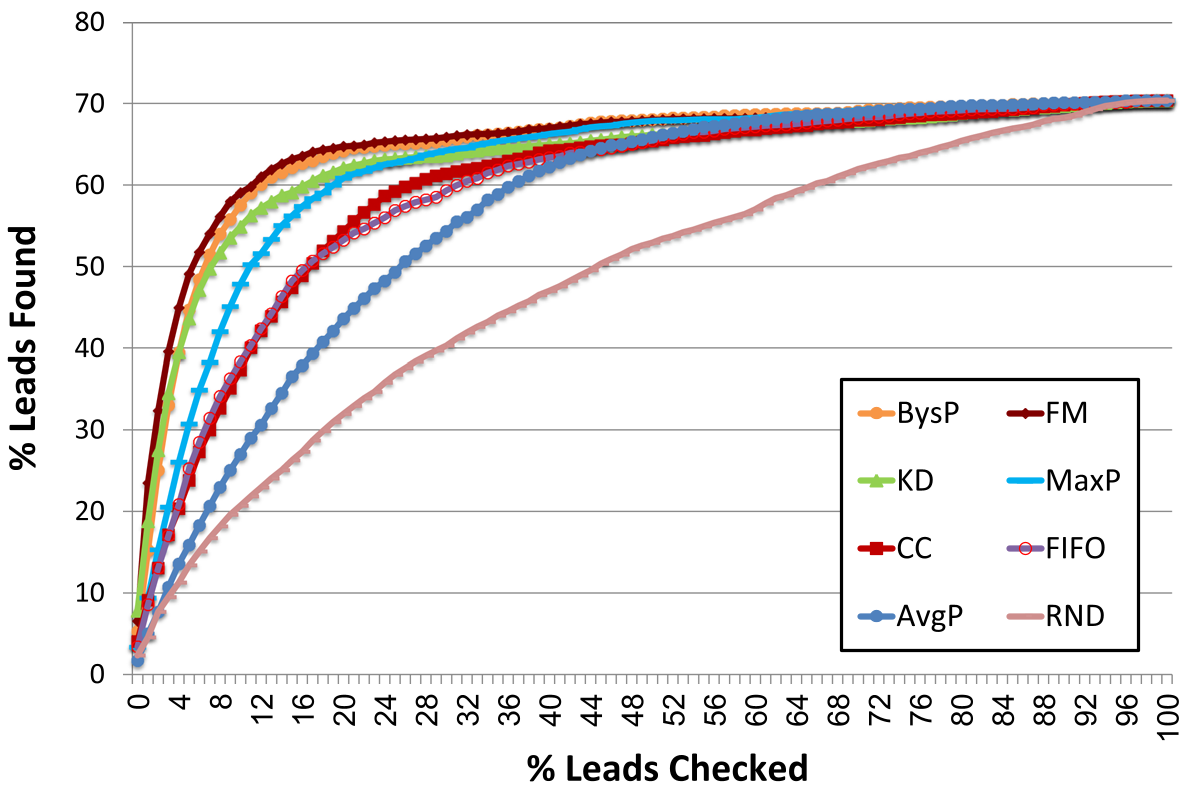 Figure 2: The steep slope of BysP/EBysP vs. the linear progression of baseline methods.
Critical Analysis & Conclusion
Takeaway
The genius of TONIC lies in its topology-only approach. It doesn't need to read your posts or analyze your photos to know you are a lead; it simply looks at who you know. This makes it incredibly robust against NLP-evasion tactics.
Limitations
- Dynamic Graphs: The study assumes a static snapshot of a social network. In reality, links appear and disappear, which could drastically change the BysP scores.
- Adversarial Networks: Sophisticated targets might intentionally create "honeypot" profiles to lead crawlers into infinite cycles of non-leads.
Future Outlook
The next evolution of TONIC likely involves Multi-Agent Crawling, where several bots coordinate their search to cover different "neighborhoods" of the target simultaneously without overlapping effort.