
Target Tracking via Crowdsourcing: Creating a Truthful Market for Information
Target Tracking via Crowdsourcing: A Mechanism Design Approach
This paper introduces an incentive-compatible mechanism for target tracking in crowdsourced Wireless Sensor Networks (WSNs). Using a reverse auction model and dynamic programming, the Fusion Center (FC) optimally allocates limited bandwidth bits among selfish, profit-motivated sensors to achieve SOTA tracking performance while extending network lifetime.
TL;DR
Syracuse University researchers have developed a way to make crowdsourced target tracking reliable by treating sensors as "profit-motivated agents." By combining Bayesian Particle Filtering with Reverse Auction Theory, they solved the problem of how to get selfish sensors to report their data truthfully and efficiently. The breakthrough lies in mapping bandwidth allocation to a Multiple-Choice Knapsack Problem (MCKP), allowing for real-time, optimal decision-making that doubles network lifetime.
Problem & Motivation: The "Selfish Sensor" Challenge
Most target tracking algorithms assume sensors are "team players" that will sacrifice their battery for the greater good. In the age of Crowdsourcing (where sensors might be your smartphone or car), this assumption fails. Users are selfish; they value their battery life and data.
If a Fusion Center (FC) simply pays users for data, what stops a user from lying about their sensing costs to get a higher payout? This potential for market manipulation leads to inefficient tracking and rapid battery depletion of the most useful sensors.
Methodology: The Auction as an Optimizer
The authors frame the tracking task as a Mechanism Design problem. The Fusion Center acts as an auctioneer, and sensors act as bidders.
1. The Information Metric
Instead of just asking for "data," the FC values the Fisher Information Matrix (FIM). Specifically, it seeks to maximize the trace of the FIM, which directly correlates to minimizing the estimation error (the Posterior Cramer-Rao Lower Bound).
2. The Truthful Auction
The mechanism is designed to be Incentive-Compatible (IC). This means the payment function is mathematically structured so that a sensor's best strategy is to report its true energy cost. If they lie, their expected utility actually decreases.
3. Solving with MCKP
The FC has a hard limit on total bandwidth ( bits). Each sensor can provide data at different quantization levels . This creates a classic optimization problem:
- Weight: Bits assigned to a sensor.
- Profit: The information gain minus the payment.
By transforming this into an MCKP, the authors use Dynamic Programming to find the global optimum in pseudo-polynomial time , ensuring the system can run in real-world tracking scenarios.
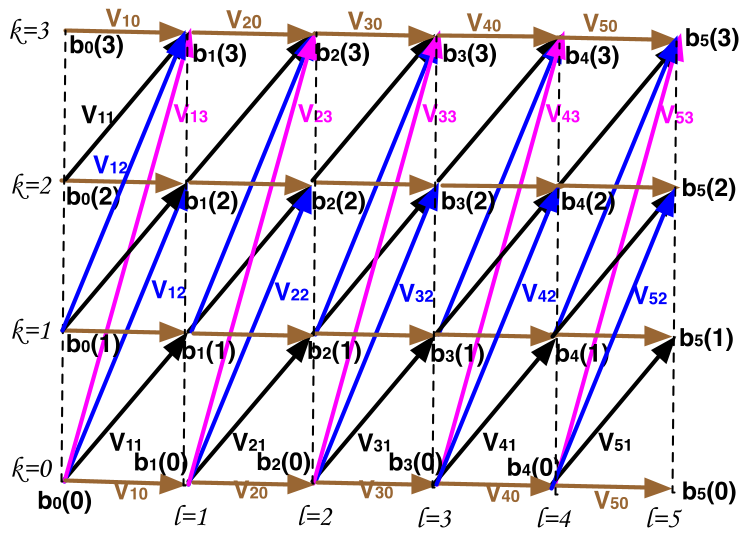 Figure 1: The trellis structure used for the Dynamic Programming approach to solve the bit allocation efficiently.
Experimental Validation
The paper compares the "Energy-Aware" auction against standard FIM-based allocation.
- Tracking Accuracy: The Mean Square Error (MSE) remains low even as the network ages, proving that the market doesn't sacrifice performance for profit.
- Sustainability: When sensors are programmed to increase their "bids" as their battery (residual energy) drops, the system automatically rotates the workload.
 Figure 2: (a) Number of sensors selected and (c) Tracking MSE over time. The mechanism dynamically activates more sensors when target uncertainty is high.
One of the most striking results is the Network Lifetime extension. Standard algorithms burn through the closest sensors quickly. The proposed mechanism stretches the network’s functional life by making low-battery sensors "too expensive" to use unless absolutely necessary.
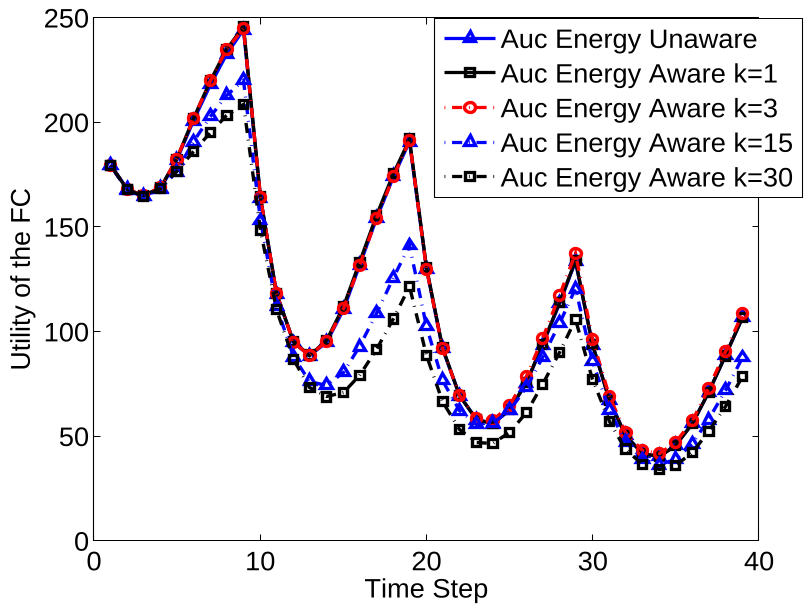 Figure 3: Remaining active sensors over time. The "Energy-Aware" (k=3 to k=30) versions maintain a functional network much longer than the unaware baseline.
Critical Insight & Conclusion
The power of this paper is in its physical intuition: information is a commodity with a price. By using the MCKP framework, the authors bridge the gap between abstract Game Theory and practical Signal Processing.
Takeaways:
- Stability: Unlike previous market models, this DP-driven auction is stable and always hits a truthful equilibrium.
- Scalability: The complexity makes it viable for medium-sized WSNs.
- Future Path: The "myopic" (short-term) nature of the current tracking could be improved. Future work looking into non-myopic strategies could lead to even more efficient energy "budgeting" over long duration missions.
This research provides a foundational blueprint for any crowdsensing system where the participants' interests are not aligned with the central controller's—a common reality in the modern IoT landscape.