
Precise Strikes: Maximizing Activation for Target Users in Evolving Social Networks
Target users' activation probability maximization with different seed set constraints in social networks
This paper introduces the Target Users’ Activation Probability Maximization (TUAPM) problem, distinguishing it from traditional Influence Maximization (IM) by focusing on activating a specific target set T. The authors propose the Influence Decay Model (IDM) to account for time-dependent probability degradation and develop a Double Greedy Algorithm (DGA) and a Scalable Algorithm (SA) to solve the problem under different seed set constraints.
TL;DR
In the world of social marketing, "more" isn't always "better." This paper shifts the focus from global influence to Target Users’ Activation Probability Maximization (TUAPM). By introducing a realistic Influence Decay Model (IDM) and efficient submodular optimization algorithms, the authors provide a toolkit for marketers to reach high-value targets even as interest in a topic fades over time.
The Problem: Why Traditional Influence Maximization Fails
Most Influence Maximization (IM) research asks: "How can I set off a chain reaction to reach the most people?" However, a luxury brand doesn't care about reaching everyone; they care about reaching specific influencers and potential buyers.
Furthermore, existing models (like IC or LT) treat social influence as a static property. In reality, a tweet from last month has far less "pull" than one from ten minutes ago. Ignoring this temporal decay leads to "over-optimistic" planning where marketers think they are reaching targets who have actually already moved on.
Methodology: The Core Innovation
1. The Influence Decay Model (IDM)
The authors modify the standard propagation probability with a logarithmic decay factor: This ensures that as the hops from the seed increase (representing time steps), the probability of successful activation shrinks, reflecting the loss of "novelty."
2. Algorithmic Solutions
The paper tackles two scenarios based on the budget:
- TUAPM-WC (Budget ): Solved via a Basic Greedy Algorithm (BGA). To make it work for large-scale networks, the authors introduce the Scalable Algorithm (SA).
- TUAPM-WOC (No constraints): Uses a Double Greedy Algorithm (DGA) to balance adding nodes vs. removing ineffective ones.
3. Maximum Activation Probability Tree (MAPT)
Instead of simulating thousands of random worlds (Monte-Carlo), SA builds a local tree of the most likely paths (MIP) from seeds to target users. This "localization" is the secret sauce for its speed.
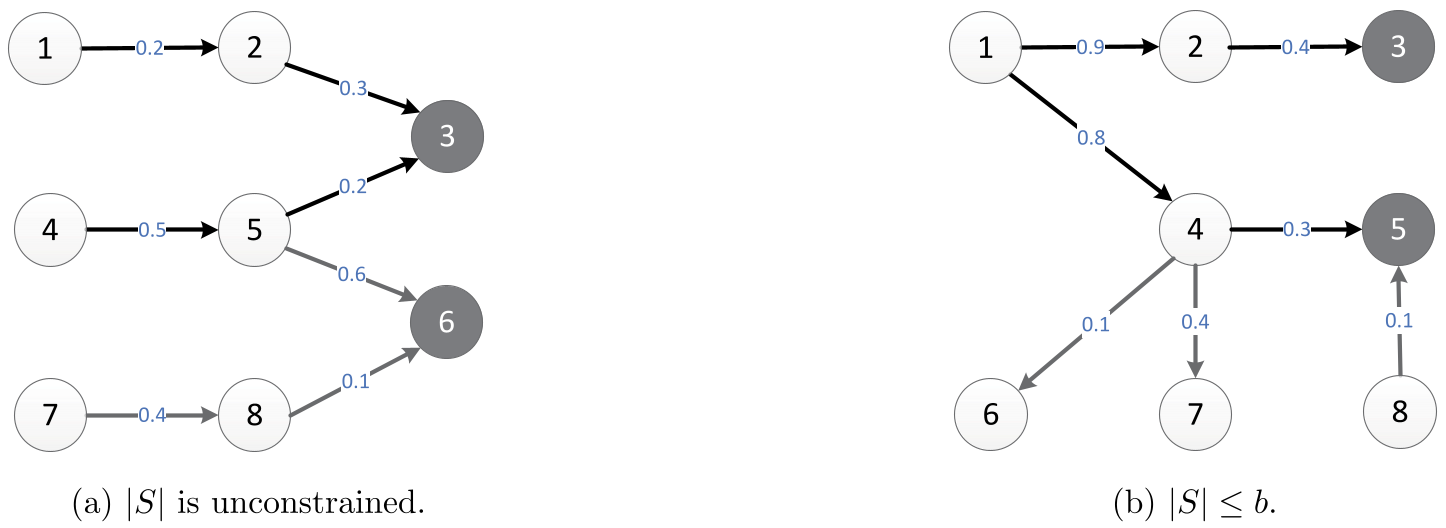 Figure 1: Comparison of seed selection strategies where localized seeds outperform global "hubs".
Experimental Results & Insights
The authors tested their approach on datasets ranging from citation networks (Cora) to massive social graphs (Facebook and DBLP).
- Decay Matters: Under the IDM, activation probabilities were lower than the standard IC model, proving that traditional models over-estimate reach.
- Efficiency: The Scalable Algorithm (SA) proved to be the "sweet spot." While random selection (RAN) is fastest, its performance is abysmal. SA offers near-greedy performance with a fraction of the computational cost of standard BGA.
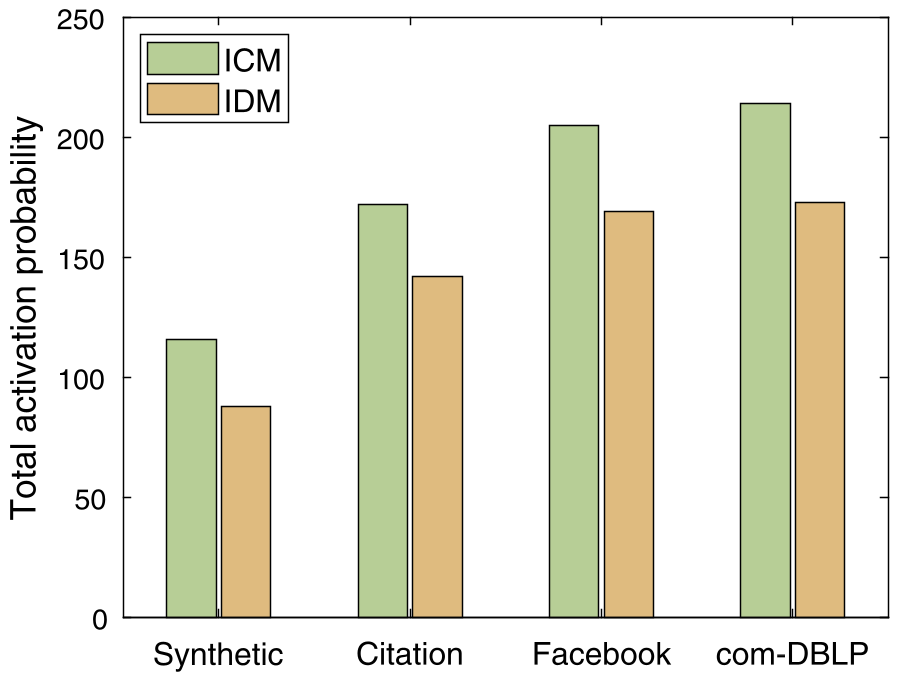 Figure 2: Performance of DGA vs BGA. Notice that DGA only starts outperforming BGA when the seed set size grows large enough to justify its unconstrained nature.
Critical Analysis & Conclusion
Takeaways
The core contribution here is the marriage of Targeted Selection and Time Decay. By proving that these specific objective functions remain submodular, the authors keep the problem within the realm of efficient, provable approximation.
Limitations & Future Work
The model assumes we know the target set perfectly. In the real world, is often a "fuzzy" set based on probabilistic interests. Future research could explore Stochastic Target Sets, where users have a membership probability in the target group.
Moreover, the IDM uses a fixed logarithmic decay. Exploring different decay rates for different types of information (e.g., breaking news vs. evergreen content) could further refine the accuracy of these marketing simulations.