
Maximizing Influence on a Specific Target: A New Frontier in Social Network Analysis
Targeted Activation Probability Maximization Problem in Online Social Networks
This paper introduces the Targeted Activation Probability Maximization (TAPM) problem, which focuses on influencing a specific target user through intermediate nodes. The authors propose two new diffusion models, Targeted Linear Threshold (TLT) and Targeted Independent Cascade (TIC), and provide data-dependent approximation solutions using a Sandwich Approximation strategy.
TL;DR
The researchers have defined the Targeted Activation Probability Maximization (TAPM) problem. Unlike traditional volume-based influence, TAPM aims to select nodes to maximize the probability that a specific individual (the target) receives a message from a source. By introducing the Targeted Linear Threshold (TLT) and Targeted Independent Cascade (TIC) models and utilizing Sandwich Approximation, the authors provide a robust solution for general graphs where traditional submodular optimization fails.
Problem & Motivation: Why Target a Single Node?
Most social network research focuses on "going viral"—the traditional Influence Maximization problem. However, real-world social engineering often has a specific destination: a scholar wanting to reach a famous mathematician, or a marketer reaching a key opinion leader.
The difficulty lies in the mathematical structure:
- Complexity: It is not just NP-hard to find the best nodes; it is #P-hard even to calculate the probability for a given set.
- Loss of Submodularity: In traditional IM, adding more seeds always helps but with diminishing returns (submodularity). In TAPM, the objective function is non-submodular (and specifically supermodular in the TLT model), meaning the "diminishing returns" rule doesn't apply, making standard greedy algorithms unreliable.
Methodology: Solving the Unsolvable
The authors tackle this by creating a "Sandwich." If you can't optimize the original function directly, you find a submodular lower bound and an upper bound .
1. The Models (TLT & TIC)
- TLT (Targeted Linear Threshold): A node is activated if the weighted sum of its active neighbors exceeds a random threshold, but only if that path consists of selected intermediate nodes.
- TIC (Targeted Independent Cascade): Each active neighbor has a one-shot probability of activating a follower, restricted to the chosen intermediate set.
2. The Core Algorithm: SSA and SA
The authors utilize a Backtracking Set approach (Algorithm 1) to build an unbiased estimator of the activation probability. By starting from the target and working backward toward the source , they identify which nodes are critical for successful diffusion.
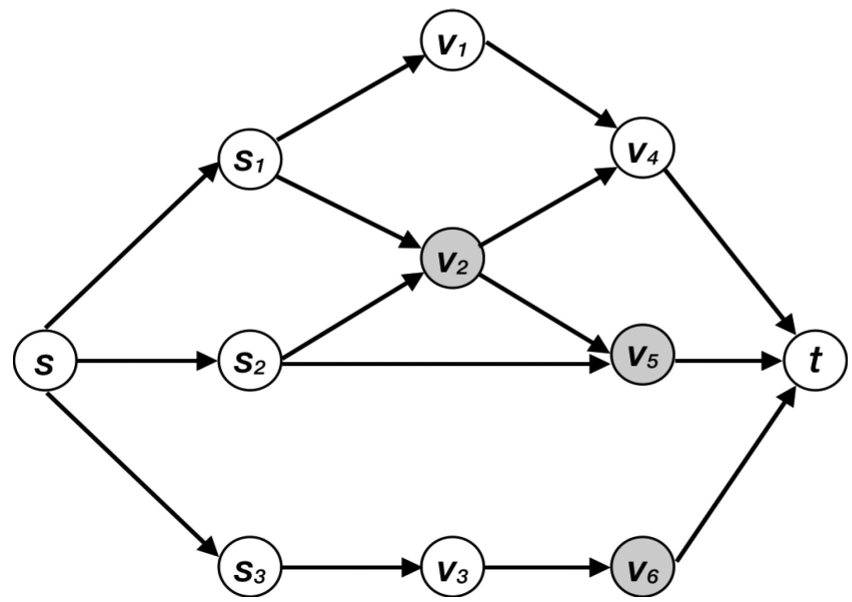 Figure: The construction used to prove NP-hardness, showing the transformation from IM to TAPM.
A key insight is the use of Maximum Probability Paths (Algorithm 2) to initialize the set . This ensures the starting point of the optimization is already grounded in the most likely successful path.
Experiments & Results
The team tested their algorithms (SSA for TLT, SA for TIC) on real-world networks including Wikipedia and Facebook.
- Performance: The proposed SSA/SA methods consistently outperformed the "Shortest Path" (SP) and "OutDegree" heuristics.
- Scalability: Even on the Facebook dataset (1.4M edges), the algorithms completed within a reasonable timeframe, despite the #P-hardness of the underlying probability computation.
- Tightness: The "gap" between the lower bound and the original function remained impressively small, suggesting the data-dependent approximation is near-optimal in practice.
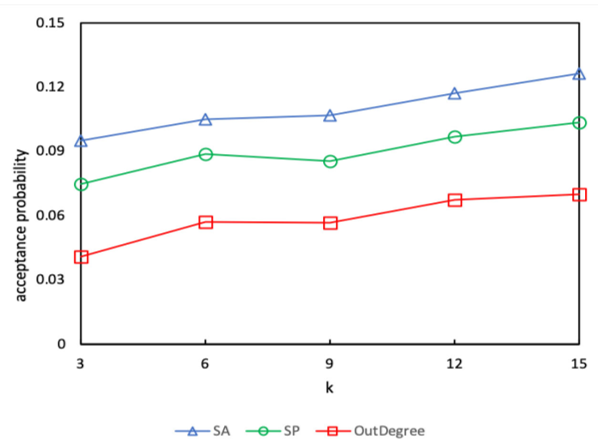 Figure: Activation probability comparison in Wikipedia, HepTh, and Facebook datasets under the TLT model.
Critical Analysis & Conclusion
The paper successfully generalizes targeted influence from simple trees/DAGs to general graphs. The proof that the TLT model serves as an upper bound for the TIC model is a significant theoretical contribution, allowing researchers to transfer solutions between different diffusion mechanics.
Takeaway
For practitioners in digital marketing or social security, this work provides a framework to identify "gatekeepers" between any two individuals in a network.
Limitations
The study assumes full knowledge of the graph's edge weights (influence probabilities). In real-world social networks, these weights are often latent and must be estimated, which adds another layer of uncertainty to the activation probability. Future work identifying a submodular upper bound directly for the TLT model would further refine the approximation ratio.