
Targeted Coupon Distribution: Applying Network Backpressure to Social Marketing
Targeted coupon distribution using social networks
The paper introduces a targeted coupon distribution mechanism using online social networks to achieve price differentiation. It proposes a dual-timescale "Backpressure-based" routing scheme that incentivizes users to forward coupons, achieving near-optimal revenue by matching supply with latent consumer demand.
Executive Summary
TL;DR: Marketing in social networks often suffers from a "black box" problem—retailers don't know who wants a product or how much they are willing to pay. This paper proposes a decentralized distribution system where users are paid to forward coupons to friends. By applying Backpressure Routing (a technique typically used to manage data packets in congested networks), the system automatically directs coupons to those with the highest demand while maximizing the store's revenue.
Background: This work sits at the intersection of Network Economics and Distributed Control. Rather than relying on a central server to "push" ads, it leverages the organic structure of social networks to "pull" demand through localized incentives.
The Core Challenge: The Information Gap
Marketers face a dilemma:
- Flooding: Send coupons to everyone, and you lose money from "high-price" customers who would have paid more.
- Restricting: Send too few, and you miss out on potential sales from "low-price" customers.
The difficulty is that user preferences are private information. A user in the middle of a social graph knows their friends' tastes better than a distant store does. The challenge is: how do you get these users to act as "intelligent routers" for your discounts?
Methodology: Backpressure as an Economic Force
The authors view the social network as a fluid network where coupons "flow" toward consumers.
1. The Dual-Timescale Design
The system operates on two distinct clocks:
- Large Timescale: The store observes total purchases and adjusts the "Target Rate" (). If a customer buys everything at a discount, the store might be over-discounting; if they buy nothing, the discount rate is too low.
- Small Timescale: Coupons move from node to node based on Queue Differentials.
2. The Incentive Mechanism (Backpressure)
Each node maintains a queue for each product. When a user decides where to send a coupon, they look at the queue length of their neighbors.

The Reward Scheme is the genius part: a node receives a reward proportional to the "pressure" gradient: . This forces coupons to flow from "high-pressure" areas (surplus) to "low-pressure" areas (high demand/sinks), ensuring that coupons are not wasted on uninterested users.
Experimental Results
The authors tested the algorithm using two scenarios: a simple tree topology and a more realistic Power-Law social network.
Performance Comparisons
The results confirm that the Backpressure algorithm (BP) is nearly optimal. By dynamically adjusting to user queues, it extracts significantly more revenue than a randomized approach.
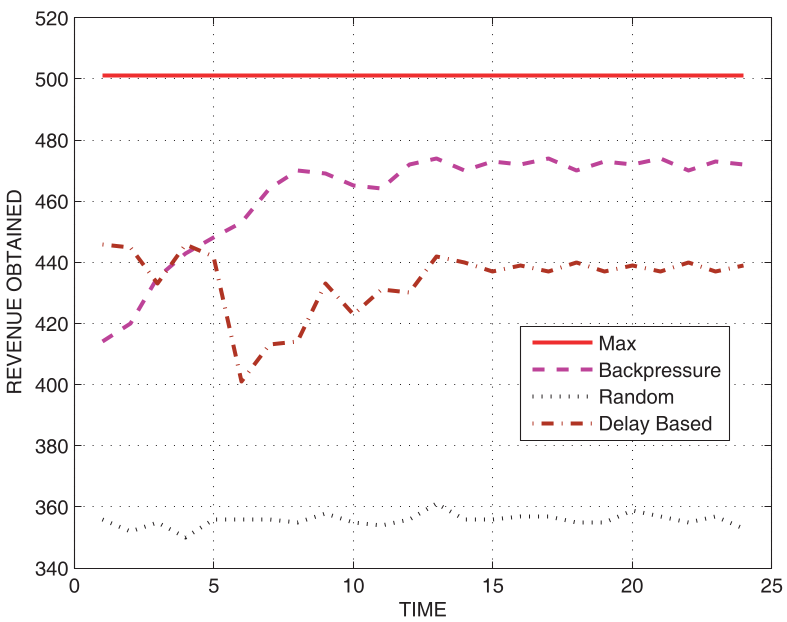 Figure 2: Trajectory of revenue in a power-law topology. Backpressure (solid line) approaches the theoretical upper bound (dotted line).
An interesting fallback is the Delay-based heuristic. Instead of tracking complex queues, users simply track how long it takes to get paid after forwarding a coupon to a specific neighbor. High delay equals "congestion" (the neighbor isn't finding buyers), while low delay equals a "hot lead."
Critical Insight & Future Outlook
Why it Works
The beauty of this method is that the store doesn't need to see the whole network. By setting local rewards based on queue differences, the store induces an Incentive Compatible behavior where users' selfish desire for rewards leads to a globally optimal distribution of coupons.
Limitations
- Trust and Collusion: The model assumes users follow the protocol honestly for rewards. In the real world, users might attempt to "sybil attack" the system by creating fake accounts to capture rewards.
- Complexity: Maintaining per-product queues for every friend might be a high cognitive load for actual human users, suggesting this would need to be handled by an automated "personal agent" app.
Conclusion
This paper serves as a bridge between hard engineering (routing) and soft sciences (marketing). It proves that the same math that keeps the Internet from crashing can also be used to build more efficient, decentralized marketplaces in the social era.