
Precise Defense: Mastering Targeted Protection Maximization in Social Networks
Targeted Protection Maximization in Social Networks
The paper introduces the Targeted Protection Maximization (TPM) problem, designed to block the minimum number of edges in a social network to protect a specific set of target nodes from misinformation. Two primary algorithms are proposed: a Hill-Climbing Greedy approach and General-TIM, a randomized sampling technique based on "Random Reverse Shortest Paths" (Random-RS-Path).
TL;DR
In the battle against misinformation and cyberbullying, protecting everyone is often impossible and unnecessary. This paper defines Targeted Protection Maximization (TPM): the art of removing the fewest possible social connections to shield a specific "at-risk" group. By utilizing a novel Random-RS-Path sampling method, the authors provide a way to solve this complex, non-submodular problem with high efficiency and accuracy.
The "Precision Medicine" of Social Networks
Most anti-rumor strategies are "broad-spectrum"—they try to minimize the total number of infected nodes. However, real-world scenarios like protecting adolescents from harmful content or shielding a company's customers from a competitor's smear campaign require a surgical approach.
The technical challenge? Under the Independent Cascade (IC) model, the influence function for specific targets loses the "diminishing returns" property (submodularity). This means traditional greedy algorithms that work for general influence maximization don't have the same theoretical safety nets here.
Methodology: From Reachability to Shortest Paths
The researchers identified that while the problem is NP-hard and non-submodular, a specific "path-based" intuition could work. They moved beyond simple Reverse Reachable (RR) sets to Random Reverse Shortest Paths (Random-RS-Path).
1. The Random-RS-Path Insight
Instead of checking if a node could be reached, the algorithm identifies the shortest paths through which a rumor reaches a target. By blocking edges on these paths, you get the highest "bang for your buck" in terms of protection.
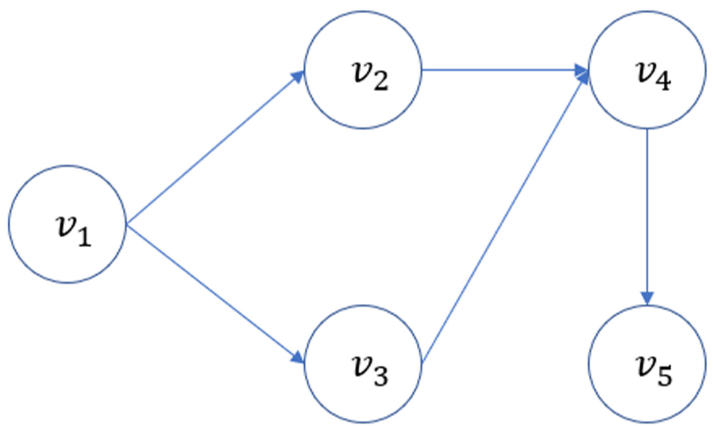 Figure: Visualizing path blocking in a realization of the social graph.
2. General-TIM Algorithm
Based on the sampling of these paths, the General-TIM algorithm transforms the problem into a Maximum Coverage challenge:
- Sample random shortest paths.
- Iteratively select edges that "break" the most paths.
- Stop when the target protection threshold is met.
Results: Efficiency vs. Effectiveness
The authors tested their approach on datasets like Wiki-Vote and Co-authorship networks. The results were clear:
- Greedy is King of Accuracy: The Hill-Climbing Greedy algorithm finds the smallest edge sets to block.
- General-TIM is the Speed Demon: It provides results nearly as good as Greedy but at a fraction of the computational time.
- Heuristics Fail: Standard strategies like "block high-degree nodes" or "block high-weight edges" were remarkably inefficient, often requiring 20x more edge removals to achieve the same protection level.
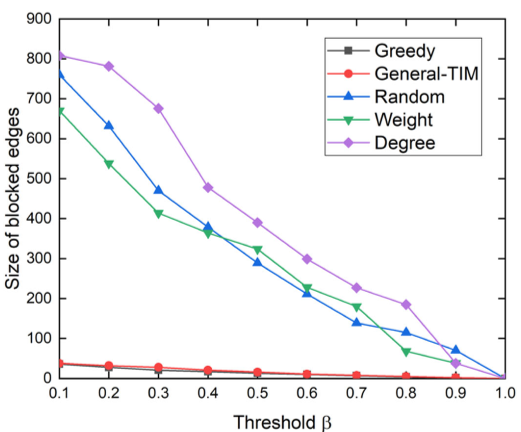 Figure: Comparison of Greedy and General-TIM against traditional heuristics. Note how Greedy/General-TIM (bottom lines) require significantly fewer edges.
Speeding Up via Community Structures
A brilliant addition to this work is the Community Speedup. Social networks are naturally clustered. The authors observed that if a community contains neither a rumor source nor a target, the edges inside it are irrelevant for blocking.
By running a modularity maximization (like Clauset-Newman-Moore) first, they can prune the search space of candidate edges significantly without losing protection quality.
Critical Insight & Future Outlook
The core takeaway is that local structure matters more than global connectivity when targets are specific.
However, there is a limitation: when the protection requirement is near-absolute (), the shortest-path approximation in General-TIM starts to struggle because rumors can "leak" through longer, sub-optimal paths. Future research might bridge this gap by incorporating "k-shortest paths" or multi-flow theory to maintain efficiency at near-zero spread thresholds.
For practitioners in platform safety and social media governance, this paper provides a robust framework for implementing "targeted blocklists" that minimize disruption to the overall network while maximizing safety for vulnerable users.