
Beyond the Top 1%: Why Targeted Local Influence Is the Future of Viral Marketing
A targeted approach to viral marketing
This paper introduces a "Targeted Approach" to viral marketing that leverages local centrality scores (MFP, RWR, LRW) to select seed users based on their proximity to a specific potential market. Unlike traditional methods using global network metrics, this approach consistently outperforms global SOTA benchmarks like Eigenvector centrality in activating high-interest users within real-world social networks (Last.fm, Ciao.com).
Executive Summary
TL;DR
This research challenges the long-standing dogma of viral marketing: "Target the most popular users to win." Instead, the authors argue for a Targeted Approach using Local Centrality. By selecting seeds based on their proximity to specific "potential markets" rather than global network importance, they achieve significantly higher conversion rates, particularly in "difficult" environments where social influence is dampening.
Academic Positioning
This work sits at the intersection of Social Network Analysis (SNA) and Predictive Marketing. It moves away from the "One-Size-Fits-All" global centrality metrics (like Eigenvector Centrality) and provides a rigorous mathematical framework for localized influence maximization using random walk theories.
The Problem: The "Global Influence" Fallacy
Most marketers assume that a celebrity or a high-degree node (a "global influencer") is the best start for any campaign. However, the authors identify a critical flaw: Homophily.
Users with specific interests (e.g., niche indie music or rare collectibles) tend to cluster together in regions of the network far removed from the global "hubs." If a viral message starts at a global hub, it often dies out before it reaches these high-value clusters. In academic terms, the Independent Cascade (IC) process is stymied by the distance between globally central seeds and the target manifold.
Methodology: The Power of Local Centrality
The core innovation is shifting from to , where is the set of known potential adopters.
1. Architecture of Target Selection
The paper utilizes three primary local metrics:
- Mean First Passage Time (MFP): The expected steps a random walker takes to reach the target market.
- Random Walk with Restart (RWR): A steady-state probability that mimics PageRank but centers on the target group.
- Local Random Walk (LRW): A limited-step walk (typically ) that focuses on the immediate neighborhood.
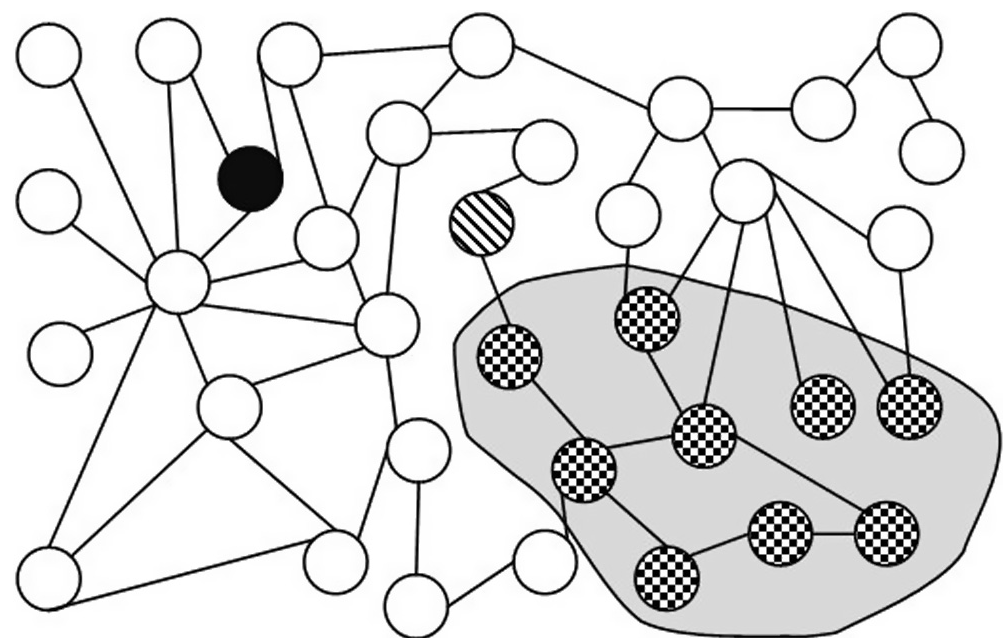 Figure 1: Comparison between a Globally Central seed (Black) and a Targeted seed (Hatched). Targeted seeds are physically closer to the chequered potential market nodes.
2. Implementation
The researchers use an extended Independent Cascade model that incorporates Inherent Preference (using a Beta distribution) and Stopping Probability (the chance an activated user fails to pass the message). This adds a layer of realism: not everyone who buys a product becomes a brand advocate.
Experiments & Results: Winning in "Difficult" Networks
The authors tested their hypothesis on real-world data from Last.fm and Ciao.com.
The "Difficulty" Resilience
The most striking finding is the performance of the Local Random Walk (LRW) in high-difficulty scenarios. As "Stopping Probability" increases (meaning people are less likely to share), the efficiency of Global Centrality (Eigenvector) plummets, while Local measures remain robust.
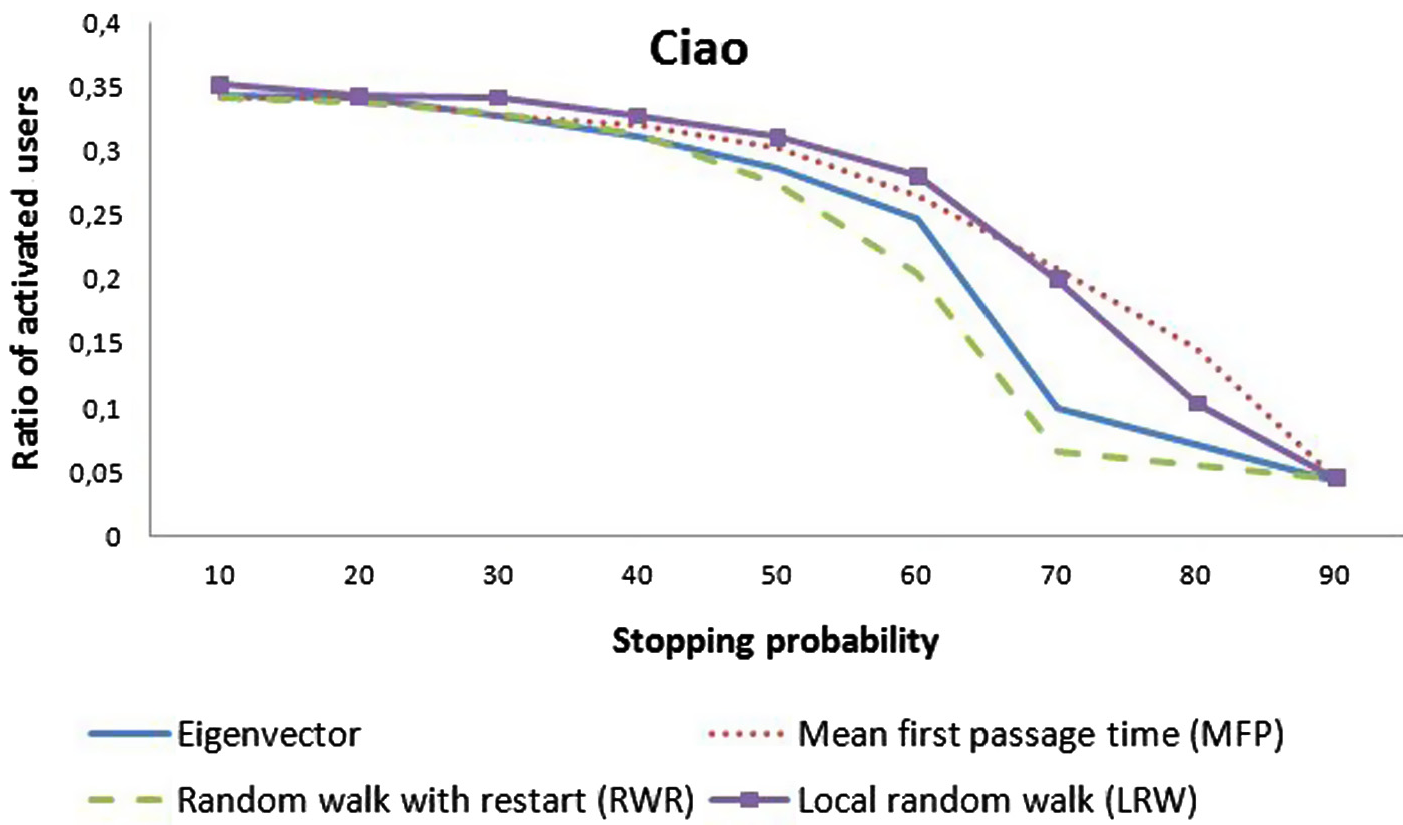 Figure 2: Performance on Ciao dataset. As the network becomes more "difficult" (moving right on the X-axis), LRW and MFP significantly outperform the Eigenvector baseline.
Key Insights from Data:
- The 5% Rule: You don't need to know the whole market. Identifying just 5% of potential adopters is enough for local centrality to beat global methods.
- Seed Diversity: Global methods always select the same "celebrity" nodes regardless of the product. Targeted methods select diverse, context-specific seeds, which is more sustainable for long-term marketing ecosystems.
- Efficiency: LRW has lower computational complexity than many global metrics, making it viable for massive real-time social graphs.
Critical Analysis & Conclusion
The Takeaway
This paper provides a mathematical justification for "micro-influencer" and "community-first" marketing. By focusing on local proximity and homophily, marketing campaigns become more resilient to social noise and negative inherent preferences.
Limitations & Future Work
While the study is robust, it primarily uses undirected graphs. Further research is needed to see how directed influence (e.g., Twitter/X follower-following asymmetries) affects local centrality. Additionally, the role of "negative" viral marketing (the spread of boycotts or bad reviews) remains an open challenge for this targeted framework.
Final Thought: If you are launching a campaign, stop looking for the person with the most followers. Start looking for the person who is most "local" to your target audience's interest cluster.