
Tackling Deception: Reputation-Based Task Allocation in Social Multiagent Systems
Task Allocation for Undependable Multiagent Systems in Social Networks
This paper proposes a negotiation reputation-based task allocation model for multiagent systems in social networks (MAS-SN) to combat deceptive agents. It introduces a mechanism that weights agent reliability against communication distance and network load to optimize both dependability and efficiency.
TL;DR
In modern decentralized networks, how do we ensure tasks are completed when agents lie about their capabilities? This paper introduces a Negotiation Reputation model for Multiagent Systems in Social Networks (MAS-SN). By rewarding honest resource contribution and punishing deception through a dynamic weighting system, the model achieves a >90% success rate and minimizes execution time even in the presence of malicious "deceptive agents."
Problem & Motivation: The Cost of Untrustworthiness
Task allocation in social networks is typically a struggle between two forces: Efficiency (finding the closest agent) and Dependability (finding an agent that actually does the work).
Prior works often fell into two traps:
- Resource-only methods: They blindly trust what agents report, leading to frequent task failures when deceptive agents "ghost" the execution phase.
- Game-theory methods: While they model selfishness well, they often ignore the network topology. In a social network, "distance" isn't just a number—it represents communication lag and resource access time.
The authors' insight is simple: An agent's past behavior is the best predictor of its future reliability. They propose a system where "Reputation" is not just a static score, but a cumulative strength of negotiation paths across the social graph.
Methodology: The Architecture of Trust
The paper utilizes a Manager/Contractor Architecture. When a task arrives, a "Manager" is selected via a centralized heuristic, who then negotiates with "Contractors" via a distributed process.
1. Negotiation Reputation ()
Reputation is calculated based on the cumulative negotiation strength across paths in the network. If Agent A has successfully worked with Agent B, the weight between them increases. This propagates through the network using an algorithm similar to All-Pairs Shortest Path, but maximizing strength instead of minimizing distance.
2. The Allocation Formula
To select contractors, the model uses a Negotiation Value ():
- : Communication distance (Efficiency).
- : Reputation (Dependability).
- : A tunable parameter to trade off speed for trust.
3. Load Balancing
To prevent "popular" honest agents from becoming bottlenecks, the formula includes an attenuation function () based on queue length () and processing rate ().
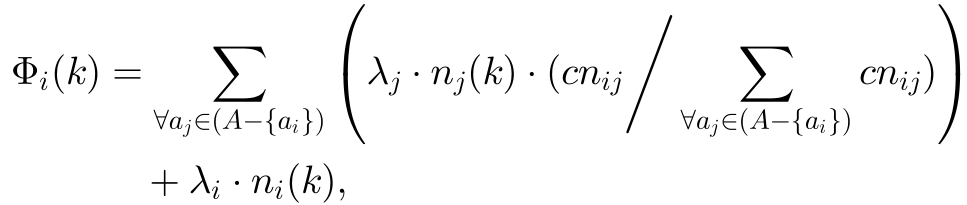 The Estimated Resource Enrichment Factor used to select the Manager Agent.
Experiments & Results
The authors tested their model against four baselines, including a "Game Theory" model and a "Transparent" (ideal) model.
Key Findings:
- Sustainability: As the number of tasks increases, the reputation system "learns." While it starts slower than game-theory models, it eventually surpasses them as it filters out deceptive agents.
- Efficiency: Task execution time was significantly lower than traditional resource-based models because it minimized the need for "re-allocating" failed tasks.
- Load Balancing: The addition of load balancing (Our model-LB) dramatically reduced waiting times, proving that reputation alone isn't enough—you also need to manage traffic.
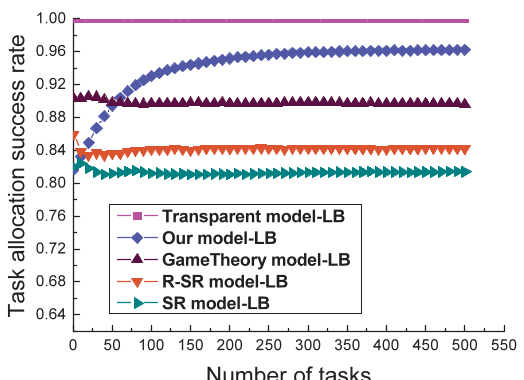 Figure 1: Success rates across different models. Note how "Our Model" climbs toward the ideal "Transparent" line as tasks increase.
Critical Analysis & Conclusion
Takeaway
The core contribution is the fusion of social metrics with structural constraints. By making "negotiation reputation" a first-class citizen in the allocation algorithm, the system becomes self-healing.
Limitations
- Static Topology: The paper assumes the social network edges are fixed. In modern mobile MAS, connections are transient.
- Overhead: While the authors claim low costs, maintaining a global reputation matrix in a truly massive-scale system could face scalability challenges.
Future Outlook
This framework is highly applicable to Edge Computing and Decentralized AI, where hardware nodes may be "self-interested" or unreliable. Future iterations that incorporate dynamic topology and cryptographic verification of rewards/punishments could become the standard for dependable decentralized coordination.