
[Task Assignment in Spatial Crowdsourcing: Bridging Efficiency and Privacy]
Task assignment in spatial crowdsourcing: challenges and approaches
This paper presents a comprehensive framework for Spatial Crowdsourcing (SC), introducing a taxonomy and addressing four critical pillars: dynamic task assignment, location privacy, incentive mechanisms, and synthetic workload generation. The author evaluates several novel algorithms, such as Least Popular Priority (LPP) and context-aware bandit strategies, to optimize real-time worker-task matching.
TL;DR
Spatial Crowdsourcing (SC) transforms data collection by requiring workers to be physically present at specific locations. This paper explores the "Server-Assigned" paradigm, proposing algorithms like Least Popular Priority (LPP) to boost task completion by 20-40% and a Differential Privacy framework that protects worker locations with minimal impact on travel overhead. It also introduces SCAWG, a tool to solve the industry's chronic lack of realistic benchmarking data.
Problem & Motivation: The Spatial Constraint
Unlike traditional crowdsourcing (e.g., Amazon Mechanical Turk), SC is bound by the laws of physics and geography. Tasks—such as taking a photo of a landmark or sensing air quality—cannot be done remotely.
The author identifies three fatal flaws in current approaches:
- The Myopia of Online Assignment: Tasks and workers arrive dynamically; servers often make "greedy" local choices that hurt long-term efficiency.
- The Privacy Paradox: Efficient assignment requires knowing where workers are, but revealing locations exposes users to stalking and sensitive habit profiling.
- The Data Void: Most researchers use synthetic or "proxy" data (like call records) that don't reflect actual crowdsourcing dynamics.
Methodology: The Core Pillars
1. Task Assignment Taxonomy
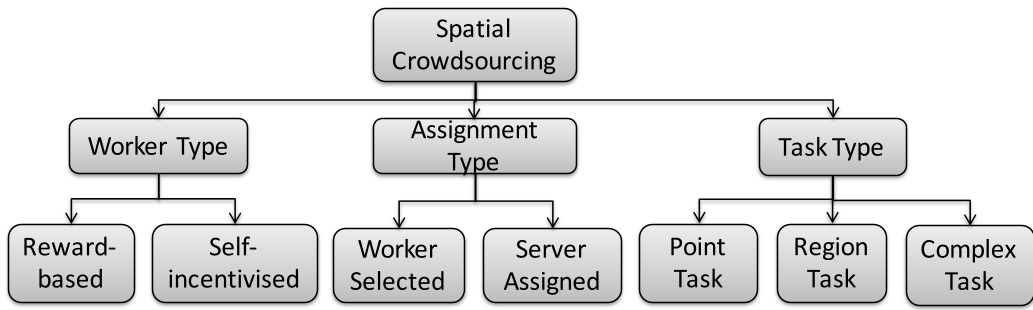
The paper categorizes SC into Worker Selected (WS) and Server Assigned (SA). While WS offers autonomy, SA allows the server to optimize the "global picture," ensuring tasks in remote areas aren't neglected.
2. Intelligent Heuristics (LPP & Bandits)
To solve the assignment problem, the author introduces Least Popular Priority (LPP). The physical intuition is simple: if a task is located in an area seldom visited by workers (a "worker-sparse" zone), it must be prioritized now, because the probability of a worker being there later is near zero. For multi-period campaigns, a Contextual Bandit approach is used to adaptively manage budgets across time.
3. Differentially Private Assignment
To protect workers, the system uses Differential Privacy (DP). Instead of sending exact coordinates , worker locations are processed through a Private Spatial Decomposition (PSD).
- Noise Injection: The server only sees "noisy counts" of workers in specific grid cells.
- Geocast: To prevent the server from identifying real vs. fake (noise) workers, tasks are broadcast via Geocast to everyone in a region, ensuring the server never establishes a 1-to-1 connection with a specific device.
Experiments & Results
The findings validate that efficiency does not have to come at the cost of privacy:
- Task Coverage: LPP increased assignments by 20%. When combined with contextual bandits for budget management, coverage improved by 40%.
- Privacy Cost: Implementing Differential Privacy only increased worker travel distance by 20%, a "privacy tax" deemed tolerable for the high level of security provided.
- Human Behavior: Real-world trials in Japan (using the Genkii app) revealed that workers stay longer with increasing reward schemes rather than fixed payments, and that individual "mobility" (how much a person travels) is positively correlated with self-reported happiness.

Critical Analysis & Conclusion
Takeaway
The paper successfully argues that Server-Assigned models are superior for global utility. By treating "task popularity" as a spatial scarcity problem and using Geocast for privacy, the author provides a blueprint for secure, industrial-scale SC.
Limitations & Future Work
While worker privacy is addressed, task location privacy remains a challenge—some requesters might not want to reveal where they need data collected. Future research will likely focus on dual-privacy (hidden workers and hidden tasks) and more complex "spatial complex tasks" where multiple sub-tasks must be completed in a specific sequence.
Ultimately, the release of the SCAWG generator might be the paper's most lasting contribution, providing the community with a standardized "gym" to test the next generation of spatial algorithms.