
Task Assignment with Worker Churn Prediction: Proactive Retention in Spatial Crowdsourcing
Task Assignment with Worker Churn Prediction in Spatial Crowdsourcing
This paper introduces the Worker Churn based Task Assignment (WC-TA) problem in Spatial Crowdsourcing (SC). It proposes a two-phase framework that utilizes an LSTM-based Latent Feeling Capturing (LFC) model to predict worker churn and employs Churn-aware Greedy/KM algorithms to prioritize tasks for churn-prone workers, maximizing total rewards while minimizing churn rate.
TL;DR
Static task assignment is no longer enough for the competitive Spatial Crowdsourcing (SC) market. This paper introduces the Worker Churn based Task Assignment (WC-TA) framework. By predicting when a worker is likely to quit (churn) using an LSTM-based "Latent Feeling" model, the system can prioritize these workers for high-reward tasks, effectively increasing retention by up to 20% while maximizing platform revenue.
Problem & Motivation: The Hidden Cost of Worker Defection
Most SC platforms (like Uber, Meituan, or GrubHub) focus on the "What" and "Where": Which worker is closest to this task?
However, they often ignore the "How": How does the worker feel about their recent assignments? If a worker is constantly assigned low-reward tasks or forced to travel long distances for small gains, they "churn"—they stop using the app. High worker turnover is expensive for platforms due to acquisition costs. Current SOTA methods focus on spatio-temporal constraints but fail to account for the psychological state of the human-in-the-loop.
Methodology: Quantifying "Satisfaction" and "Passion"
The researchers propose a two-phase framework: Prediction followed by Strategic Assignment.
1. Latent Feeling Capturing (LFC) Model
Instead of treating churn as a simple binary classification (0 or 1), the authors treat it as a regression problem of predicting a worker's Idle Time Interval.
- Satisfaction Vector: Encodes rewards, spatial distance between tasks, and locations.
- Passion Vector: Encodes time intervals between tasks and historical persistence.
These vectors are fed into a dual-path LSTM to capture sequential dependencies in worker sentiment. If the predicted idle time exceeds a threshold , the worker is classified as "churn-prone."
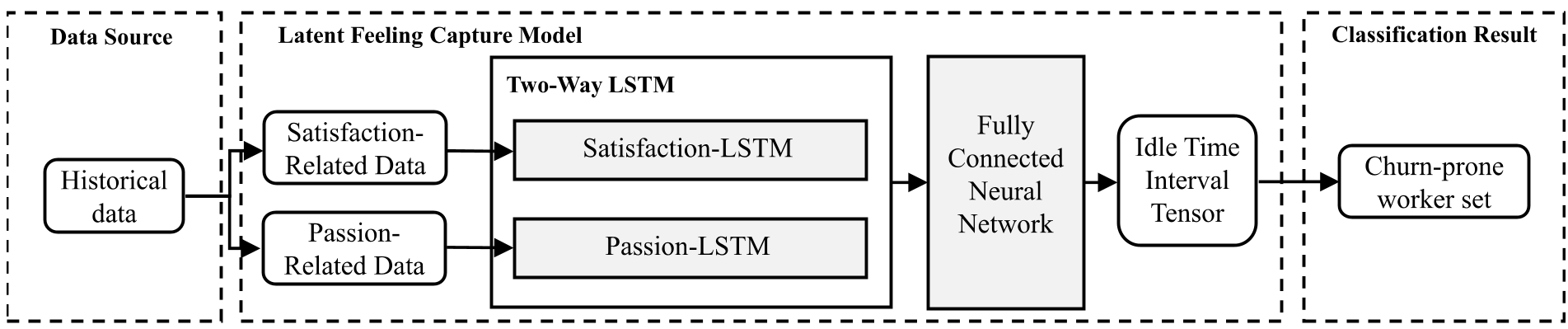 Figure 1: The Latent Feeling Capturing (LFC) Model structure showing the dual-path LSTM for passion and satisfaction.
2. Churn-aware KM Algorithm
Once churn-prone workers are identified, the platform must "save" them. The researchers use a modified Kuhn-Munkras (KM) algorithm for Bipartite Maximum Weight Matching.
- Edge Weights: .
- By increasing the weight based on idle time, the algorithm naturally prioritizes churn-prone workers for available tasks, giving them a "reason to stay."
Experiments: Does Retention Hurt Revenue?
Using 31,262 users from the Yelp check-in dataset, the authors tested their framework against traditional Greedy and KM baselines.
Key Findings:
- Prediction Accuracy: The LFC model outperformed Linear Regression (LR) and Multi-layer FC networks, particularly as the time threshold increased.
- Retention vs. Reward: Surprisingly, the Churn-aware KM (KM+WC) didn't just help workers; it also increased the Total Reward of the system. This is because prioritizing churn-prone workers often reshuffles the assignment graph in a way that resolves competition more efficiently.
- Assignment Ratio (AR): KM+WC improved the assignment of at-risk workers by 10-20% compared to standard KM algorithms.
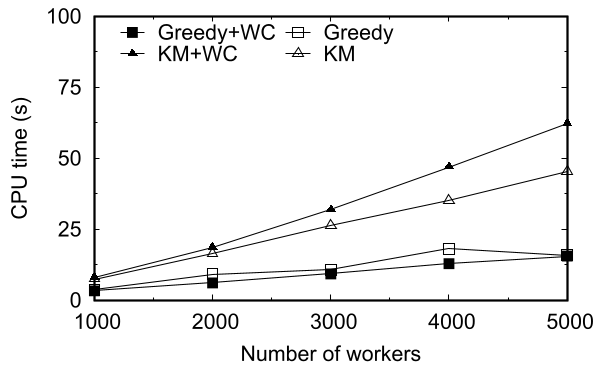 Figure 2: Performance analysis showing the impact of task volume (|S|) on rewards and assignment ratios.
Critical Analysis & Conclusion
The core insight of this paper is that worker retention is a task assignment constraint. By treating a worker's mental state (latent feelings) as a measurable feature, platforms can transition from reactive management to proactive intervention.
Limitations:
- The study assumes workers share the same speed, which is rarely true in urban environments with traffic.
- The "Feeling" model relies on check-in data; in a real SC app, factors like "cancellation rate" or "app usage time" would likely provide even stronger signals.
Takeaway: Future SC systems must be "human-centric." Predicting churn isn't just a business metric; it's a vital input for the optimization algorithms that drive the gig economy.