
Task Characterization: The Secret to High-Efficiency Crowdsourcing
Task Characterization for an Effective Worker Targeting in Crowdsourcing
The paper introduces a novel task characterization and worker targeting framework for Crowdsourcing (CS) that clusters Human Intelligence Tasks (HITs) based on intrinsic features. By learning the correlation between task types and worker profiles, it achieves high-quality data collection with significantly reduced budget and time overhead compared to traditional sampling or majority voting.
TL;DR
Crowdsourcing often suffers from the "jack of all trades, master of none" paradox, where tasks are assigned to a broad crowd, leading to inconsistent quality and high verification costs. This paper proposes a system that automatically characterizes and clusters tasks, then targets specific worker groups who have the highest probability of success for that specific task type. By moving from "Mass Assignments" to "Profile Targeting," it slashes both time and budget overhead.
The "One Size Fits All" Failure
In the world of Crowdsourcing (CS), there is a persistent struggle between Quality and Cost. Historically, platforms have used two extremes:
- Naive Aggregation: Treat all workers the same and use Majority Voting. This fails when tasks require specific expertise (e.g., medical labeling).
- Exhaustive Sampling: Assign a small portion of a task to everyone to see who does well, then assign the rest to the winners. This is accurate but incredibly expensive and slow.
The authors identify a critical insight: Tasks are not identical, but they share traits. A worker who excels at "Semantic Labeling" might be terrible at "Sentiment Analysis." By capturing this relationship, we can skip the sampling "trial-and-error" phase entirely.
Methodology: The Three Pillars of Task Characterization
The core innovation lies in how the authors breakdown a task into a feature vector. They categorize Human Intelligence Tasks (HITs) into three dimensions:
- Presentation Features: How is the task shown? (UI, layout). This tests a worker’s perceptional skills.
- Action Features: What does the worker do? (Clicking, typing, translating). This identifies technical/behavioral skills.
- Content Features: What is the task about? (Medical, Fashion, Code). This targets domain knowledge.
Systematic Workflow
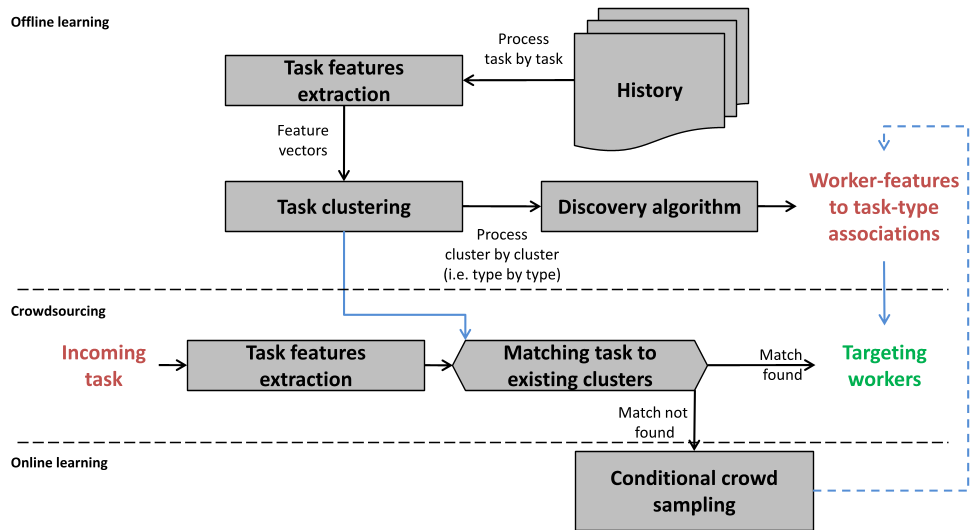
As shown in the architecture diagram below, the system operates in an Offline/Online loop:
- Offline: Clusters historical tasks and uses a discovery algorithm to find which worker demographics (age, education, interests) performed best for which cluster.
- Online: When a new task arrives, it is mapped to a cluster, and the "Targeting" engine immediately invites the most reliable workers.
Breaking Down the Discovery Algorithm
The "Discovery Algorithm" is the brain of the operation. It doesn't just look for "good workers"—it looks for Task-Type/Worker-Feature Associations. For example, it might discover that Graduate Students in Humanities are the most reliable group for Semantic Labeling of Literature, while Teens might be more effective at Categorizing Video Memes. Once these associations are learned, the system no longer needs "Gold Answers" (ground truth) to verify quality; it trusts the alignment.
Experimental Insights & SOTA Comparison
The paper positions this work against state-of-the-art "Sampling" methods (like those by Li et al.). While sampling methods eventually find the right workers, they waste a significant portion of the budget on the "Sampling Phase."
The proposed Task Characterization method:
- Eliminates Overhead: No need to pay 100 people just to find the 10 experts for every new task.
- Agnostic Approach: Unlike previous works that required domain-specific metrics, this text-mining approach works across various domains (Translation, Labeling, Sentiment).
- Reliability Boost: By filtering out workers whose profiles don't match the task "perceptional/technical" needs, it naturally excludes spammers and low-effort contributors.
Critical Analysis & Future Outlook
While the paper presents a robust framework for structured HITs, the cold-start problem remains a minor hurdle. For a brand-new task type that hasn't been clustered before, the system must revert to online learning.
The Takeaway: The future of Crowdsourcing isn't "the crowd"—it's the "Targeted Sub-Crowd." As AI models require increasingly niche and high-quality data (for things like RLHF), the ability to automatically characterize tasks and find specialized human "Gold Standards" will be the difference between a high-performing model and a hallucinating one.
Conclusion
By treating Crowdsourcing as a Matching Problem rather than a Aggregation Problem, the authors provide a scalable path to high-quality data collection. This work paves the way for smarter platforms that act as intelligent brokers between complex human problems and the diverse talents of the global digital workforce.