
Beyond the Cloud: Enabling Smart Healthcare via Edge Intelligence and Task Offloading
Task offloading in edge computing for machine learning-based smart healthcare
This paper explores "oHealth" (opportunistic healthcare) by utilizing Edge/Fog computing and Femto-clouds for machine learning-based tasks. It proposes a task offloading framework to move compute-intensive healthcare monitoring from resource-constrained IoT devices to local edge nodes, validated using kNN, NB, and SVC algorithms.
TL;DR
As healthcare shifts toward continuous monitoring, the computational burden on wearables has become unsustainable. This paper introduces a framework for opportunistic healthcare (oHealth) that leverages Edge/Fog computing to offload Machine Learning (ML) tasks from individual devices to local clusters (Femto-clouds). By distributing data classification tasks among nearby devices, the authors achieve significant energy savings while maintaining strict data privacy.
Problem & Motivation: The "Heavy" Cost of Smart Health
Modern smart healthcare relies on "evolutionary intelligence"—the ability of a system to learn from data streams (heart rate, movement, glucose) in real-time. However, running sophisticated ML models like Support Vector Classification (SVC) on a smartwatch or smartphone is a recipe for a dead battery.
The authors identify a critical trade-off:
- Cloud Computing: High resource availability but suffers from latency, high bandwidth costs, and serious privacy concerns regarding sensitive medical logs.
- Standalone Edge: Low latency and high privacy, but lacks the "muscle" for intensive data mining and symptom permutation analysis.
The solution? Middleware. By using Fog nodes and Femto-clouds (a collaborative group of local devices), we can find a "Goldilocks zone" for healthcare AI.
Methodology: The Femto-cloud Architecture
The core of the paper is a layered architecture where tasks are dynamically offloaded based on complexity and resource availability.
1. The Master Edge (ME) Node
In a household or public transit scenario, a device is elected as the Master Edge. This node acts as a local coordinator, receiving health logs and deciding whether to process them locally, distribute them among a Femto-cloud of household devices, or (as a last resort) send them to the Cloud.
2. Multi-Layered Offloading
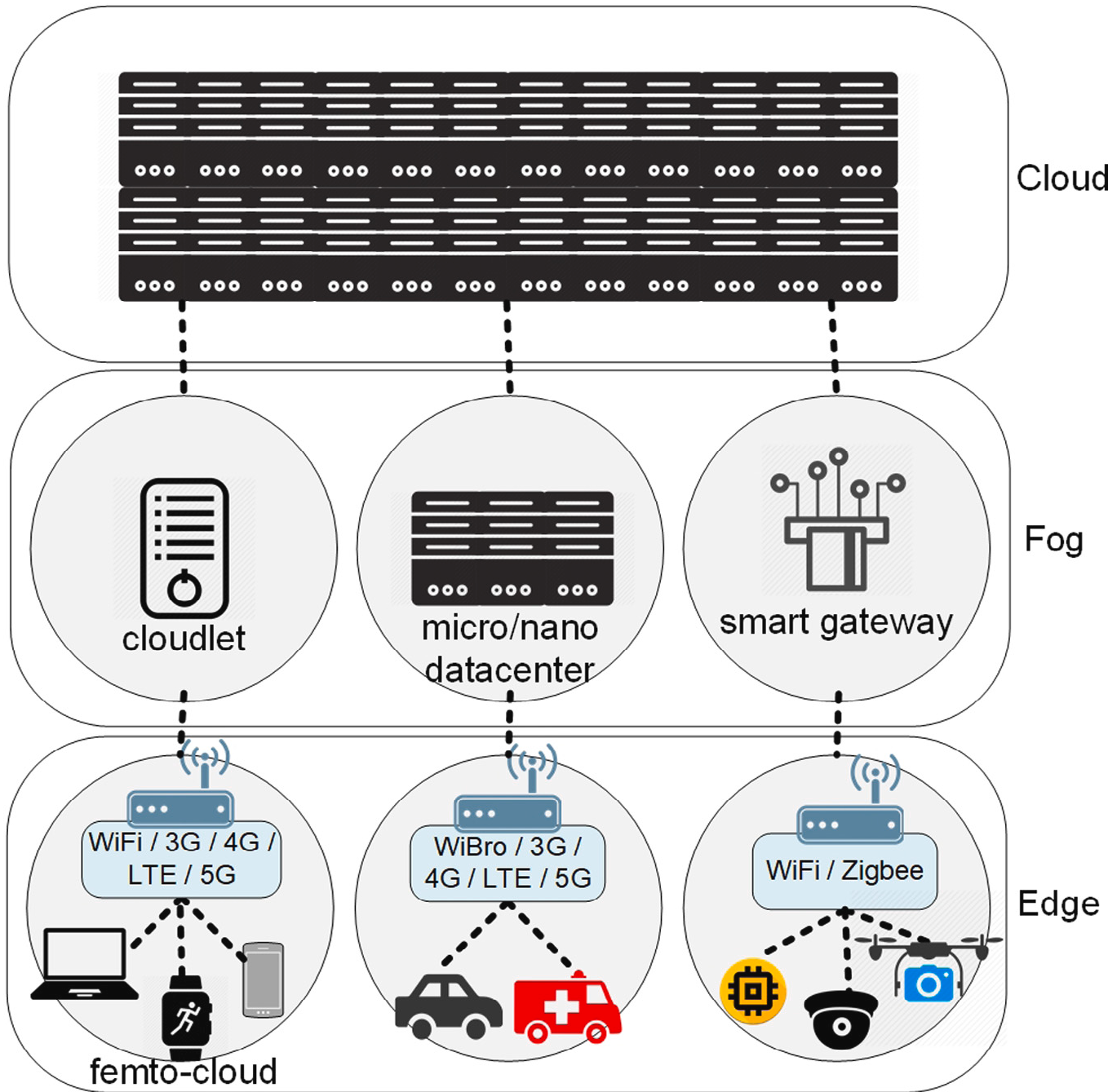 Fig 1: The integration of Edge, Fog, and Cloud layers for a seamless task execution flow.
The paper details an indoor safety scenario where a smartphone detects a fall through acoustic and motion sensors. To confirm the emergency without compromising privacy, a local Fog node analyzes video data from a drone or home camera rather than sending the stream to a remote server.
Experimental Results: Quantitative Gains
The authors tested three classifiers (kNN, NB, and SVC) using the PAMAP2 Human Activity Recognition (HAR) dataset. The goal was to measure energy consumption when the task is split between 1 to 4 local devices.
- SVC (Support Vector Classification): Observed the most drastic reduction in energy consumption. Because SVC is computationally "heavy," the overhead of communicating data between devices was far outweighed by the speed of parallel processing.
- kNN (k-Nearest Neighbors): Energy consumption was roughly halved when offloaded to a 4-node Femto-cloud.
- NB (Naive Bayes): Showed the least benefit because the algorithm is already highly efficient; for such light tasks, the cost of communication can negate the gains of distribution.
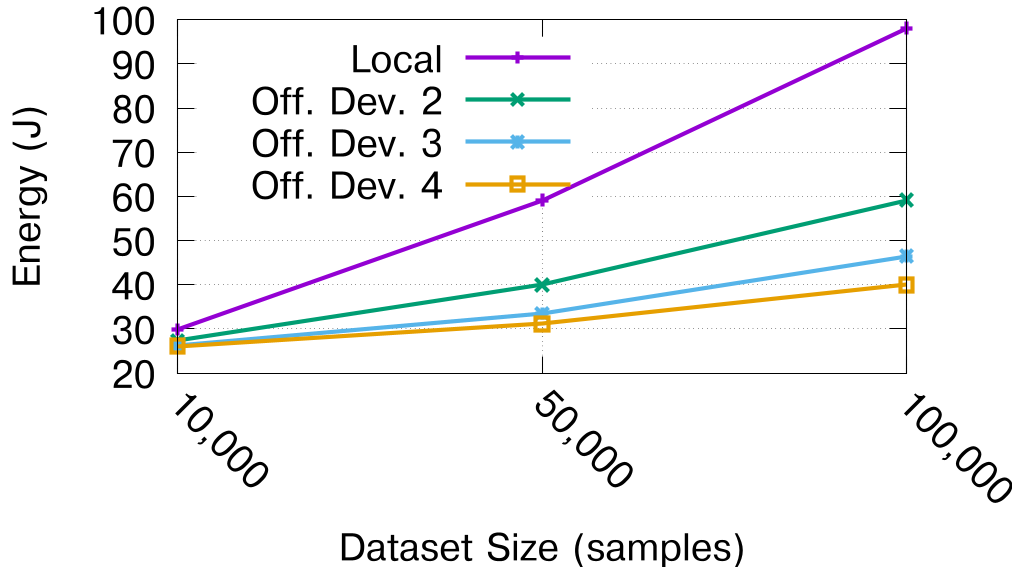 Fig 2: Scaling the number of devices significantly reduces the energy footprint of intensive tasks like SVC.
Critical Insight & Future Outlook
The true value of this work lies in its definition of oHealth (Opportunistic Healthcare). By envisioning a world where doctors can provide feedback via public transit Fog nodes and household devices collaboratively monitor for genetic disease symptoms, the paper moves AI from a centralized luxury to a ubiquitous utility.
Limitations
- Incentive Alignment: Why should a neighbor's device help process my health data? While the authors suggest "reciprocal computation," real-world implementation would require robust blockchain or micro-payment incentives.
- Network Overhead: As task complexity decreases, the "communication tax" of WiFi/Bluetooth can become a bottleneck.
Conclusion
This study serves as a blueprint for the next generation of Privacy-Preserving Healthcare AI. By moving the processing to the network's "edge," we can build systems that are not only smarter but also more resilient and energy-efficient.