
Intelligent Offloading: Optimizing the Edge-Fog-Cloud Interplay for Healthcare IoT
Task Offloading for Edge-Fog-Cloud Interplay in the Healthcare Internet of Things (IoT)
This paper proposes a holistic multi-layer reference architecture for Edge-Fog-Cloud interplay in Healthcare IoT (IoMT) and introduces a Reinforcement Learning (RL)-based task offloading technique. The framework optimizes performance for mission-critical applications, specifically achieving state-of-the-art results in ECG-based arrhythmia detection.
TL;DR
The revolution of Smart and Connected Health (SCH) is hindered by the latency of Cloud computing and the resource constraints of Edge devices. This paper introduces a hierarchical Edge-Fog-Cloud reference architecture combined with a Deep Reinforcement Learning (RL) offloading mechanism. By intelligently distributing tasks like CNN-based ECG analysis across layers, the system reduces response times by 36% and improves battery efficiency for wearable medical devices.
Background: Beyond the Cloud-only Bottleneck
As the Internet of Medical Things (IoMT) scales, the "Cloud-IoT" paradigm is hitting a wall. Vital signs like ECG signals generate high-velocity data that demands real-time processing to detect life-threatening arrhythmias. Sending this raw data to a distant cloud server consumes excessive energy and introduces dangerous delays. While Edge Computing (on-device) and Fog Computing (local network nodes) offer relief, the industry lacks a unified reference model to manage the complex interplay between these heterogeneous resources.
Methodology: A Hierarchical Orchestration
The authors propose a multi-tier architecture designed for vertical and horizontal communication. At its heart lies the Fog Orchestration Controller (FOC), which monitors resource metrics and manages service deployment.
The Deep Q-Learning Agent
To handle the dynamic nature of network traffic and device power levels, the paper employs Deep Q-Learning. The agent resides at the Edge (L0) and observes the system state (CPU, RAM, Bandwidth) before deciding where to execute a task:
- L0: The local Wearable/IoT device.
- L1: The local Fog node (Access Point).
- L2: An adjacent Fog node (Neighboring cluster).
- L3: The Cloud server.
The reward function is particularly elegant, balancing two often-conflicting goals:
- Response Time: Penalizing solutions that exceed the Service-Level Agreement (SLA).
- Energy Consumption: Optimizing for the battery life of the wearable sensor.
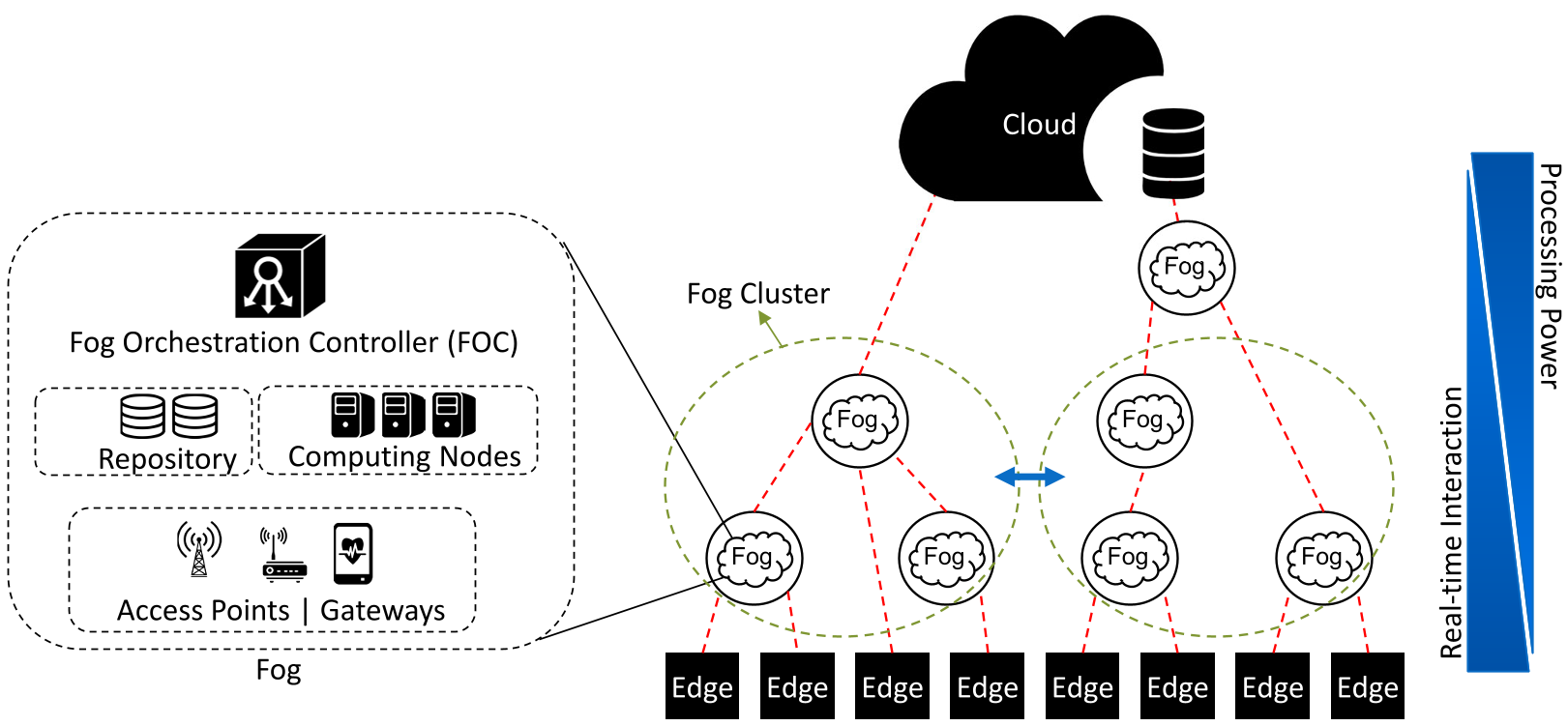 Fig 1: The proposed reference architecture illustrating the entry of data through Fog Gateways and the management by Orchestration Controllers.
Case Study: CNN-based Arrhythmia Detection
To validate the model, the authors used the MIT-BIH dataset to train a Convolutional Neural Network (CNN) for classifying heartbeats. While accurate (with F1-scores up to 0.99), CNNs are too computation-intensive for simple wearables.
Key Experimental Results
The study compared five scenarios ranging from "Local-only" to "Multi-layer Optimized" processing.
- Latency Win: Scenarios that utilized the full Edge-Fog-Cloud interplay outperformed local execution by 36%.
- The Power-Speed Trade-off: By adjusting the weights of the RL reward function ( for delay, for energy), the system achieved a 17.6% energy saving at the cost of only a minor 7.3% latency increase.
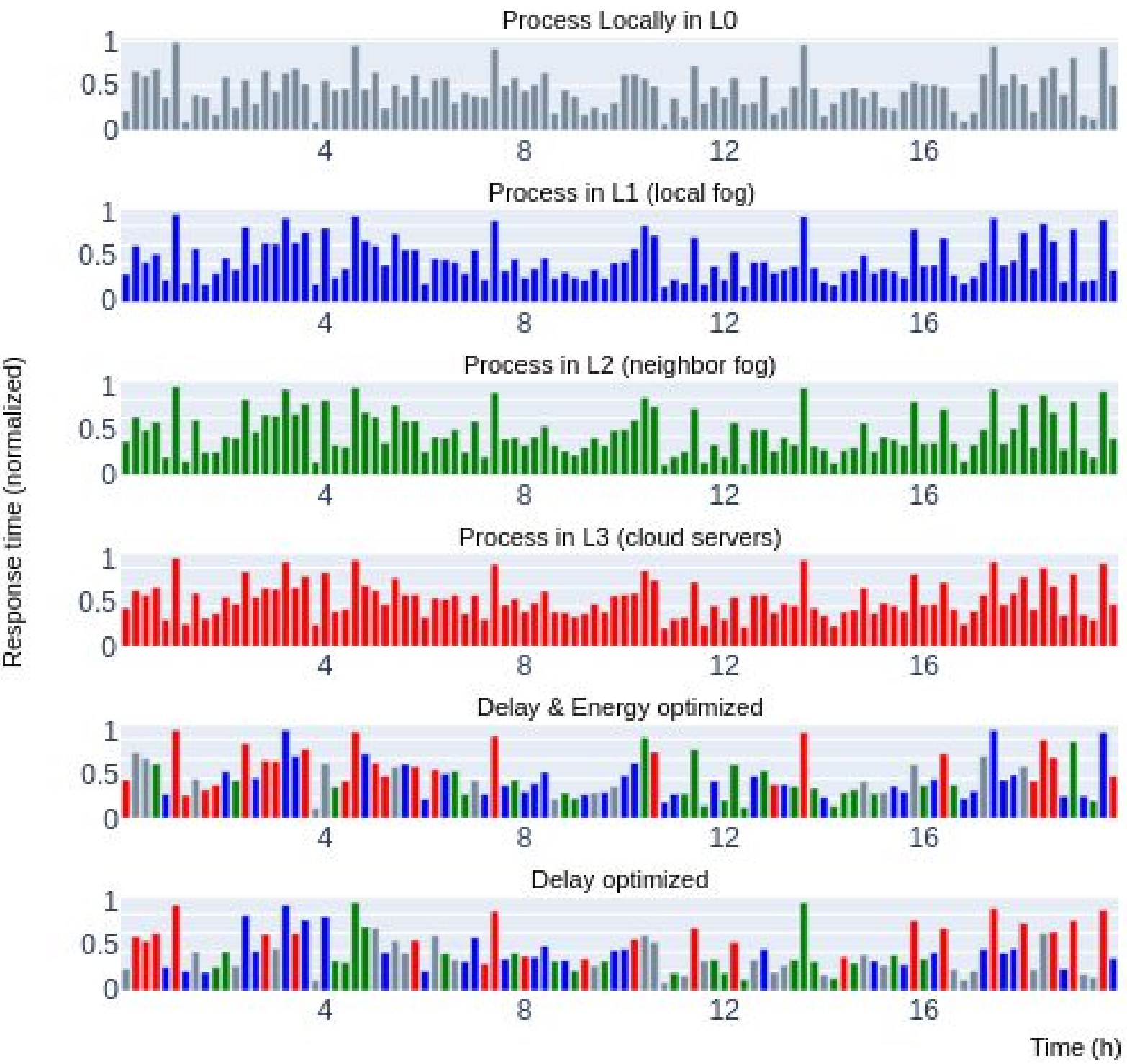 Fig 2: Response time comparison showing the significant performance gains of the distributed RL scenarios.
Critical Insight: Why This Matters
The hallmark of this work is its holistic approach. While many papers focus solely on the RL algorithm or the hardware architecture, this research bridges the two. It recognizes that "one size fits all" offloading is impossible in healthcare; a patient in a critical care unit might prioritize latency above all else, while a patient monitored at home for long-term trends might prioritize battery life. The RL agent's ability to tune these parameters dynamically is a significant step toward "Patient-Centric" healthcare.
Conclusion & Future Outlook
This paper successfully demonstrates that the interplay between Edge, Fog, and Cloud is not just an architectural choice but a necessity for the future of IoMT. However, moving forward, the industry must address the privacy and security of data as it hops between these layers—a challenge the authors acknowledge for future work.
Key Takeaways:
- Hierarchical architectures reduce network backhaul load.
- Reinforcement Learning effectively navigates the complexity of heterogeneous IoT environments.
- Collaborative Intelligence is the key to making AI-driven medical diagnostics viable on low-power wearable devices.