
Efficient Crowdsourcing: Solving the "New Task" Cold Start with the Hungarian Algorithm
New Task Oriented Recommendation method Based on Hungarian algorithm in Crowdsourcing Platform
This paper proposes a task-oriented recommendation method specifically for "new tasks" in crowdsourcing platforms. It introduces a multi-objective optimization model that balances quality, time, and cost efficiency, solving it through a transformed Hungarian algorithm.
TL;DR
Crowdsourcing platforms often struggle with "New Task" matching due to a lack of historical data. This paper introduces a multi-objective optimization model focusing on quality, time, and cost. By leveraging the Hungarian Algorithm on a synthesized efficiency matrix, the authors achieved a significant boost in recommendation precision and potential user earnings compared to traditional preference-based methods.
Problem & Motivation: The Paradox of Crowdsourcing
Crowdsourcing is a distributed problem-solving model that relies on the "wisdom of the crowd." However, it faces a persistent efficiency gap:
- Selection Mismatch: Users often choose tasks they aren't competent for, wasting time and resources.
- The Cold Start Problem: New tasks (released on the same day) lack interaction data, making it hard for platforms to know which expert should handle them.
- Single-Objective Failure: Prior work often focuses solely on user reputation or shortest path, ignoring the multi-faceted nature of project success (Cost vs. Speed vs. Quality).
The authors' insight is to treat recommendation not as a "ranking" problem, but as an Optimal Assignment Problem (Bipartite Matching).
Methodology: From Text Similarity to Optimal Matching
The core of the method lies in two major technical steps:
1. Estimating Efficiency for New Tasks
Since a "New Task" has no history, the authors use TF-IDF and Cosine Similarity to compare the new task's title and description with tasks a user has completed in the past.
- Entropy Weight Method: Used to weigh different evaluation indices (e.g., plan screening time, reward amount, description length).
- Efficiency Matrix (): For every user and task , an efficiency value is calculated across three target (Quality, Time, Cost).

2. The Transformed Hungarian Algorithm
The Hungarian algorithm typically solves 1-to-1 matching where the number of agents equals the number of tasks (). In crowdsourcing, users () vastly outnumber tasks (). The authors perform a Matrix Expansion:
- They create "copy tasks" for each task to allow multiple users to be recommended to the same task.
- They add "virtual users" with zero efficiency to balance the matrix into a square.
- The multi-objective values are fused into a single efficiency synthesis matrix using the Delphi method.
Experiments & Results: Real-World Validation
Using data from the commercial platform epwk.com, the study compared their method against simple user-preference filters.
- Accuracy Boost: The proposed method reached a precision of 0.58, significantly outperforming preference-only methods (0.34) and single-objective efficiency methods.
- Revenue Growth: Simulated results showed that users could earn substantially more income because they were matched with tasks they were actually capable of winning.
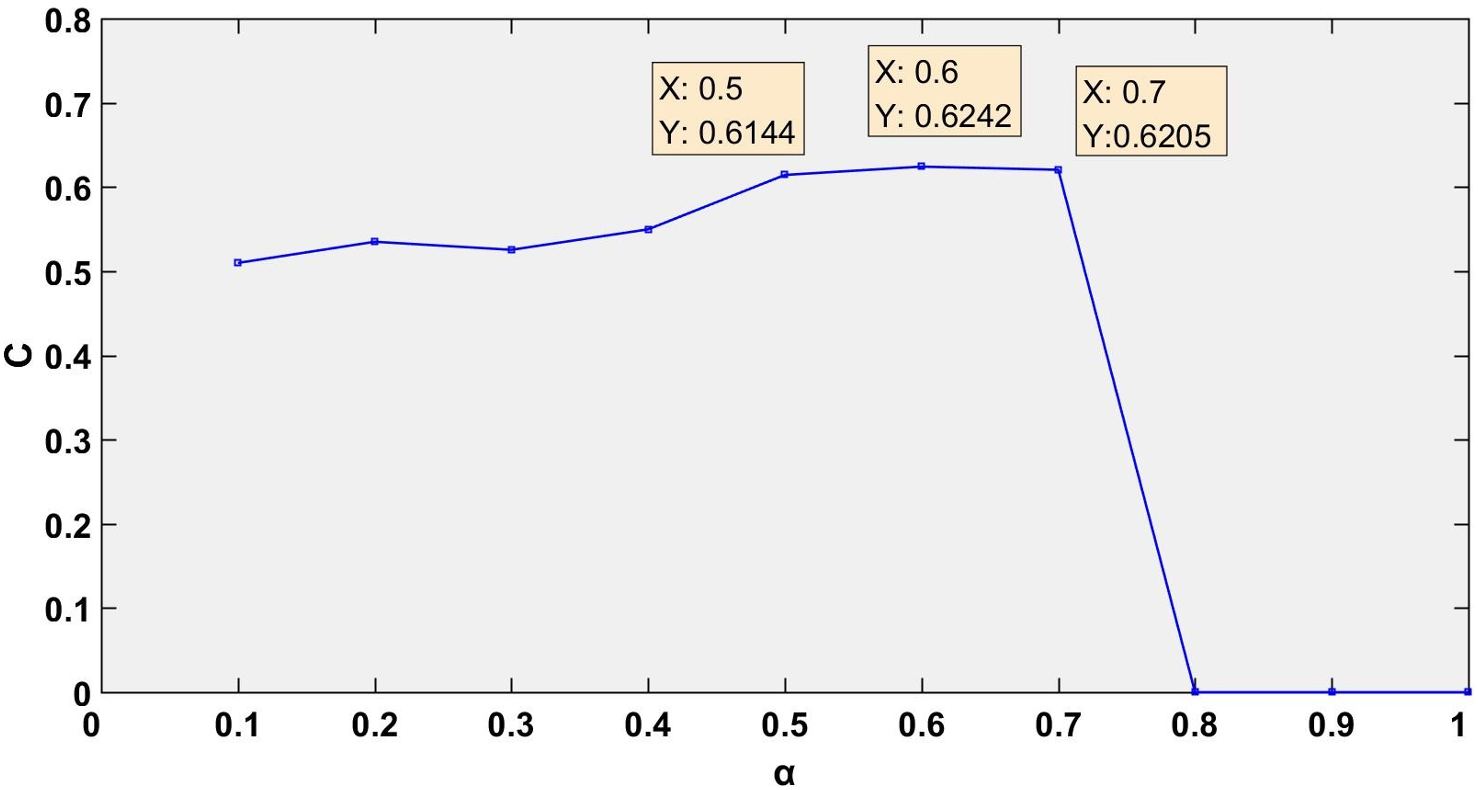 Figure: The parameter (similarity threshold) is critical. Setting it between 0.5 and 0.7 ensures that the estimated efficiency remains realistic without losing data.
Critical Analysis & Takeaways
Contributions
This paper successfully bridges the gap between Natural Language Processing (to understand task requirements) and Combinatorial Optimization (to solve the assignment). By shifting the focus from "what the user likes" to "what the user can efficiently complete," they address the core productivity bottleneck of crowdsourcing.
Limitations
- Static vs. Dynamic: The Hungarian algorithm is generally used for static snapshots. In real-world platforms, tasks and users arrive asynchronously in a stream.
- Compute Complexity: While the expansion matrix solves the assignment problem, a massive number of users might make the Hungarian algorithm () computationally expensive for real-time web-scale deployment without further optimization.
Conclusion
For platform architects, this research highlights that structured matching is superior to passive recommendation. By anticipating the "Efficiency" of a user-task pair before the task even begins, platforms can minimize the cycle of "failed submissions" and maximize the economic throughput of the global talent pool.