
Specialized Task Recommendation for ASD: A CBR-Driven Approach to Therapy
A Task Recommendation System for Children and Youth with Autism Spectrum Disorder
The paper introduces a specialized Task Recommendation System for children and youth with Autism Spectrum Disorder (ASD). It utilizes a Case-Based Reasoning (CBR) machine learning approach to suggest personalized therapeutic activities based on the PEDI-CAT-ASD framework, aiming to bridge the communication gap between parents, therapists, and children.
TL;DR
Managing therapy for children with Autism Spectrum Disorder (ASD) requires constant coordination between parents and clinicians. This paper presents a mobile recommendation system that uses Case-Based Reasoning (CBR) to suggest personalized tasks. By leveraging clinical data from the PEDI-CAT-ASD framework, the system provides a structured, gamified environment for children while offering analytics and coordination tools for caregivers.
Problem & Motivation: The Support Gap in ASD Therapy
ASD is characterized by communication challenges and the need for consistent external stimuli to maintain engagement. While early intervention is critical, the burden on parents to "bring the therapy home" is immense. Current market solutions are often fragmented: some are purely educational games (like MITA), while others are mere tracking logs. There is a lack of systems that:
- Synthesize clinical assessment data into daily actionable tasks.
- Synchronize three-way communication between the kid, the parent, and the therapist.
- Adapt dynamically to the child's progress (the "Prognosis Improvement" challenge).
The authors' insight was to use a "human-like" reasoning model—CBR—which solves new problems by retrieving solutions from similar past cases, mirroring how a therapist might recall what worked for a similar patient.
Methodology: Case-Based Reasoning (CBR) at the Core
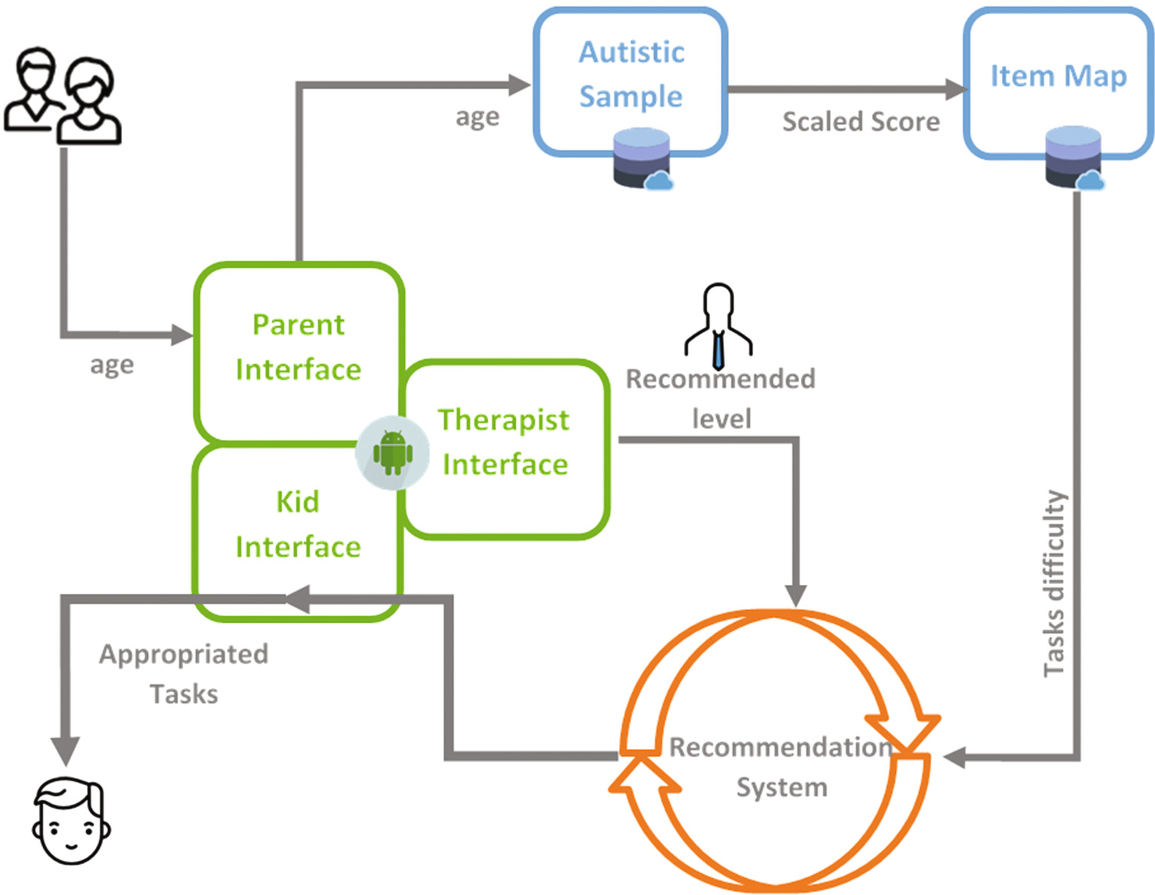
The architecture is a client-server model where the server hosts a CBR engine. The "intelligence" of the system relies on the PEDI-CAT-ASD repository, a clinical item bank of 276 activities across daily, social, and mobility domains.
1. Model Architecture
The system flow (shown below) starts with the parent inputting basic child data, which the system maps to a Scaled Score to determine initial task difficulty.
2. The CBR Cycle
To recommend a task (), the system defines a as:
- Retrieval: Uses a k-Nearest Neighbor (k-NN) algorithm.
- Similarity Measures: The system uses a weighted formula where and are given a weight of 1.0, while contextual factors (like ) get 0.5.
- Learning (Retain Phase): When a parent marks a task as "done" and rates the difficulty, the system updates the case's suitability degree, allowing it to "learn" which tasks are truly effective for specific profiles.
User Experience & Gamification
The application segments the experience into three roles. The Kid interface focus on rewards and task completion, using symbolic values to motivate the user.
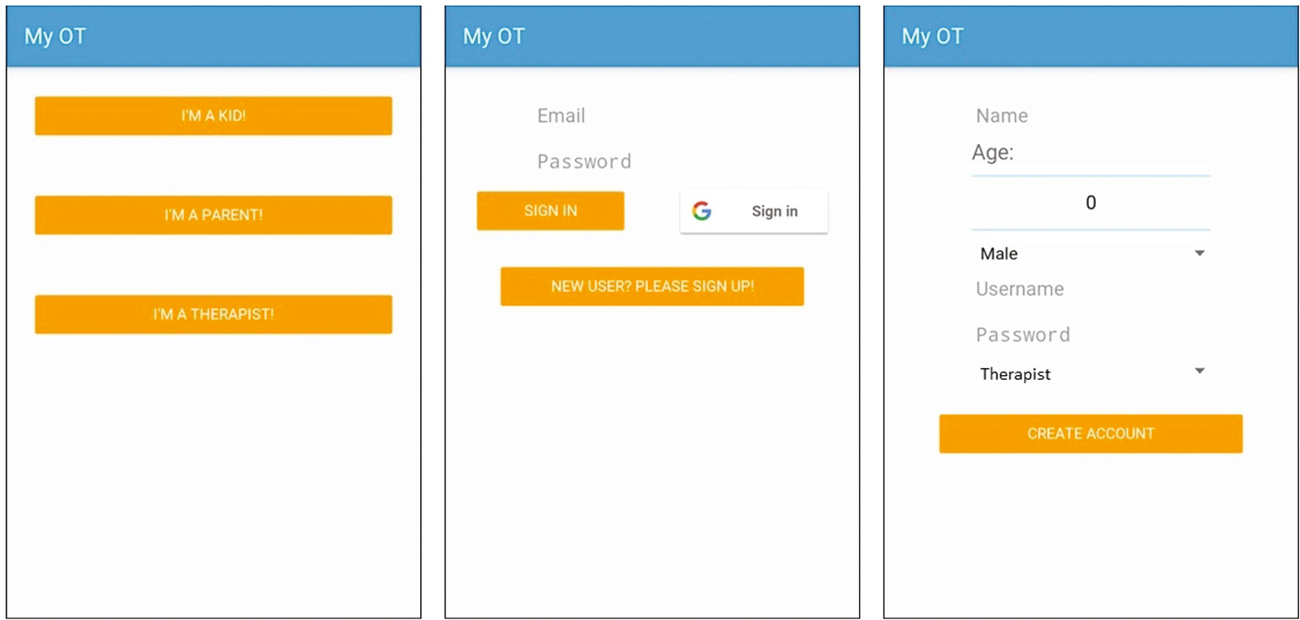
The Therapist/Parent interface (as seen in Fig 3b and 4) provides a "Diary" for session notes and "Analytics" to track progress across different developmental domains.
Experiments & Results
The designers validated the recommendation logic using a dataset of 105 parents of autistic children. By categorizing cases by age (5, 10, and 15 years), they created a benchmark for predicted scaled scores.
Key Findings:
- Expert Reception: Occupational therapists confirmed that the structured feedback loop (Trial -> Parent Approval -> Score Update) mimics clinical supervision effectively.
- Accuracy Tuning: By applying a threshold of 2 years for the attribute and an interval function for , the system maintains high precision in task matching.
| Local Similarity Logic | Method | Weight |
|---|---|---|
| Age | Threshold (val=2) | 1.0 |
| Difficulty | Interval Function | 1.0 |
| Context (Time/Gender) | Equal Function | 0.5 |
Critical Analysis & Conclusion
Takeaway
The strength of this work lies in its Clinical Grounding. Unlike generic productivity apps, this system is tethered to the PEDI-CAT-ASD framework, ensuring that the "recommendations" are medically relevant.
Limitations & Future Work
The current implementation relies heavily on a relatively small initial case base. As the authors admit, the system needs testing in a larger, representative sample within the Portuguese population. Furthermore, the "Kid" interface could benefit from better accessibility features (visual icons for every task) to accommodate non-verbal users.
Moving forward, integrating Deep Learning to predict the trajectory of a child's development—rather than just the next task—could transform this from a recommendation tool into a predictive clinical assistant.