
TaskMate: Turning Ambiguous Crowdsourcing Instructions into High-Quality Tasks
TaskMate: A Mechanism to Improve the Quality of Instructions in Crowdsourcing
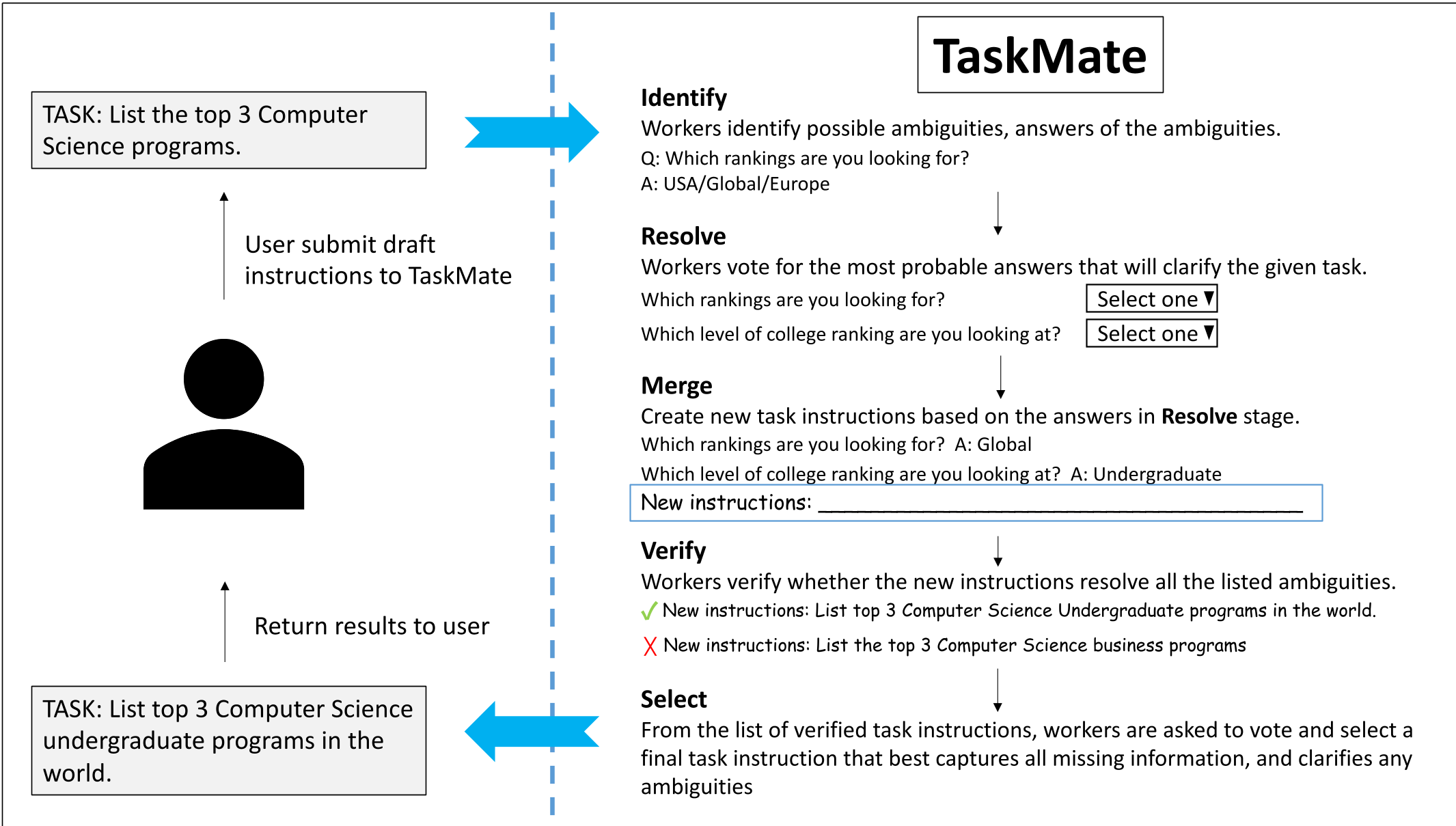
TaskMate is a collaborative crowdsourcing workflow designed to improve the quality of microtask instructions by delegating refinement to crowd workers. It utilizes a five-stage pipeline (Identify, Resolve, Merge, Verify, Select) to transform ambiguous requester drafts into high-quality, executable instructions without requiring constant requester intervention.
TL;DR
One of the biggest hurdles in crowdsourcing isn't the workers' ability, but the clarity of the instructions they receive. Requesters are often too busy to write perfect prompts, leading to a "garbage in, garbage out" cycle. TaskMate is a novel system that lets the crowd fix the instructions themselves through a 5-stage collaborative workflow, allowing requesters to save time while ensuring high-quality results.
The "Curse of Knowledge": Why Instructions Fail
Requesters often suffer from the "curse of knowledge"—they know what they want so well that they forget to define it for a stranger. This leads to three types of ambiguities:
- Input Ambiguity: Vague parameters (e.g., "Find a theater in Chicago"—which airport?).
- Process Ambiguity: Unclear steps (e.g., "Search for the price"—on which website?).
- Output Ambiguity: Undefined formats (e.g., "Give me the weight"—in grams or ounces?).
Current solutions like WingIt or Daemo require the requester to stay online to answer questions. TaskMate shifts this burden, asking: What if the crowd could figure out the requester's intent and rewrite the manual?
Methodology: The 5 Stages of TaskMate
The system breaks down the refinement process into a verifiable pipeline:
- Identify: Workers attempt the task and flag "stumbling blocks" as Q&A pairs (e.g., "Q: Which year? A: 2019").
- Resolve: Other workers vote on the most likely interpretation the requester intended.
- Merge: Creative workers rewrite the original vague instruction to include the new clarifications.
- Verify: A separate group ensure the new instruction hasn't lost the original meaning.
- Select: A final vote chooses the cleanest, most professional version.
Insights from the Design
The authors made a critical observation regarding human psychology in crowdsourcing: Instruction length matters. Previous research showed that simply tacking a Q&A section onto a task makes it too long, discouraging workers. TaskMate’s Merge stage is vital because it doesn't just add information; it synthesizes it into a concise, readable prompt.
Experimental Evidence
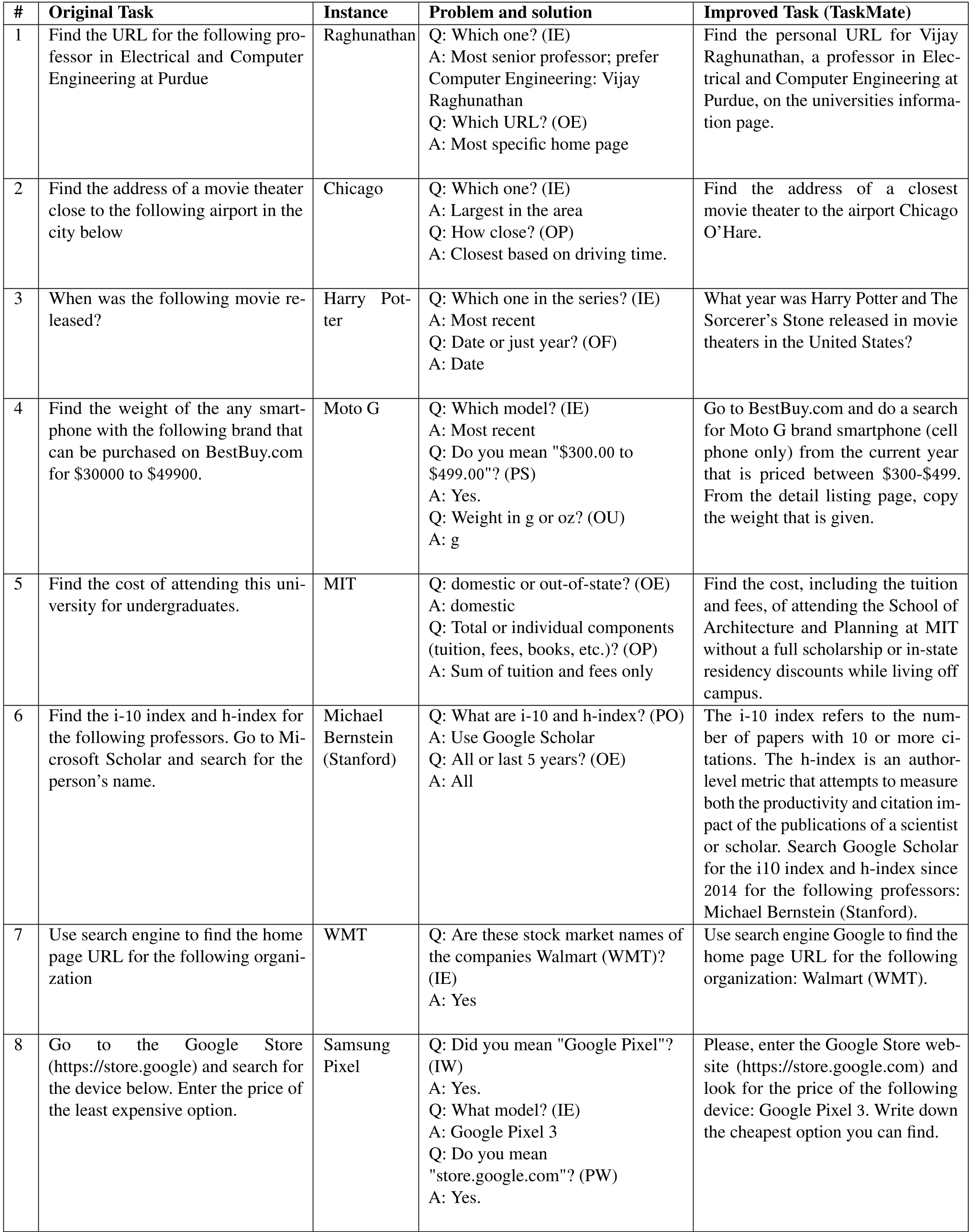
The study tested 30 distinct tasks. For example, a task that started as "Find the weight of any smartphone... for 49900" (a clear typo) was refined by the crowd into: "Search for Moto G brand smartphone... priced between 499... copy the weight in grams."
Critical Analysis & Conclusion
While TaskMate is powerful, the authors hit a common crowdsourcing wall: worker detection capability. Workers aren't always naturally good at spotting ambiguities—they often just "guess" and move on. The study suggests that future versions could benefit from:
- Training: Teaching workers specifically how to look for Input/Process/Output gaps.
- AI Integration: Using NLP to suggest potential ambiguities before a human even sees them.
Takeaway for Experts
TaskMate is a masterclass in Decomposition. By separating "thinking about the task" from "doing the task," it creates a self-healing system. In an era where "Prompt Engineering" is a sought-after skill for AI, TaskMate proves that the crowd was doing prompt engineering for humans long before it was cool.
Future Outlook: Could this workflow be used to refine prompts for LLMs (like GPT-4)? Absolutely. The logic of TaskMate is universal: clarity is a collaborative process.