
TaskRec: Solving the Crowdsourcing Needle-in-a-Haystack via Unified Matrix Factorization
TaskRec: Probabilistic Matrix Factorization in Task Recommendation in Crowdsourcing Systems
The paper introduces TaskRec, a task recommendation framework for crowdsourcing systems (like Amazon Mechanical Turk) using Unified Probabilistic Matrix Factorization (PMF). It maps implicit worker behaviors into numerical ratings and integrates worker-task, worker-category, and task-category relationships into a single latent feature space to address the cold-start problem.
TL;DR
In modern crowdsourcing platforms like Amazon Mechanical Turk (MTurk), workers are often overwhelmed by thousands of micro-tasks, while requesters struggle to find qualified labor. This paper proposes TaskRec, a system that transforms implicit worker actions into "ratings" and uses a Unified Probabilistic Matrix Factorization (PMF) to suggest the right tasks to the right people, even when data is sparse.
Context: Why Crowdsourcing is Not Netflix
Recommendation systems are ubiquitous in movies (Netflix) and e-commerce (Amazon). However, crowdsourcing presents two unique challenges:
- No Explicit Ratings: Workers don't rate tasks; they simply complete them, skip them, or get rejected.
- The Dynamic Cold-Start: New tasks and workers enter the system every minute. How do you recommend a task that has never been performed?
Previous attempts relied on simple classification. TaskRec instead moves toward Collaborative Filtering, leveraging the "wisdom of the crowd" through latent factors.
Methodology: Bridging the Gap with Categories
The core innovation of TaskRec is the Unified Latent Space. Instead of just looking at the Worker-Task matrix (which is extremely sparse), the authors integrate three perspectives:
- Worker-Task Preferring (): The primary matrix, derived from behavior.
- Worker-Category Preferring (): Does this worker like "Audio Transcription" in general?
- Task-Category Grouping (): What "genre" does this specific task belong to?
By sharing the Worker Feature Vectors (), Task Feature Vectors (), and Category Feature Vectors () across these matrices, information "leaks" from categories to individual tasks. This allows the system to recommend a new task if its category matches a worker’s historical preference.
Architecture & Mathematical Insight
The authors utilize a Bayesian approach to maximize the posterior distribution of these latent features.
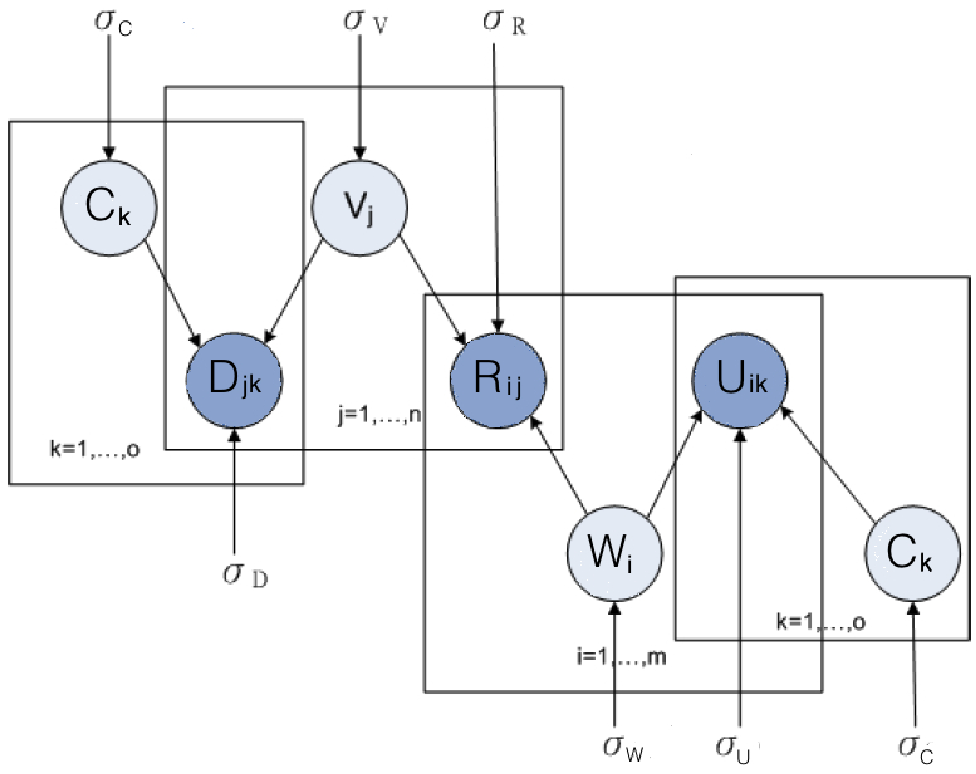
The optimization moves beyond standard PMF by adding two regularization terms that force the latent vectors , , and to remain consistent across all three matrices.
Behavior to Rating Transformation
To solve the "missing ratings" problem, the authors proposed a heuristic scale:
- 5: Task Accepted (Highest preference)
- 4: Task Rejected (High effort, low quality - controversial mapping)
- 3: Task Submitted
- 2: Task Selected but not finished
- 1: Task Browsed
- 0: No interaction
Experimental Analysis: A Reality Check
The authors tested TaskRec against standard PMF on the NAACL 2010 MTurk dataset.

The Catch: Interestingly, TaskRec showed a higher Mean Absolute Error (MAE) than basic PMF. The authors provide a refreshingly honest post-mortem:
- Categorization Noise: The MTurk
HITTypeIDused for categories was too broad/noisy for the specific dataset. - Data Bias: Most tasks in the dataset were "Approved," leading to heavily skewed ratings that favored a simple global average over complex factorization.
Depth Insight: Scalability vs. Accuracy
While the accuracy suffered due to dataset limitations, the Complexity Analysis is a win. With a complexity of , where is the number of observations, TaskRec is theoretically ready for massive production environments. It proves that a unified approach is computationally feasible for real-time recommendation.
Conclusion & Future Directions
TaskRec lays the groundwork for shifting crowdsourcing from "search-based" to "discovery-based" systems. While the initial results were hampered by poor metadata, the logic of using category-level latent factors is sound. Future research should look into Bias Correction (e.g., accounting for "easy" vs. "hard" requesters) and more granular task taxonomies to fully unlock the power of Unified Matrix Factorization.