
TasRec: Solving the "Choice Overload" in the Gig Economy with Hybrid Recommendations
TasRec: A Framework for Task Recommendation in Crowdsourcing
TasRec is a multi-dimensional recommendation framework designed for crowdsourcing platforms, utilizing hybrid filtering to match workers with tasks. It leverages Doc2Vec embeddings and Pointwise Mutual Information (PMI) to achieve high-precision recommendations, significantly outperforming skill-matching baselines on platforms like Topcoder.
TL;DR
The "Gig Economy" is booming, but workers are drowning in tasks. TasRec is a sophisticated recommendation framework that uses NLP (Doc2Vec) and association mapping (PMI) to match workers to tasks based on four dimensions: Profile, Past History, Peer Behavior, and Poster Compatibility. It boosts recommendation accuracy from a measly 24% to over 92%.
The Friction in Crowdsourcing
Crowdsourcing platforms like Topcoder and Amazon Mechanical Turk have become vital for software development. However, the "search friction" is immense. Research shows workers spend nearly half their time just filtering through tasks.
Current systems are "dumb"—they show the most recent tasks or look for exact skill matches. If a task requires "Hive" and your profile says "Hadoop," a basic system misses the connection. This leads to:
- Low Productivity: Time wasted on searching.
- Suboptimal Quality: Workers picking "first-page" tasks rather than tasks they are best at.
- Poster Burden: Requesters must screen unqualified candidates who "guessed" their fit.
Methodology: The Four Pillars of TasRec
TasRec moves beyond simple filters by building a multidimensional preference model for every worker:
1. Profile Preference (The Semantic Layer)
Instead of keyword matching, the authors trained a Doc2Vec model on 1.5 million tasks. This allows the system to understand that a "Mobile Developer" might be a great fit for a "UI Design" task even if the keywords don't align perfectly.
Skill Fitness is calculated using Pointwise Mutual Information (PMI). This identifies related skills. As shown in the data, "Hadoop" and "Hive" have a high correlation (0.67), allowing the system to recommend Hive tasks to Hadoop experts.
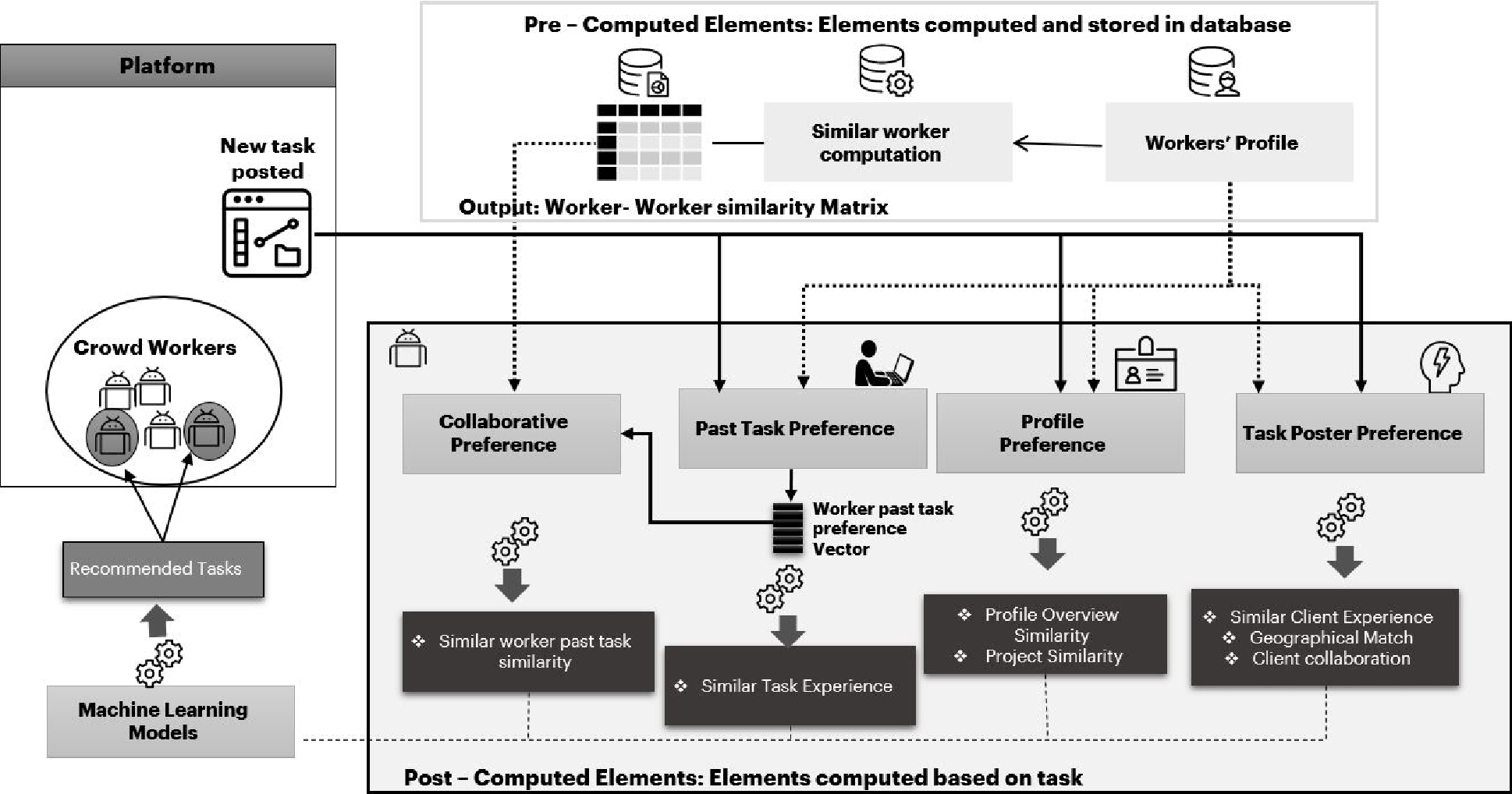
2. Past Task Preference
This tracks the "trajectory" of a worker. Using Algorithm 1, the system calculates the Euclidean distance between a worker’s past successful projects and new postings, adjusted for the ratings they received.
3. Collaborative Preference
Solving the Cold-Start Problem: If a new worker joins, the system looks at similar workers (Worker-Worker Similarity) and recommends what they found successful.
4. Task Poster Preference
Success in crowdsourcing isn't just about skills; it's about "fit." TasRec measures geographical compatibility and previous collaboration history with specific task requesters.
Experimental Results: A Total Overhaul
The framework was tested on data from a major hiring platform and Topcoder. Using Random Forest and Decision Tree classifiers, the system achieved a massive performance gain over the skill-matching baseline.
| ML Algorithm | Platform | F-measure |
|---|---|---|
| Baseline (Skill Match) | - | 0.243 |
| Random Forest | Hiring | 0.92 |
| Random Forest | Topcoder | 0.95 |

The authors found that Past Task Preference was the single most important factor (Information Gain: 0.246), confirming that historical behavior is the best predictor of future interest.
Implementation: Transparency and Control
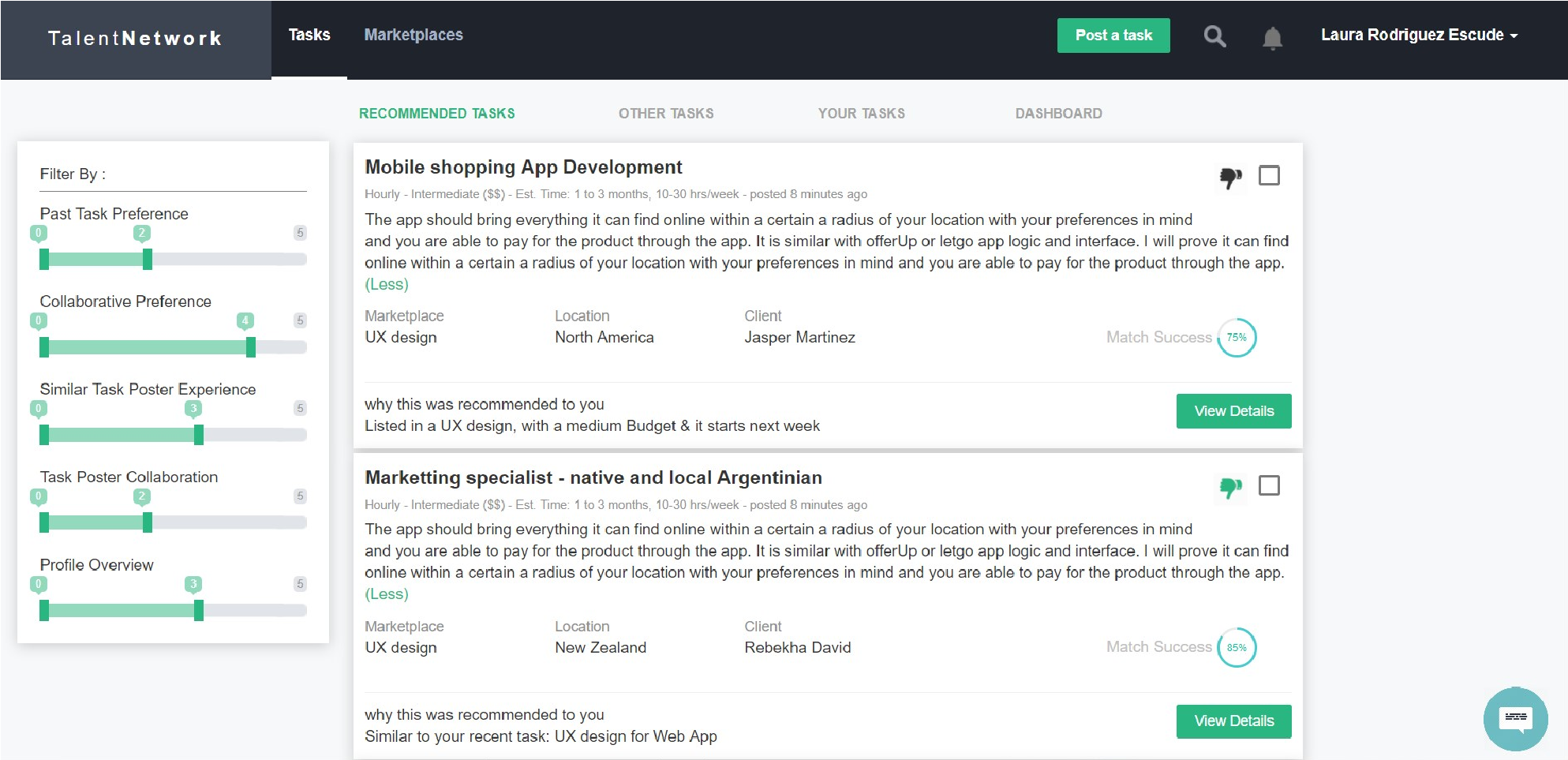
Unlike "black-box" recommenders, the implemented TalentNetwork tool gives workers control. Workers can manually adjust the "weight" of each dimension (e.g., "I want to prioritize tasks from posters I've worked with before").
Critical Insight & Conclusion
TasRec proves that the "Skills Gap" in crowdsourcing is often just an "Information Gap." By using NLP to bridge related technologies and collaborative filtering to guide newcomers, platforms can significantly increase worker retention and output quality.
Future Outlook: While TasRec is robust, it primarily focuses on historical data. Integrating "Future Career Aspirations"—recommending tasks that help a worker learn a new skill—would be the next frontier in personalized work.