
Tax Avoidance vs. Evasion: How Social Circles Dictate Financial Honesty
Tax Avoidance and Social Control
This paper introduces an agent-based model (ABM) that distinguishes between legal tax optimization and illegal tax evasion within a "small-world" social network. It demonstrates that social utility—the drive to conform to peers—significantly influences aggregate tax compliance more than individual risk-aversion alone.
TL;DR
Why do people pay taxes when the risk of getting caught for evasion is statistically low? This paper argues that the answer lies in our social networks. By building an Agent-Based Model (ABM) that accounts for both legal tax optimization (loopholes) and illegal tax evasion, the researchers demonstrate that our neighbors' behavior is a more powerful deterrent—or catalyst—for tax compliance than the threat of a government audit.
Background: Beyond the Fear of Audits
Classic economic theory suggests we are all "rational calculators" who evade taxes if the expected penalty is lower than the tax savings. However, empirical data shows people are more honest than these models predict. The missing link? Social Control. This study positions itself as a bridge between psychological motives (guilt/shame) and cold mathematical optimization by placing agents in a "small-world" network where their utility is tied to their peers.
The "Trilemma" of the Taxpayer
In this model, an agent faces three choices:
- Honest Behavior: Pay full taxes ().
- Legal Optimization: Use professional skills to exploit gaps (). This involves a "complexity" factor ()—the more complex the law, the more predictable (but limited) the savings.
- Illegal Evasion: Hide income (). This costs nothing upfront but carries the risk of a penalty () and an audit ().
Methodology: The Logic of Social Utility
The core innovation is the inclusion of the Social Utility (SU) function:
Agents feel "social pressure" to conform. If your neighbors are evading, you feel less "social disutility" for evading too. Conversely, if you are the only one breaking the law in a community of honest taxpayers, your total utility drops due to social stigma.
 Figure 1: Conceptual framework of agent interactions within the social network.
Simulation Results: The "Honesty" Paradox
Using the NetLogo simulation environment, the authors ran scenarios based on German tax parameters.
1. Evasion is "Sticky"
The baseline scenario revealed that taxpayers generally favor illegal evasion over legal optimization. Why? Because optimization requires an upfront cost (), while evasion is "free" unless you are caught.
2. The Impact of Audits
When the audit frequency is increased, there is a visible shift:
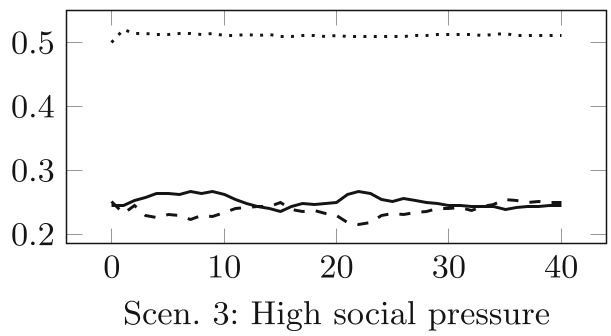 Scenario 2: High audit frequency suppresses evasion but often pushes people toward legal optimization rather than true honesty.
3. The Power of "Inherent Honesty"
One of the most surprising findings (Scenario 4) was that when the "inherently honest" fraction of the population was removed, the gap between evasion and optimization widened significantly. This suggests that a "moral core" in a segment of society acts as a behavioral anchor for everyone else.
Critical Insight: Complexity and Compliance
The paper offers a deep insight into Tax Complexity (). If a government simplifies the tax code to make it more abstract (lower ), it actually increases the potential for massive legal optimization, but it also increases uncertainty. Professional "optimizers" thrive in complex environments because they can produce small, predictable savings.
Conclusion
The study concludes that social interaction doesn't just "influence" tax behavior—it intensifies it. A small increase in tax rates can lead to a disproportionately large jump in evasion because of the "contagion effect" within social networks.
Takeaway for Policy Makers: Combatting tax evasion isn't just about hiring more auditors; it's about fostering social environments where honesty is the visible norm. If the "peer group" starts to favor evasion, the traditional levers of fiscal control (penalties and audits) become significantly less effective.
Limitations & Future Work
The model assumes agents have perfect visibility of their neighbors' legal strategies—an assumption that might not hold in the secretive world of tax evasion. Future research could explore "information asymmetry," where agents only realize their neighbors are evaders when they see them getting caught.