
Bridging the Gap Between Social Profiles and Careers: A Taxonomy-Based Approach
Taxonomy-based job recommender systems on Facebook and LinkedIn profiles
The paper introduces a taxonomy-based job recommender system that maps Facebook and LinkedIn user profiles to the ONET-SOC occupational taxonomy. By replacing traditional TF-IDF vectors with ONET vectors and utilizing SVM-based learning, the system achieves state-of-the-art results for social recruitment.
TL;DR
Recommending jobs to Facebook and LinkedIn users is notorious for being "hit or miss" due to the casual nature of social data. This paper presents a specialized recommender system developed by Work4 that maps messy social profiles to the structured O*NET-SOC taxonomy. By moving from a "bag-of-words" (TF-IDF) approach to a "bag-of-occupations" approach, the authors achieved an AUC of 0.85, significantly outperforming traditional Collaborative Filtering and TF-IDF baselines.
The Motivation: When Social Data Fails TF-IDF
Recruiting on Facebook is a double-edged sword: you have massive reach, but the data is "noisy." While a LinkedIn user might have a structured professional headline, a Facebook user might list their job in informal terms or leave parts of their bio blank.
Standard information retrieval models like TF-IDF treat these as just words. If a user writes "Coder" and a job asks for a "Software Engineer," TF-IDF might see low overlap. The authors realized they needed a semantic anchor—a way to translate both users and jobs into a shared language of professional occupations.
Methodology: The O*NET Vector Transformation
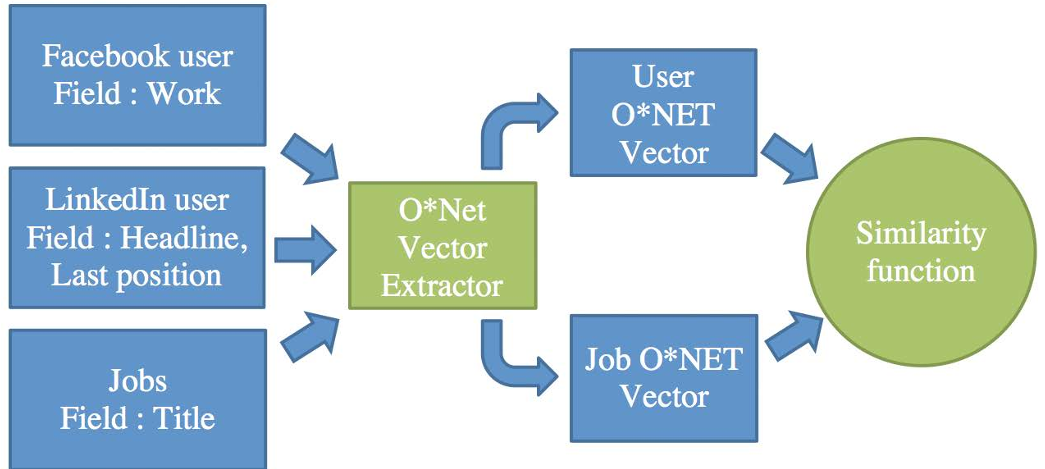
The core innovation is the extraction of O*NET vectors. Instead of representing a document by the frequency of words, the system queries the O*NET database (containing ~1,040 standardized occupations) to find the most relevant categories.
1. Vector Construction
For a user listed as a "Software Engineer," the O*NET vector includes a probability distribution across categories:
- Software Developers: 1.00
- Software Quality Assurance Testers: 0.85
- Web Developers: 0.52
- Avionics Technicians: 0.01
This effectively acts as dimensionality reduction, shrinking the feature space from over 218,000 unique terms to exactly 1,040 occupation-based dimensions.
2. Architecture and Similarity
The authors explored several "Engines":
- Engine-3a/b: Heuristic similarities like Cosine and Pearson Correlation.
- Engine-3c/d: Novel similarity functions based on Fuzzy Logic (Max-Min and Max-Product operators).
- Engine-4: A supervised SVM model trained to distinguish between "matches" and "non-matches."
Experiments and Results
The system was tested on six real-world datasets from Work4, covering candidate applications, user feedback, and manual reviews.
Boosting Performance Across Networks
One of the most striking findings was how the taxonomy model leveled the playing field between social platforms. Using TF-IDF, Facebook data performed significantly worse than LinkedIn data. With the O*NET vector, the gap narrowed, proving that the taxonomy helps "clean" the informal nature of Facebook profiles.
Comparison with SOTA
The SVM approach (Engine-4) was compared against Collaborative Topic Regression (CTR) and standard Matrix Factorization (CF).

Key Win: Engine-4 reached an AUC of 0.85, whereas CTR reached 0.79. The authors attribute this to Engine-4's ability to learn from both positive (relevant) and negative (non-relevant) signals, whereas CTR often relies on "one-class" data.
Critical Insights & Future Outlook
The success of this method highlights a vital principle in Industry AI: Domain Knowledge matters. While deep learning can often find patterns, anchoring recommendations in a human-verified taxonomy like O*NET provides a layer of interpretability and robustness that "bag-of-words" models lack.
Limitations:
- Language Barrier: The current O*NET implementation is English-centric.
- Static Taxonomy: Job titles evolve (e.g., "Prompt Engineer" didn't exist when O*NET was first mapped).
Future Work: The authors plan to extend this to multi-language support and integrate more metadata, such as location and seniority levels, into the vector model. For recruiters, this research proves that even the most "unprofessional" social profiles can be accurately mapped to the right career path if you have the right dictionary.