
Reclaiming the Social Graph: A Taxonomy of Decentralized Online Social Networks
A taxonomy of decentralized online social networks
This paper provides a comprehensive taxonomy and survey of Decentralized Online Social Networks (DOSNs), specifically focusing on peer-to-peer (P2P) alternatives to centralized platforms like Facebook. It evaluates eight landmark proposals—including PeerSon, SafeBook, and SuperNova—based on a rigorous framework of architecture, availability, and privacy.
TL;DR
As centralized social media giants consolidate control over user data, a paradigm shift toward Decentralized Online Social Networks (DOSNs) offers a path to digital autonomy. This classic survey dissects the architectural DNA of early DOSN pioneers—ranging from DHT-based structures to gossip-driven microblogging—providing a roadmap for building social platforms that prioritize privacy over profit.
The Motivation: Escaping the Data Silo
The dominance of platforms like Facebook and Twitter has created a "Data Silo" effect. In these centralized ecosystems, a single authority controls the infrastructure, owns the content, and dictates the terms of service. This results in three critical failure points:
- Privacy Erosion: User data is "mined" for the advertising industry.
- Lack of Interoperability: You cannot move your social graph from one platform to another without starting from scratch.
- Single Point of Control: Centralized entities can change privacy settings or delete accounts at will.
The DOSN movement proposes a "Peer-to-Peer" (P2P) model where users collaborate to form the infrastructure, ensuring that no single entity holds the keys to the kingdom.
Methodology: The Architectural Spectrum
The paper classifies DOSN designs into three primary categories based on how they handle control (lookups) and storage:
1. Structured Architectures (The DHT Route)
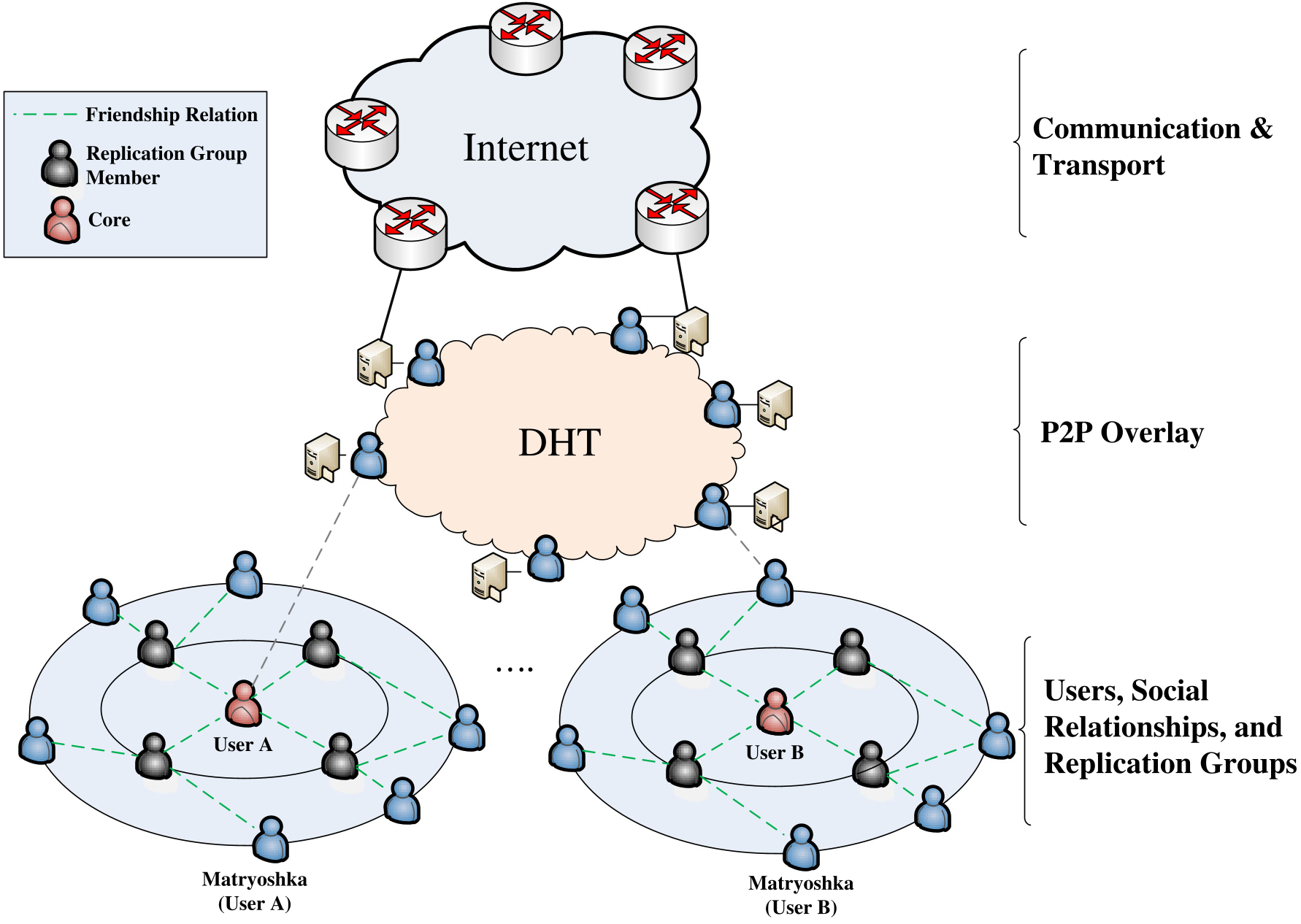
Systems like PeerSon and SafeBook utilize Distributed Hash Tables (DHTs).
- The Insight: By using a structured overlay, the system can locate users or content in a fixed, predictable number of steps (usually logarithmic).
- Safebook's Innovation: It introduces the Matryoshka structure—a concentric ring of trusted peers. Your data is stored and routed only through people you trust, mimicking real-life social circles.
2. Semi-structured (Super-Peers)
SuperNova introduces a hierarchy. "Super-peers" (users with high bandwidth/stability) act as backbones, managing index services and "Storekeepers" for less reliable nodes.
3. Unstructured (Gossip/Flooding)
FETHR and Cuckoo focus on microblogging (Twitter-style). They rely on "Gossip" protocols where updates are pushed from one subscriber to another. While highly resilient and simple, they can be bandwidth-heavy due to redundant data propagation.
Key Comparison: Can We Solve the Availability Challenge?
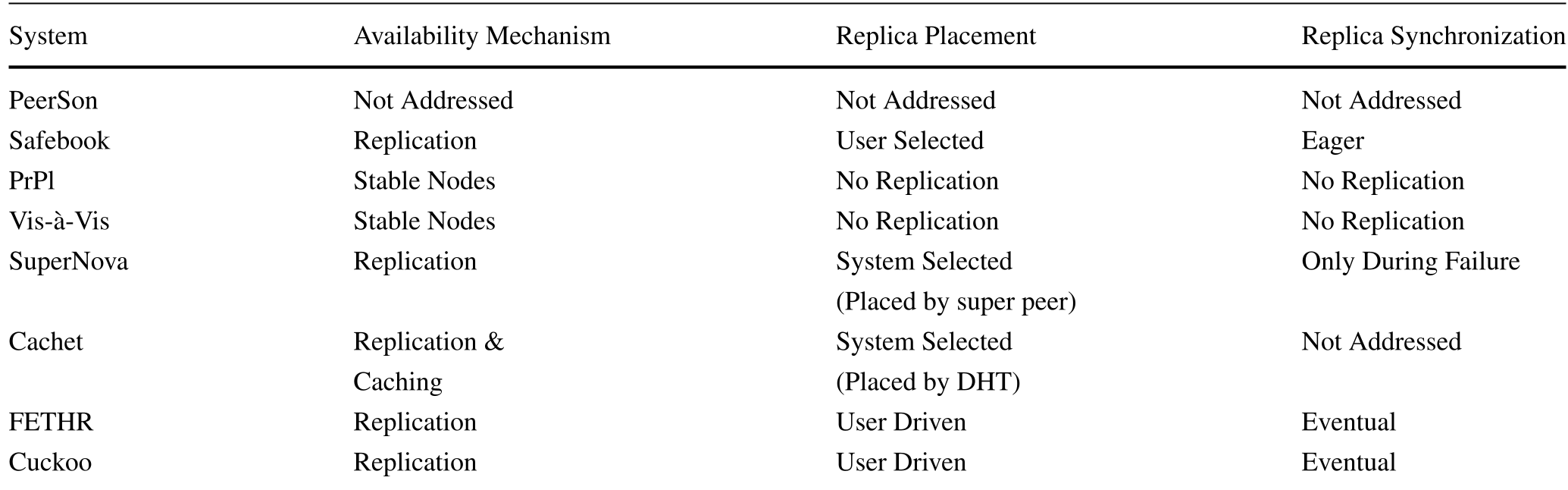
The "Achilles' heel" of P2P networks is churn—users going offline. Centralized clouds are 24/7; your laptop is not.
| System | Availability Mechanism | Trade-off |
|---|---|---|
| Safebook | Replication to Trusted Friends | High privacy, but limited by friend uptime. |
| PrPl / Vis-à-Vis | Stable/Virtual Nodes (Amazon EC2) | Guaranteed 24/7, but requires a hosting fee. |
| SuperNova | System-selected Storekeepers | Efficient, but involves managing complex incentives. |
Deep Insight: The Broadcaster Scalability Bottleneck
One of the most profound findings in the paper is the Scalability Metric. While DHTs handle millions of users effectively, Broadcasters (users with millions of followers) create a massive bandwidth bottleneck. In a P2P setting, the "uplink" of a single user's home connection is insufficient to push a status update to a million peers. This suggests that "Pure P2P" might need hybrid "Social CDNs" or caching layers to survive real-world traffic.
Security: Encryption is Not a Silver Bullet
The paper highlights a critical security tension. Most DOSNs use Public Key Infrastructure (PKI) to ensure confidentiality. However:
- Computational Cost: Constant encryption/decryption of newsfeeds slows down the mobile experience.
- Sybil Attacks: In a decentralized world, how do you stop one person from creating 10,000 fake accounts? SafeBook suggests face-to-face identity verification, while others rely on "Trust Graphs."
Critical Analysis & Conclusion
This taxonomy proves that there is no "one-size-fits-all" for decentralized social media. If you prioritize Privacy, SafeBook’s Matryoshka is the gold standard. If you prioritize Performance, the "Stable Node" model of Vis-à-Vis (Virtual Individual Servers) is the most practical.
The Takeaway: The success of the next generation of social media (like Mastodon or Nostr) depends on solving the Bandwidth vs. Autonomy trade-off. This paper laid the groundwork by identifying that the real challenge isn't just decentralization—it's maintaining social "quality of service" without a central master.
Limitations
As a 2014 paper, it lacks coverage of Blockchain-based incentives (like Steemit or Deso) and modern Zero-Knowledge Proofs, which could solve several of the privacy/authentication issues the authors raised.
Main Source: "A taxonomy of decentralized online social networks" - Springer 2014