
SIgMa: Bridging the Gap Between Data Mining and Classroom Pedagogy
Generating Teacher Adapted Suggestions for Improving Distance Educational Systems with SIgMa
This paper introduces SIgMa, an adaptable teacher-oriented feedback tool integrated with the Magadi distance educational system. It utilizes statistical analysis and association rule mining (Apriori algorithm) to identify anomalous student behavior patterns and provide tailored pedagogical suggestions via a dedicated Teacher Model.
TL;DR
Educational data is a goldmine, but most teachers aren't data scientists. This paper presents SIgMa (Suggestions for Improving educational aspects in Magadi), a system that transforms raw student logs into actionable pedagogical suggestions. By combining statistical analysis with a rule-based engine and a customizable Teacher Model, SIgMa identifies "anomalous" student behaviors—such as spending way too much time on a "simple" task—and tells the teacher exactly how to fix the course material.
The Motivation: Why Teachers are Drowning in Data
Modern e-learning environments (like Moodle or the Magadi system discussed here) capture every click and timestamp. However, this creates a "data overload" problem. Existing tools like EPRules or LOCO-Analyst often require teachers to do the heavy lifting of analysis themselves. The authors identified a clear need for a tool that:
- Automates the Analysis: Using Data Mining without requiring the teacher to code.
- Provides Context: Explaining why a set of numbers matters.
- Adapts to the Educator: Not every teacher defines "difficult" the same way.
Methodology: From Raw Logs to Smart Suggestions
SIgMa operates as an intelligence layer on top of the Magadi educational environment. Its architecture follows a sophisticated pipeline:
1. Data Categorization & Statistics
Instead of looking at raw seconds or binary scores, SIgMa categorizes data into semantic buckets:
- Time Spent: LOW, MEDIUM, HIGH.
- Evaluation: CORRECT, INCORRECT, NOT FINISHED.
- Difficulty: Defined by the teacher in the system's metadata.
2. Association Rule Mining
The system uses the Apriori algorithm (via the WEKA tool) to find hidden correlations. For instance, it might discover a rule like: If Evaluation=CORRECT then Spent_time=HIGH.
3. The Logic Engine (JESS)
This is where the "magic" happens. A rule-based system matches statistical anomalies against Anomalous Behavior Patterns.
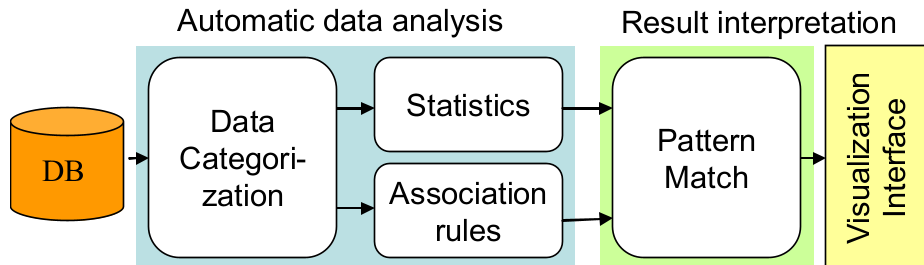
4. The Teacher Model: Putting the Human in the Loop
Unlike rigid black-box systems, SIgMa features a Teacher Model. Teachers can set their own thresholds. If one teacher thinks a 20% failure rate is a "red flag" while another is okay with 40%, the system adjusts its suggestions accordingly.
Real-World Validation
The authors tested SIgMa with a cohort of 17 real students taking a programming exam.
- Findings: The system flagged two questions that were "too easy" (where everyone got them right instantly) and identified confusing wording in relational exercises.
- Teacher Feedback: Educators appreciated the specific Suggestions (e.g., "Review the question statement; it seems difficult to understand").
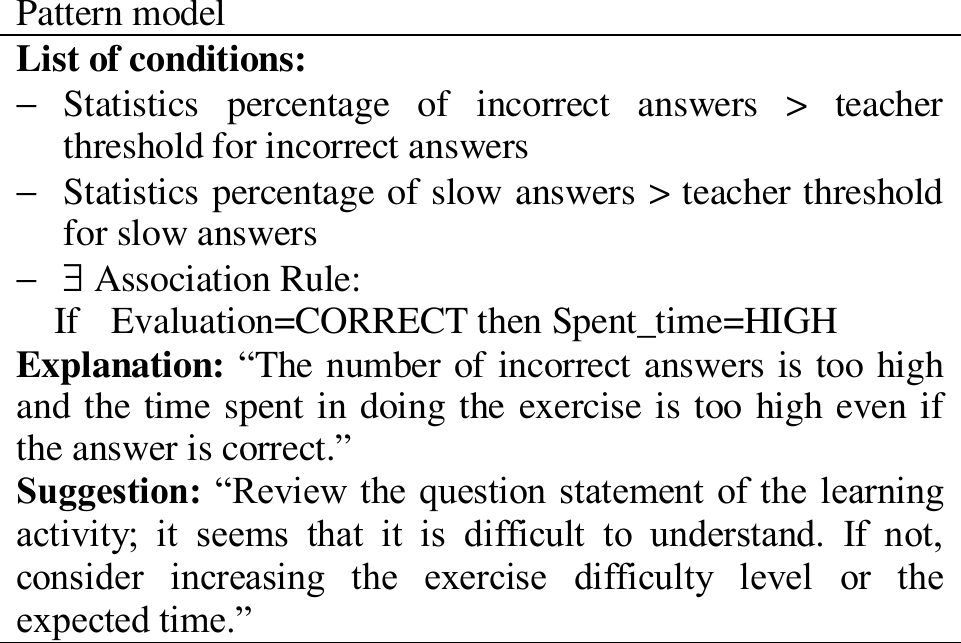 Above: An example of how the system detects a deceptive difficulty level.
Critical Insights & Future Outlook
The true value of SIgMa isn't just in the data mining—it's in the Expert System approach to pedagogy. By providing an "Explanation" and a "Suggestion," the system acts as a co-pilot for the teacher.
Limitations:
- The current patterns are "hard-coded" in JESS, though the authors plan to open this up to teachers.
- The reliance on the Apriori algorithm is effective but might struggle with very large, high-dimensional datasets compared to modern neural approaches.
Conclusion: SIgMa represents a vital shift toward User-Centered AI in Education. It acknowledges that for technology to be adopted in schools, it must speak the language of the teacher, not the language of the database.