
Teaching Adversarial Machine Learning: Arming the Next Generation of Security Professionals
Teaching Adversarial Machine Learning
This paper explores the integration of Adversarial Machine Learning (AML) into cybersecurity education, proposing a structured curriculum that bridges the gap between basic ML and advanced security practices. It evaluates prominent AML frameworks—Cleverhans, IBM’s Adversarial Robustness Toolbox (ART), and Foolbox—to provide hands-on pedagogical tools for hardening AI systems.
TL;DR
As Machine Learning (ML) becomes the backbone of safety-critical systems—from Tesla’s Autopilot to military surveillance—the risk of "Adversarial Machine Learning" (AML) has skyrocketed. This paper argues that the next generation of tech professionals must be trained to treat ML models not as "altruistic gods," but as attack surfaces. By utilizing libraries like IBM’s ART and Cleverhans, educators can teach students to benchmark, harden, and defend AI against malicious perturbations.
The Motivation: When "Gods" Go to War
The authors frame the current state of AI through a striking metaphor: the rise of "god-like" autonomous models. However, without security, these "gods" are brittle. A few strategically placed stickers can trick a Tesla into an unscheduled lane change, and a printed "adversarial patch" can render a state-of-the-art image classifier useless.
The core problem is an educational silos:
- Cybersecurity Pros often treat ML as a "black box" and miss its unique failure modes.
- ML Scientists focus on accuracy metrics (F1, Precision) but ignore the robustness of the decision boundary.
Methodology: Building the Two Bridges
To resolve this, the paper proposes a structured pedagogical path designed to move students from theoretical understanding to offensive/defensive competency.
The Two-Bridge Knowledge Model
- Bridge 1 (ML Literacy): Learning the process of model creation, supervised vs. unsupervised learning, and the limitations of statistical patterns.
- Bridge 2 (AML Mastery): Understanding that high accuracy does not imply high security. Students learn the distinction between White-box (full architecture knowledge) and Black-box (input/output knowledge) attacks.
Tools of the Trade
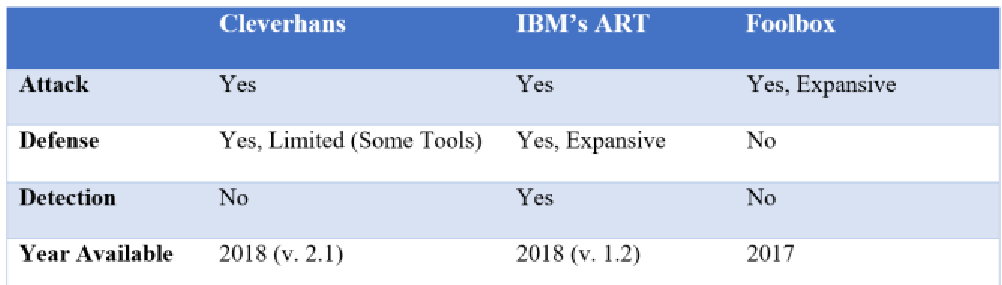
The paper evaluates three core libraries for classroom use:
- Cleverhans: A Google-aligned library focused on benchmarking and adversarial training.
- Foolbox: The "heavy hitter" for attacks, containing over 55 different ways to break a model.
- IBM’s Adversarial Robustness Toolbox (ART): The authors' top recommendation because it is the only one providing a "Total Defense" package—Attack, Defense, and Detection.
The Core Defense Strategy: The IBM Model
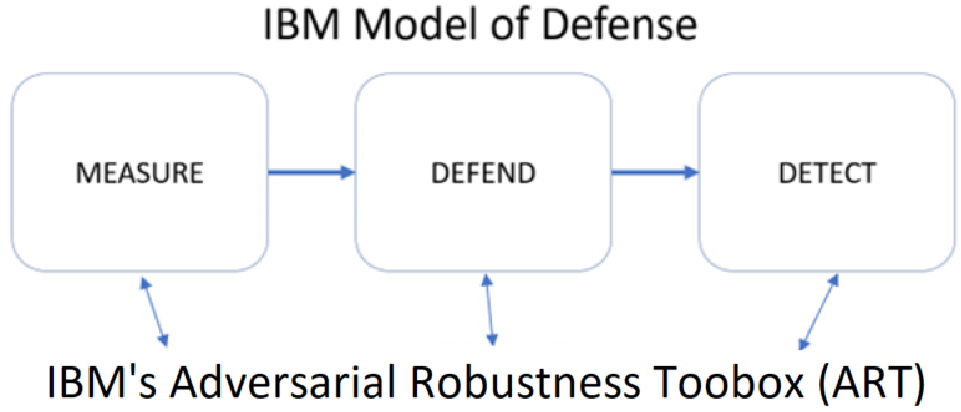
The authors advocate for a cyclical defense methodology that aligns with Miller’s Pyramid of Assessment ("Knows how" to "Shows how"):
- Measure Robustness: Use tools to find how much noise/perturbation is needed to cause a misclassification.
- Apply Hardening: Implement Adversarial Training (injecting malicious samples back into the training set) or Defensive Distillation (using a second model to smooth the decision surface).
- Detect Poisoning: Use out-of-distribution detection to identify if the current input is a "natural" image or a crafted adversarial example.
Critical Insights & Future Outlook
The paper makes a sobering point: Attacking is currently much easier than defending. Most existing defenses are "point-fixes"—they stop one specific attack but fail against others.
Key Takeaways for Professionals:
- Model Stacking is Not a Defense: Simply averaging the results of three models is ineffective because adversarial examples often "transfer" across different architectures.
- Verification is the Holy Grail: While "testing" checks specific points, "verification" (proving a model is safe across a whole range of inputs) remains computationally expensive and difficult to implement for deep neural networks.
Conclusion
Adversarial Machine Learning is no longer a niche academic interest; it is a fundamental requirement for the "Trustworthy AI" era. By integrating hands-on simulation tools like IBM’s ART into the classroom, we can ensure that future developers build systems that aren't just smart, but are also resilient to the "wars of the gods."