
Elevating Educational Repositories: The Power of Teaching-Style Based Social Networks
A Teaching-Style Based Social Network for Didactic Building and Sharing
The paper introduces a cluster-based Social Network (SN) for teachers, leveraging the Grasha Teaching Style (TS) paradigm to improve educational material retrieval. By employing a customized k-means clustering algorithm, the system groups educators with similar pedagogical profiles to facilitate peer-to-peer sharing and intelligent recommendations.
TL;DR
Most educational platforms treat teachers as mere consumers of content, ignoring their unique "pedagogical DNA." This paper introduces a specialized social network that clusters teachers using the Grasha Teaching Style (TS) paradigm. By applying a modified k-means algorithm to group similar instructional styles, the system transforms discovery from a keyword search into a community-driven recommendation engine, significantly improving the relevance of shared didactic materials.
Problem & Motivation: The "Siloed Teacher" Syndrome
In the current digital landscape, teachers are often islands of productivity. They create or hoard "Learning Objects" (LOs) in local repositories, failing to benefit from the collective wisdom of their peers. While platforms like Merlot provide repositories, they lack intelligent profiling.
The core technical challenge is: How do we quantify "teaching style" to foster meaningful collaboration? Prior works often focused on student modeling (learning styles), but this paper argues that to support teachers, we must model their unique pedagogical attitudes.
Methodology: Quantifying Pedagogy with Grasha Clusters
The authors define a Teacher Model (TM) consisting of two vectors:
- Teaching Experience (TE): The ontological record of courses taught.
- Teaching Style (TS): Based on Grasha’s five dimensions: Expert, Personal Model, Formal Authority, Delegator, and Facilitator.
The Modified k-means Algorithm
To build the Social Network (SN), the authors didn't just use standard k-means. They acknowledged that Grasha defines specific clusters where certain styles are "Primary" and others are "Secondary."
They introduced a Classification Matrix (a binary map of the four Grasha clusters) to guide the clustering. The centroid update rule is uniquely constrained:
- Primary Styles: Updated to the maximum value found in the cluster.
- Secondary Styles: Updated to the minimum value.
This creates an "Optimal Centroid" (a dummy teacher) that acts as the pedagogical north star for that cluster.

Experiments & Results: Does It Actually Help?
The authors tested their system with 20 educators across University and technical high school levels. They compared two modalities:
- Dummy Retrieval: Standard keyword-based search.
- Intelligent Retrieval: Material proposed based on the SN cluster membership.
The results, visualized in their user satisfaction histograms, show a clear "rightward shift" for the Intelligent Retrieval. Teachers using the TS-based network rated the retrieved materials significantly higher on the Likert scale.
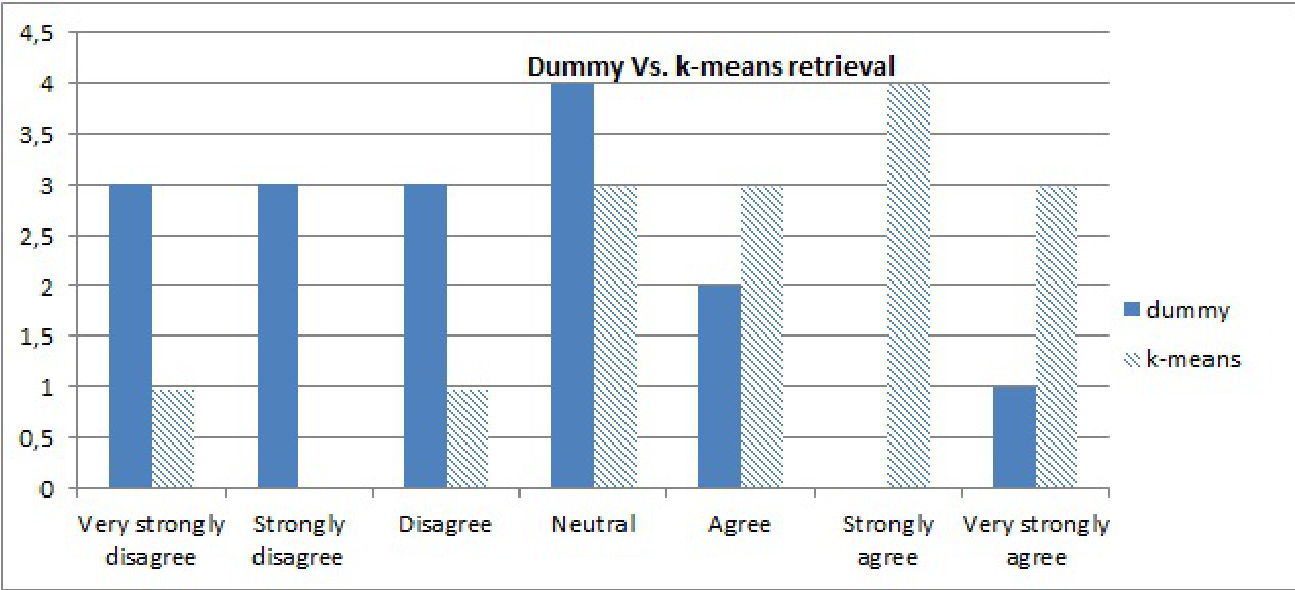
The dashed bars (Dummy) peak at lower satisfaction, while the solid bars (Intelligent) dominate the high-satisfaction scores.
Critical Analysis & Conclusion
The Takeaway
The synergy of a Social Network is not just about connectivity, but about relevance. By grouping teachers who think and teach similarly, the "Teaching-Style Based Social Network" creates a shortcut for professional development.
Limitations & Future Work
While the initial results are promising, the sample size (20 teachers) is small. Furthermore, the model relies on self-reported TS scores. Future iterations could benefit from:
- Automated Style Inference: Using NLP to determine a teacher's style from their uploaded materials.
- Web 2.0 Integration: Adding real-time chat, forums, and collaborative editing tools directly into the TS-clusters.
By treating teaching style as a dynamic vector rather than a static label, this research paves the way for a more empathetic and efficient digital staffroom.