
Beyond One-Expert-Per-Skill: Optimizing Team Formation for Complex, Generalized Tasks
Team Formation for Generalized Tasks in Expertise Social Networks
This paper introduces a framework for team formation in expertise social networks targeting "Generalized Tasks," where each required skill demands a specific number of experts rather than just one. The authors propose a Grouping-based approach and an ε-neighborhood density seed selection method, significantly outperforming existing Steiner-tree-based heuristics in both communication cost and computational efficiency.
TL;DR
Building a project team isn't just about finding one person who knows Python; it’s about finding three who can work together without a communication breakdown. This paper generalizes the Team Formation problem by requiring multiple experts per skill and introduces a Grouping-based approach that transforms massive social networks into lean "Group Graphs," slashing search time and communication overhead.
The "Basic Task" Fallacy
In the landscape of Expertise Social Networks, the seminal work by Lappas et al. defined team formation as finding a set of individuals that cover all skills with the minimum communication cost. However, this assumes a "Basic Task" structure—one skill, one person. In reality, complex projects (like the DBLP co-author networks analyzed here) require redundancy and specialized roles. If you need five experts in "Graph Databases" and two in "Visualization," a simple Steiner Tree approximation fails to account for the overlapping roles and the density of the network.
Methodology: From Chaos to Groups
The authors argue that the traditional greedy search on an "Enhanced Graph" (where skills are nodes connected to experts) is too slow and often results in redundant "inter-mediators"—people who don't have the skills but act as expensive bridges.
1. Density-Based Seed Selection
Instead of starting the Steiner Tree search at a random node, the authors utilize ε-neighborhood density. By calculating the clustering coefficient within a local radius of a skill node, the algorithm starts at the most "socially central" expert, naturally leading to a more compact team with lower communication costs.
2. The Group Graph & Role Composition
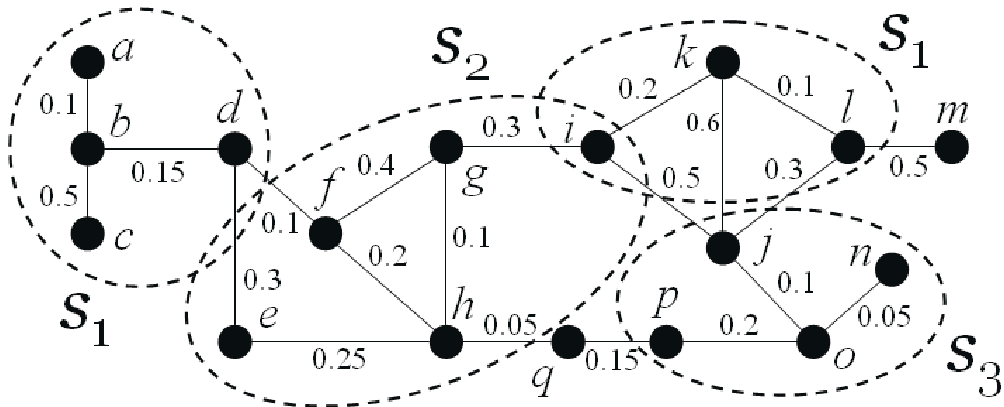
This is the paper's most significant contribution. Instead of searching individual nodes, the system:
- Groups experts by skill into connected subgraphs.
- Constructs a Group Graph where edges represent the minimum shortest path between entire functional groups.
- Performs Role Composition, identifying specific individuals as Connectors (overlapping skills), Inter-mediators (bridges), or Collaborators (intra-group support).
Experimental Battleground: DBLP Results
Using 5,482 authors and 11,905 skills from the DBLP database, the authors compared their Grouping+Density approach against the classic baseline.
Scalability and Cost
The results are clear: as the complexity of the task increases (more skills required), the Grouping-based method keeps the "inter-mediator" count low and the communication cost manageable.
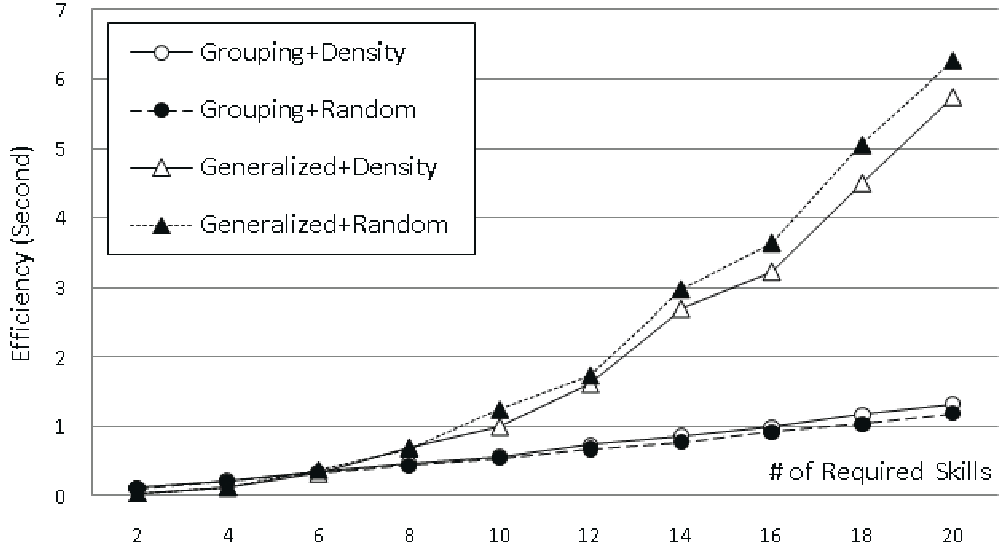 Figure: As tasks grow in complexity, the grouping method (linear growth) vastly outperforms the generalized Steiner approach (exponential growth).
The Power of Roles
By categorizing team members into functional roles, the algorithm ensures that the team isn't just a collection of specialists, but a functional unit. The Grouping method effectively finds "shortcuts" through individuals who are multi-talented (connectors), thus reducing the total team size (cardinality).
Critical Insight & Conclusion
The beauty of the Grouping-based approach is its ability to reduce the search space. By abstracting the Social Network into a Group Graph, we move from a "micro" view of every single interaction to a "macro" view of how functional departments collaborate.
Limitations: The model assumes that communication cost is static and purely based on past collaboration frequency (co-authorship). It does not yet account for "load balancing"—an expert in the real world cannot be part of 10 teams simultaneously.
Future Outlook: This work paves the way for automated HR systems and project management tools that can parse LinkedIn-style networks to suggest optimal, reasonably sized task forces for multi-disciplinary R&D projects.