
Beyond Experts: Orchestrating High-Impact Social Events via Influential Team Formation
Team formation with influence maximization for influential event organization on social networks
This paper introduces the Influential Team Formation (ITF) problem, a novel task that combines Team Formation and Influence Maximization to identify an optimal set of event hosts. The proposed methods, particularly the Similar Influence Search (SimIS) heuristic, aim to maximize the Influence-Cost Ratio (ICR) to ensure event success through broad reach and low internal communication overhead.
TL;DR
Organizing a successful conference or campaign requires more than just skilled people; it requires a team that is both well-connected and highly influential. This paper formalizes the Influential Team Formation (ITF) problem, introducing the Influence-Cost Ratio (ICR) to balance the inherent tension between social reach and team coordination costs.
The "Influence vs. Coordination" Paradox
In the landscape of social network analysis, two domains have long lived apart:
- Team Formation (TF): Aims to find a group that covers all skills while minimizing the distance between members (Communication Cost).
- Influence Maximization (IM): Aims to find "seeds" that spread information to the maximum number of people.
The conflict is structural. IM algorithms want seeds to be far apart to avoid "influence overlap," but TF algorithms want members to be close together to ensure they can actually talk to each other. If you pick a team using purely IM, they might be strangers who can't collaborate. If you use purely TF, they might be a "bubble" that can't reach anyone outside their immediate circle.
Methodology: The ICR and SimIS Heuristic
To bridge this gap, the authors propose the Influence-Cost Ratio (ICR): Where is the influence spread and is the total all-pair shortest path distance.
While the paper explores greedy approaches, the star of the show is the Similar Influence Search (SimIS). Its logic is elegant:
- Step 1: Find the single most influential node (using Group-PageRank).
- Step 2: Select the next node whose "influence distribution" over the entire network most closely matches the current team.
- The Intuition: In a social manifold, nodes with similar influence vectors are likely to be neighbors. By matching influence distributions, you find nodes that are physically close ( stays low) but are strategically positioned to reinforce a powerful "influence front."
 Figure 1: The visual distinction between selecting for pure connectivity (TF), pure reach (IM), and the balanced hybrid (ITF).
Experimental Validation
The authors tested their algorithms on Facebook and Google+ datasets, alongside real-world data from Meetup.
1. The Simulation Battle
The SimIS and M-Greedy (an interweaving approach) models consistently yielded higher ICR scores compared to the baselines. Interestingly, while the greedy approach is more intuitive, it is computationally expensive (); SimIS provides a near-identical performance boost with a fraction of the latency.
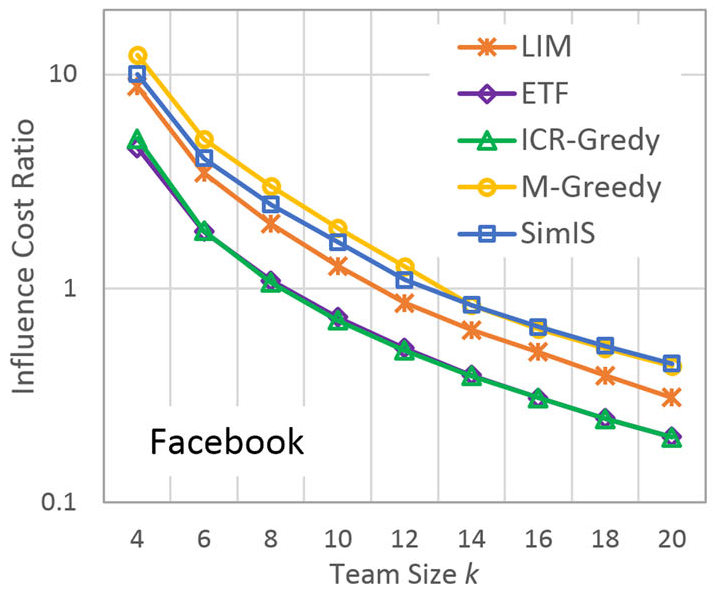 Figure 2: Performance of ICR across varying team sizes. SimIS (in red) maintains a high ratio compared to traditional IM and TF methods.
2. Real-World Prediction (Meetup)
By analyzing events in Chicago and San Francisco, the study found that the ITF framework could accurately identify the "early organizers" of successful events.
- Organizer Hit Rate: Reached 80% for certain configurations.
- Neighboring Precision: The models were particularly good at predicting which immediate neighbors of a host would be converted into event participants.
Critical Insight: Why This Matters
The real contribution here isn't just a new algorithm; it's the recognition that Influence is a Team Sport.
In the era of decentralized marketing and community-led growth, we are often tasked with picking "influencers." Most brands just pick the top individuals by follower count (a naive IM approach). This paper suggests that a highly connected clique of mid-tier influencers might actually perform better—not because they have more reach individually, but because their low communication cost and similar influence profiles allow them to saturate a community more effectively.
Limitations & Future Work
The paper assumes we know everyone's "skills" (labels) perfectly. In the real world, user profiles are messy and incomplete. Furthermore, the model assumes everyone invited wants to be an organizer. Future iterations will need to incorporate stochastic availability—what happens when your most influential node says "No"?
Despite these hurdles, ITF provides a robust mathematical foundation for the next generation of social service tools, moving us from "finding people" to "engineering impact."