
Hierarchical Team Formation: Scaling Expert Collaboration via Communication Load Constraints
Team Formation with the Communication Load Constraint in Social Networks
This paper introduces the "Team Formation Problem with Communication Load Constraint," aiming to assemble a set of experts from a social network that covers all required project skills while minimizing communication costs. It proposes a hierarchical team structure where each leader manages a limited number of subordinates, modeled as a Degree-Constrained Minimum Spanning Tree (DCMST).
TL;DR
Building a team of experts isn't just about collecting skills; it's about how they talk to each other. This paper moves beyond simple "flat" team structures to hierarchical organizations. By introducing a communication load constraint, the authors ensure no leader is overwhelmed. They provide an optimal pruning algorithm and a high-performance approximation for large-scale social networks.
Background & Motivation: The Management Bottleneck
In classical Team Formation Problems (TFP), the goal is to find a subgraph of experts that covers a project's required skills with minimum edge weights (communication cost).
Earlier studies (Lappas et al., Kargar & An) assumed a "star" topology where one leader talks to everyone. This is fundamentally unscalable. In reality, managers have a limited span of control. When a project requires dozens of skills, a single leader becomes a bottleneck. To solve this, the authors propose a hierarchical tree structure where each node (leader/expert) communicates with at most others.
Methodology: The Two-Phase Framework
The researchers break the problem into two distinct stages:
Phase 1: Team Generation
Identify all subsets of experts that satisfy the project's skill requirements.
Phase 2: Hierarchy Establishment
For every candidate team, find the optimal way to arrange them in a tree such that every node's degree and the sum of edge weights is minimized. This is specifically the Degree-Constrained Minimum Spanning Tree (DCMST) problem.
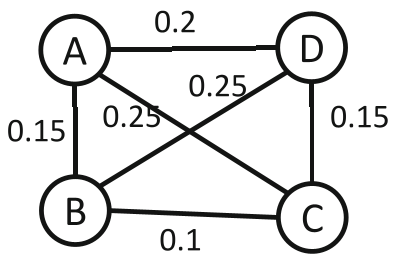 Fig 1: A communication graph for a candidate team . The goal is to find the best tree structure under the load constraint.
The "Opt" Strategy: Pruning via Lower Bounds
Finding a DCMST is NP-complete. To avoid calculating this for every single candidate team, the authors derived a Lower Bound (LB) strategy. If the absolute best-case communication cost for Team A is still worse than the current best-known team, Team A is discarded immediately without building its hierarchy.
Algorithms: From Optimal to Scalable
- Algorithm Opt: Uses the Lower Bound to prune the search space. It guarantees an optimal solution.
- Algorithm Approx: For networks with hundreds of experts, even pruning isn't enough. This algorithm replaces the exact hierarchy search with a 2-opt change approximation, which iteratively swaps edges to reach a near-optimal tree.
Experimental Validation
Using real-world data from the DBLP (Computer Science bibliography), the authors evaluated how their methods handle increasing project complexity and network size.
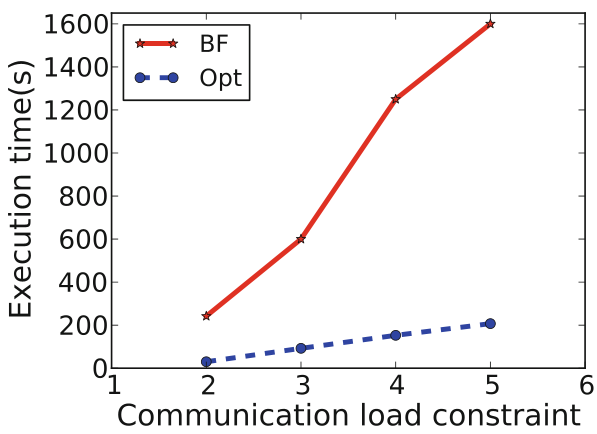 Fig 2: Impact of load constraints and network size on execution time.
Key Findings:
- Efficiency: Algorithm Opt is significantly faster than Brute-Force, especially as the load constraint becomes more complex.
- Scalability: Algorithm Approx is the only solution capable of processing networks with 300+ nodes in under a minute.
- Accuracy: The approximation algorithm only loses about 6-10% in cost accuracy compared to the optimal solution, a very acceptable trade-off for the massive gain in speed.
Critical Analysis & Conclusion
Takeaway
The paper successfully bridges the gap between theoretical social network analysis and practical management science. By modeling team structure as a degree-constrained tree, it addresses the "human factor" of communication limits.
Limitations
- Dynamic Networks: The model assumes a static social network. In reality, costs change as people work together.
- Skill Depth: It treats skills as binary (has/has-not) rather than a proficiency scale.
Future Outlook
This work lays the foundation for automated organizational chart generation. Future research could integrate load balancing across multiple simultaneous projects, ensuring that "star" experts aren't over-utilized across the entire company.