
TeamExp: Engineering the Perfect Team via Social Network Intelligence
TeamExp: Top-k Team Formation in Social Networks
TeamExp is an efficient system for top-k team formation in social networks that identifies experts covering required project skills while minimizing communication costs. It leverages two novel cost functions—Sum of Distances and Leader Distance—and implements polynomial-delay procedures to find the k-best teams, significantly outperforming traditional diameter-based metrics on the DBLP dataset.
TL;DR
Finding the right people is only half the battle; the real challenge is finding the right people who can actually talk to each other. TeamExp is a specialized system designed to solve the Top-k Team Formation Problem. It moves beyond simple skill-matching by optimizing for the lowest "communication cost" in a social network, using novel distance-summation metrics and efficient approximation algorithms to provide real-time recommendations.
The "Disconnected Team" Problem
Most team discovery systems look for individuals. However, projects are collaborative. If your "Dream Team" consists of experts who have never worked together or are separated by massive social distances, the project will likely fail due to communication overhead.
Prior research used Graph Diameter (longest shortest path) or Minimum Spanning Trees (MST) to measure cost. The authors of TeamExp argue these are flawed:
- Diameter is too sensitive to outliers; it only looks at the two most distant people.
- MST doesn't account for the fact that in many projects, every expert needs to talk to every other expert, not just a subset.
Two Visions of Collaboration: Methodology
TeamExp introduces two distinct communication structures to better reflect real-world professional dynamics:
1. Sum of Distances (The Collaborative Mesh)
This assumes every skill-holder for task needs to communicate with the holder of task . The cost is the sum of shortest paths between all pairs in the team. Insight: While this is NP-hard, the authors use a 2-approximation algorithm to find near-optimal teams in polynomial time.
2. Leader Distance (The Star Topology)
In many projects, a leader acts as the central hub. Here, the cost is the sum of distances from the leader to each member. Architectural Optimization: By restricting the leader search space to only those who possess at least one required skill, the system achieves a speedup of several orders of magnitude.
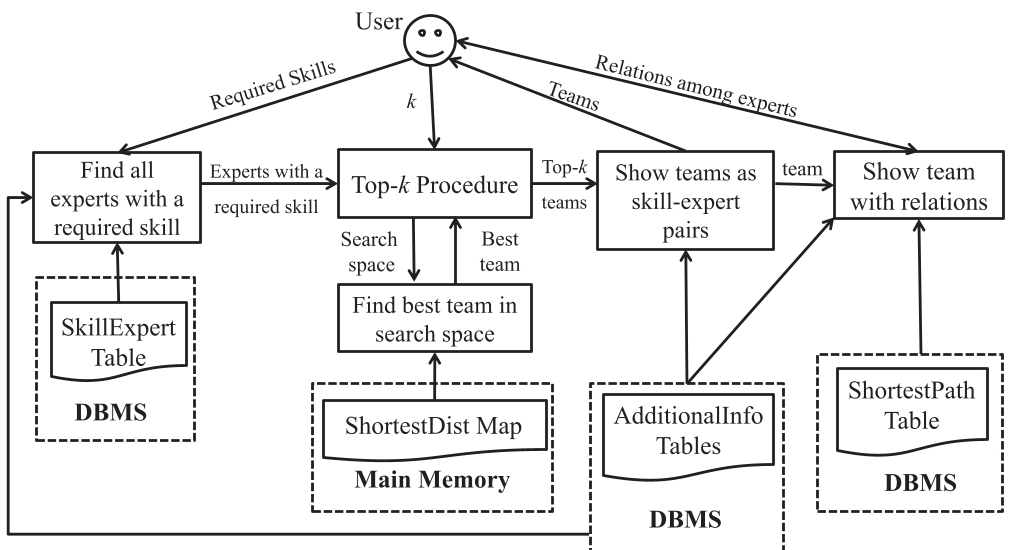
System Architecture & The DBLP Demo
The system is built on a robust backend comprising:
- SkillExpert Table: For rapid skill-to-node lookups.
- ShortestDist Map: A pre-computed memory cache of distances to avoid expensive on-the-fly Dijkstra calculations.
- Top-k Procedure: An algorithm that partitions the search space to find the best teams without re-scanning the entire network.
The authors demonstrated the system using the DBLP dataset, a social network of computer science researchers.
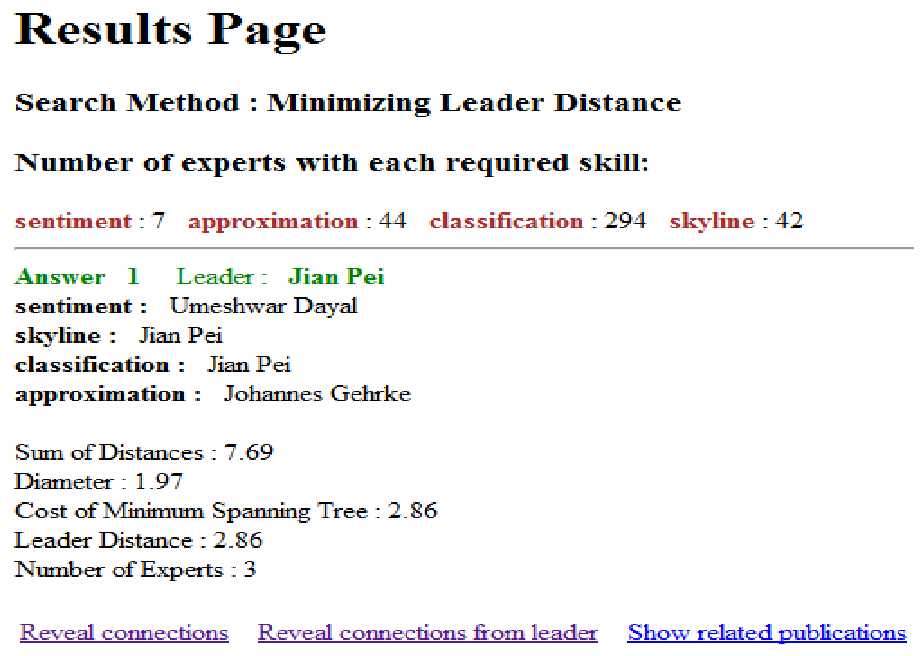 In the figure above, the system identifies a team for "sentiment, approximation, classification, and skyline" skills, visualising how a leader like Jian Pei coordinates the group.
Critical Analysis & Future Outlook
Values: TeamExp's greatest strength is its flexibility. By providing "Top-k" results instead of just one, it allows human decision-makers to weigh factors like "Expertise Level" (number of publications) against "Communication Compactness."
Limitations: The current model assumes a static social network. In reality, weights change as people collaborate. Furthermore, the "Sum of Distances" 2-approximation, while efficient, may still miss the absolute global optimum in very dense, complex networks.
Conclusion
TeamExp transforms team formation from a "search and pick" task into a sophisticated graph optimization problem. By recognizing that communication structure (whether via a leader or a mesh) dictates project success, this research sets a high bar for future HR-tech and collaborative software designs.