
TeamFinder: Boosting Expert Team Formation via Spectral Co-clustering
TeamFinder: A Co-clustering based Framework for Finding an Effective Team of Experts in Social Networks
The paper introduces TeamFinder, a hierarchical framework for expert team formation in large-scale social networks. It combines graph grouping, spectral co-clustering, and an incremental diameter-based search to identify teams that cover required skills while minimizing communication costs, achieving superior scalability and reduced team cardinality compared to previous SOTA baselines.
TL;DR
Finding the perfect team is more than just matching skills; it’s about internal synergy. TeamFinder is a new framework that treats team formation as a multi-stage optimization problem. By clustering experts and skills simultaneously using spectral methods, it shrinks the search space, ensures members can actually talk to each other (low communication cost), and scales to massive datasets like DBLP where traditional algorithms fail.
The Bottleneck of Collaboration
In the digital age, we don't just need one expert; we need a "dream team." However, current recommendation systems struggle with two main issues:
- Complexity: Searching for the optimal sub-graph in a network of millions is computationally prohibitive.
- Sparsity: Expertise profiles are often incomplete. If an expert doesn't have a specific tag, traditional keyword matching misses them, even if their collaborators suggest they possess that capability.
The authors argue that the "Communication Cost"—often measured by the diameter of the team's connection graph—is the pulse of an effective team. High diameter means information travels slowly; low diameter means a tight-knit, efficient unit.
Methodology: The TeamFinder Pipeline
TeamFinder doesn't just scan the whole graph. It uses a "zoom-in" approach:
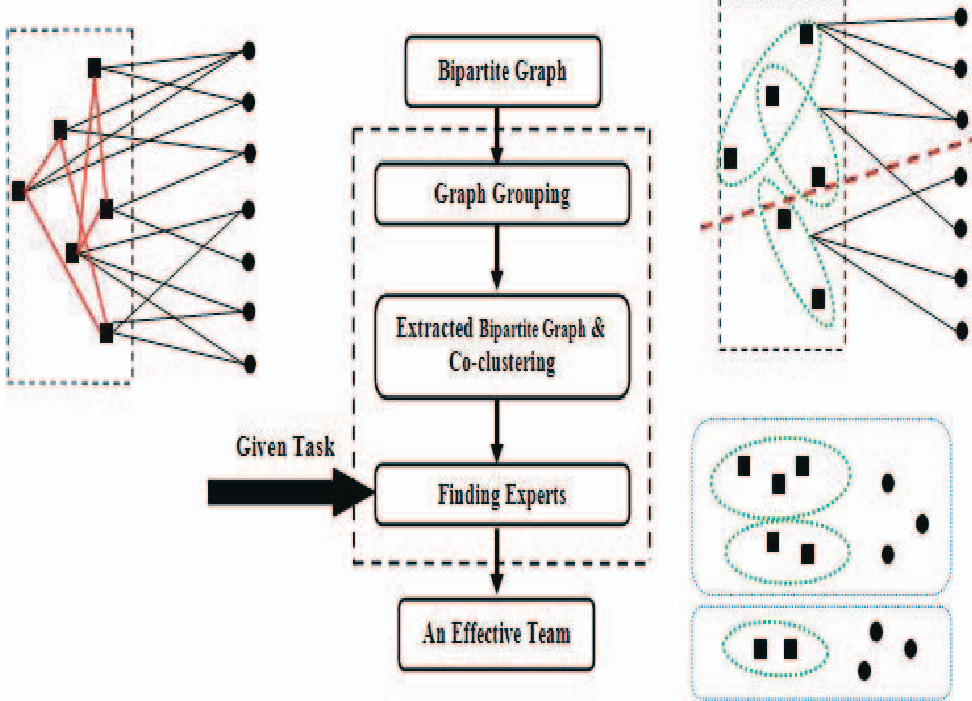
1. Graph Grouping
The algorithm first identifies "Supporter Sets" for every skill. It creates groups based on the strongest connections (using Tarjan's algorithm) to ensure the initial candidates are already well-embedded in the social structure.
2. Spectral Co-clustering
To handle the scale, the framework constructs a bipartite graph between expert groups and skills. It applies Spectral Co-clustering, which finds the optimal "cuts" in the graph to group similar experts and the skills they collectively cover.
3. Incremental Team Selection
Within these condensed "co-clusters," the algorithm performs a greedy search. Unlike the classic RarestFirst approach, TeamFinder looks at the distance between a new candidate and the entire existing team rather than just the next skill's supporter. This subtle shift significantly lowers the final team's diameter.
Experiments: Proving the Efficiency
The researchers used the DBLP co-authorship dataset, focusing on major conferences in AI, DB, Mining, and Theory.
Communication Cost & Cardinality
As shown in the results, TeamFinder maintains a remarkably low diameter even as the number of required skills grows from 2 to 20. More importantly, it selects fewer people to do more work (lower cardinality), which is a key requirement for real-world project budgeting.
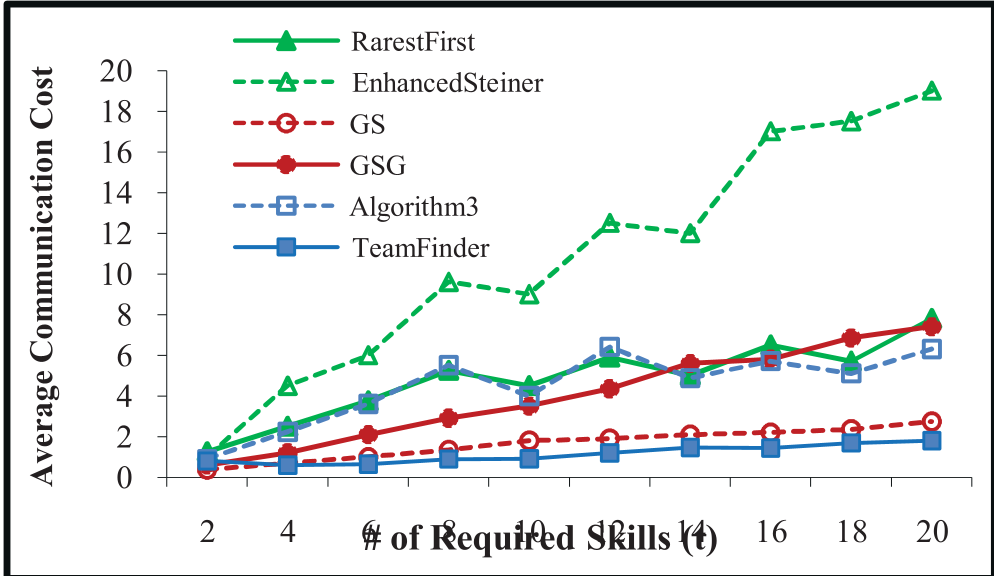 (a) Communication Cost (Diameter) Comparison | (b) Team Cardinality Comparison
Scalability
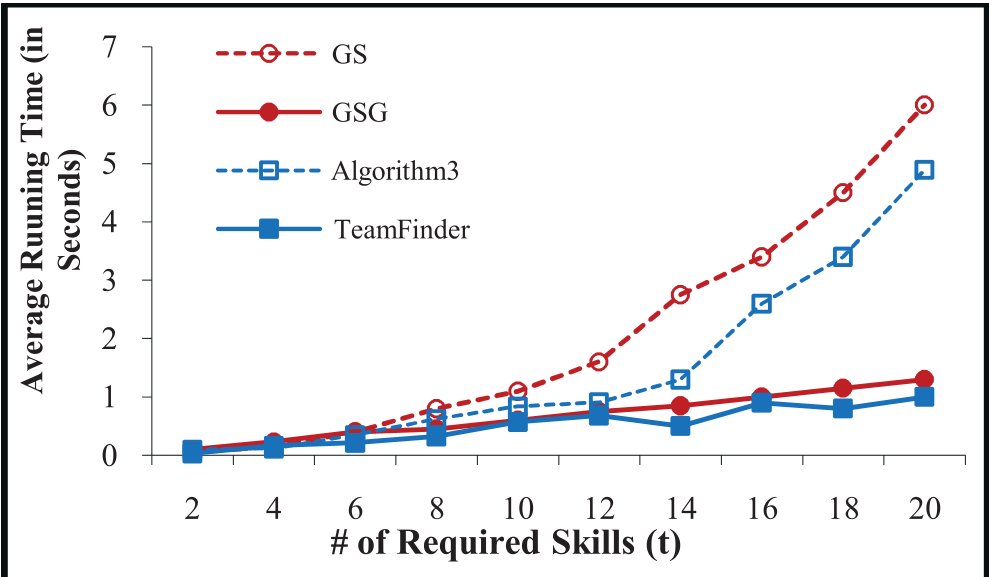
While baselines like GS (Generalized Steiner) saw their execution times spike as tasks became more complex, TeamFinder stayed efficient. The co-clustering step successfully pruned the irrelevant "noise" of the social network.
Critical Insight & Conclusion
TeamFinder’s genius lies in its structural intuition. By grouping experts before trying to form a team, it respects the natural "communities" that already exist in academic or professional circles.
Takeaway: If you want to build a scalable recommendation engine for collaborative tasks, don't look at experts in isolation. Use spectral clustering to find the "hidden islands" of expertise in your bipartite graph first.
Limitations: The current model uses the Jaccard distance between paper sets as a proxy for collaboration quality. Future work could incorporate more nuanced metrics like "citation impact" or "temporal decay" of skills to make the recommendations even more robust.