
TeamGen: Reimagining Team Formation with Hierarchical Intelligence
TeamGen: An Interactive Team Formation System Based on Professional Social Network
TeamGen is an interactive team formation system that leverages professional social networks to assemble project teams with hierarchical structures. Unlike traditional flat-team models, it introduces algorithms specifically designed for tree-structured organizations, achieving high efficiency through a specialized sub-team index.
TL;DR
Assembling the perfect project team in a massive corporation is more than just matching skills; it's about ensuring people can actually talk to each other. TeamGen is a sophisticated system that moves away from "flat" team models to embrace the hierarchical (tree-structured) reality of modern business. By introducing "Local Density" metrics and a high-speed "Sub-team Index," it turns an NP-Hard optimization problem into a practical, interactive tool for HR and project managers.
Background & Motivation: Beyond the Flat Network
Traditional team formation research often treats a team as a "blob" of experts. While this works for small startups or one-off tasks, it fails in large enterprises like Infosys or IBM. In the real world:
- Hierarchy matters: There are leaders, sub-leaders, and specialists.
- Communication is local: A developer needs to communicate intensely with their lead (local density), but rarely with a specialist in a completely different sub-department (global density).
The authors identified two massive hurdles: the computational complexity (NP-Hard) of tree-based matching and the need to integrate messy, real-world operational data (emails, project logs, etc.) into a clean Professional Social Network (PSN).
Methodology: The Core Innovations
1. Modeling Hierarchical Specifications
TeamGen defines a team as a tree where edges represent "report-to" relationships. This allows the system to distinguish between different roles and proficiencies within specific sub-branches of a project.
2. Local Density vs. Global Density
Instead of calculating the communication cost between every single pair in a 50-person project (which is noisy and often irrelevant), TeamGen focuses on the cost within each sub-team. If a manager and their direct reports have a strong history of collaboration, the "local density" is high, and the team is likely to succeed.
3. The Algorithms: TDTF, BPTF, and Indexing
- Top-Down (TDTF): Starts with the leader and recursively finds the best followers.
- Bottom-Up (BPTF): Starts with specialists and climbs the tree to find suitable leadership.
- Index-Based Search: This is the "secret sauce." The system realizes that many project structures repeat. By indexing successful sub-teams from the past, the system can skip intensive calculations and pull "pre-validated" groups of experts instantly.
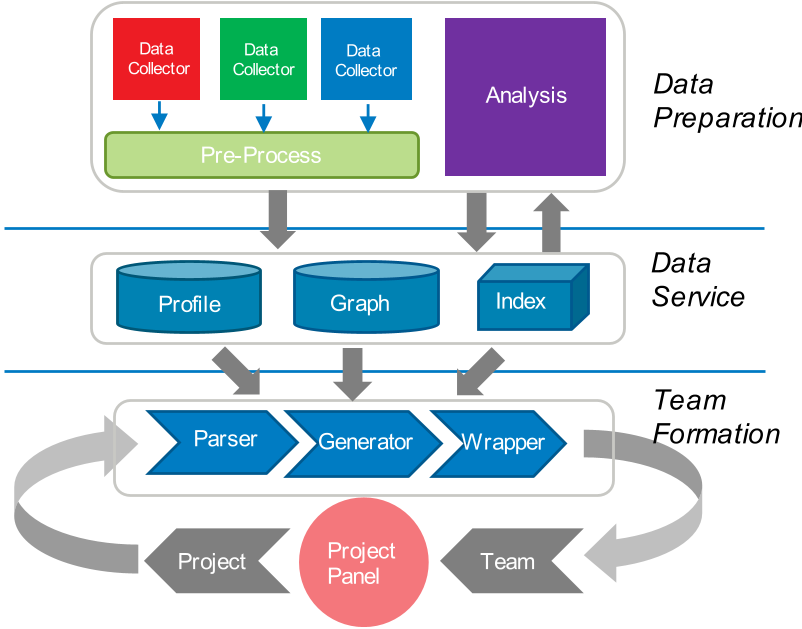 Figure 1: The TeamGen System Architecture, showing the flow from raw data to the interactive Project Panel.
Performance: Efficiency Meets Effectiveness
The system was tested on a massive dataset of 145,000 employees and 1.2 million relationships. The results were clear:
- Scalability: While traditional algorithms like "Rare First" struggle as teams grow, BPTF maintains high local density.
- Speed: The Index-based algorithm reduces runtime significantly (log scale), making "interactive" team building possible without waiting minutes for a result.
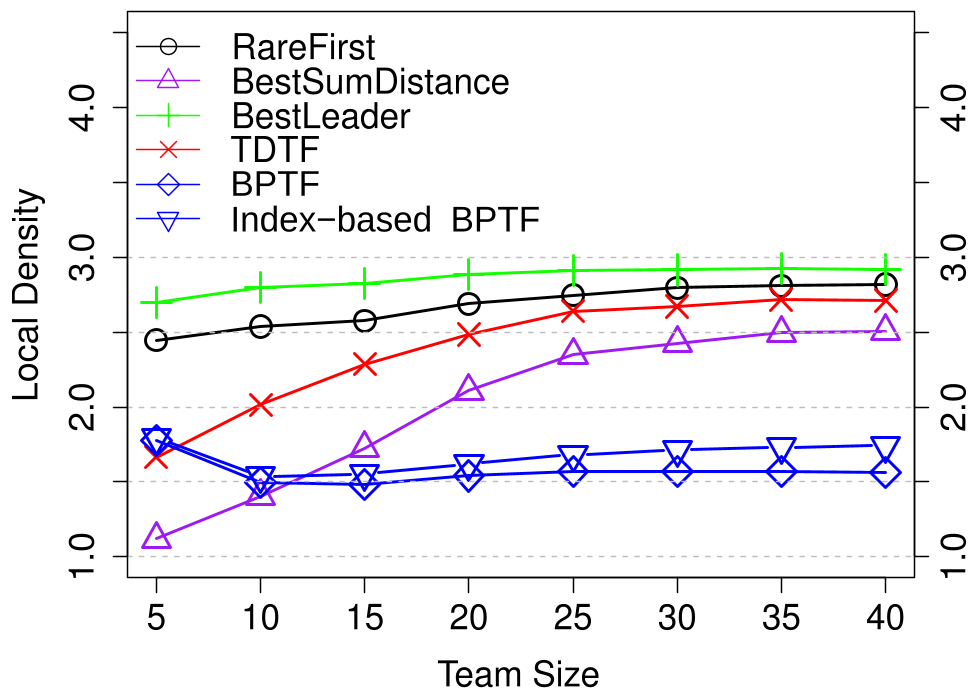 Figure 2: Performance comparison showing that BPTF and Index-based approaches maintain superior communication costs (Local Density) as team size increases.
Deep Insight & Conclusion
TeamGen’s brilliance lies in its pragmatism. By acknowledging that real human organizations are trees, not cliques, it focuses optimization where it actually matters: the immediate working group.
Takeaway: Future HR tech should stop looking for the "optimal group" and start looking for the "optimal structure." The use of a "Sub-team Index" is a powerful lesson in software engineering—often, a clever cache of historical successes is better than a pure mathematical search from scratch.
Limitations: The system relies heavily on the quality of "co-assignment" data. It may struggle in companies with poor data-capturing habits or in highly innovative projects where no historical "sub-team" index exists.
Future Outlook: Integrating LLMs to better parse "Skill Requirements" from project documents could make TeamGen even more automated, moving it from a "decision support" tool to an "autonomous recruiter."