
PETSS: Reimagining Gas Pipelines as Giant Batteries for Renewable Energy
Techno Economic Analysis of PETSS (Pipeline Energy Transport and Storage System)
The paper introduces PETSS (Pipeline Energy Transport and Storage System), a novel framework that utilizes existing natural gas infrastructure to transport and store renewable energy. By using solar-powered compressors to increase gas pipeline pressure and micro-turbines to extract that energy at remote ends, it achieves a hybrid storage-transport solution with promising economic viability.
TL;DR
Researchers have proposed a system called PETSS (Pipeline Energy Transport and Storage System) that turns existing gas pipelines into a medium for both transporting and storing renewable energy. By converting solar power into gas pressure and using micro-turbines to reclaim it as electricity, the system achieves a faster payback period than traditional transmission lines and half the initial cost of standard Compressed Air Energy Storage (CAES).
The Motivation: Infrastructure is the Bottleneck
As we shift toward renewable energy, we face two brutal realities:
- Intermittency: Solar doesn't shine at night, necessitating massive storage.
- Transmission Cost: Building new high-voltage lines to remote areas is financially draining.
The authors observed that thousands of kilometers of gas pipelines already exist. Instead of seeing them purely as fuel carriers, why not see them as pressurized energy conduits? By using excess renewable energy to "over-pressurize" these pipes, we can move and store energy without laying a single new cable.
Methodology: Turning Pressure into Power
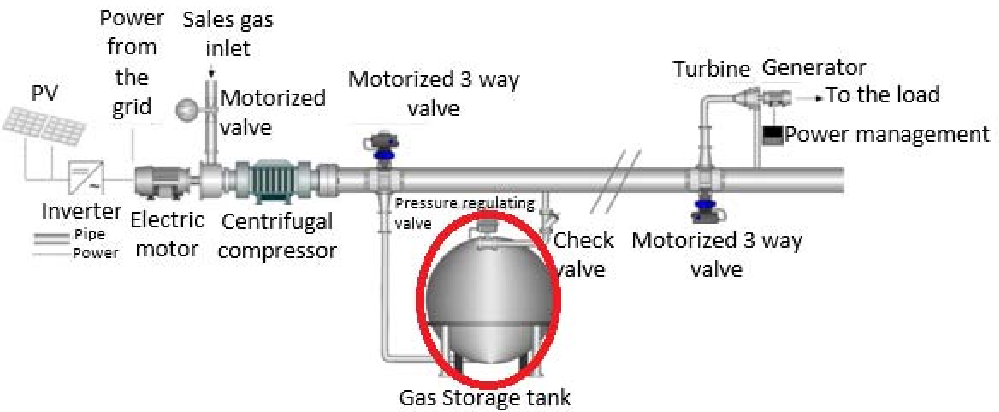
The PETSS framework consists of a renewable source (PV), a motor-driven compressor, the pipeline itself, and a micro-turbine at the receiving end.
The Two Architectures
- Direct Transport: Solar power directly drives the compressor. The downstream electricity fluctuates with the sun, leading to lower efficiency (18-22%) and unfavorable turbulence in the pipe.
- Optimized Storage (PETSS-S): Introduces a storage tank as a buffer. During peak sun, the compressor fills the tank; during clouds/night, a control valve releases this pressurized gas to keep the micro-turbine running at steady, optimal levels.
Thermodynamic Optimization
The core challenge is the efficiency-pressure trade-off. Using Genetic Algorithms (GA) via the GOSET toolbox, the authors searched for the "Sweet Spot." They modeled the system dynamics using TRNSYS and MATLAB, accounting for:
- Van Der Waals state equations for real gas behavior.
- Panhandle equations for long-distance pressure drop.
- Isentropic efficiency of the micro-turbines.
The GA result identified 59 bar as the optimal operating pressure for the UAE-based test case.
Experiments and Results
The study compared PETSS against two incumbents: conventional Overhead Transmission Lines (OHTL) and standard CAES.
Efficiency Gains
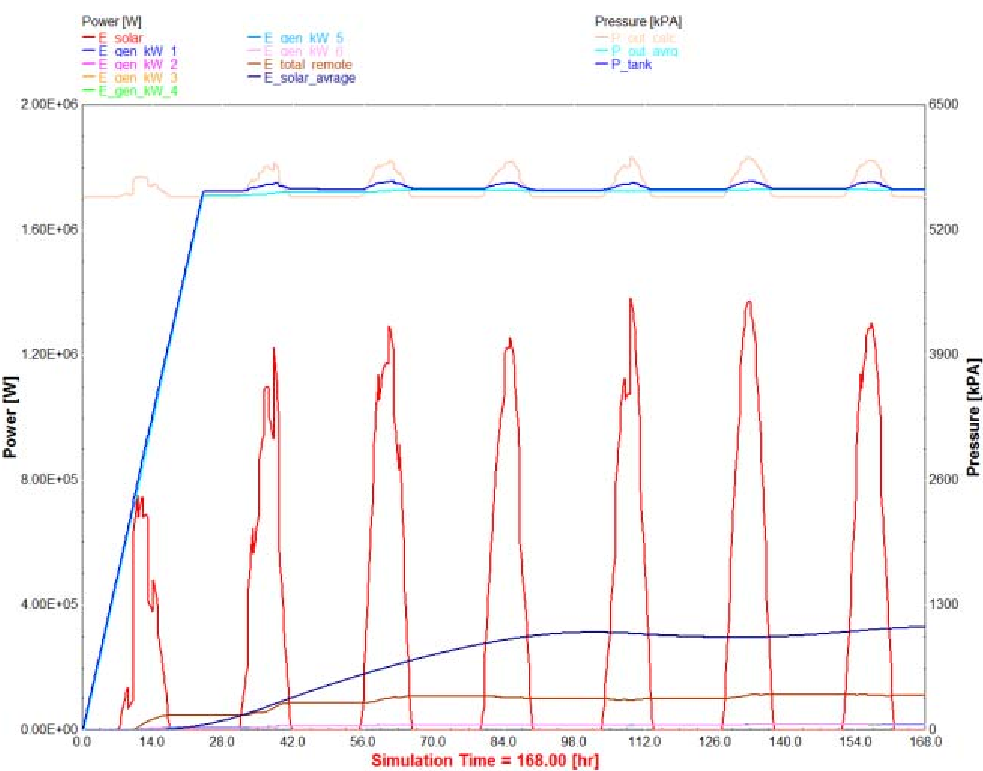
By adding the storage buffer and optimizing the pressure, the system efficiency jumped from 18-22% to 25-30%. While lower than pure electrical cables, the lack of new infrastructure costs makes it a winner.
Economic Superiority
The results in the table below showcase the "promising" results mentioned in the abstract:
| System | Payback Period (Yrs) | Internal Rate of Return (IRR) |
|---|---|---|
| Conventional Power Line | 12.31 | 5.1% |
| Proposed PETSS Transport | 10.93 | 6.5% |
| Conventional CAES | 17.72 | 2.8% |
| Proposed PETSS Storage | 9.66 | 8.2% |
The PETSS storage system's initial investment is roughly 45% lower than a standalone CAES system because it piggybacks on existing industrial compressors and pipelines.
Critical Insight & Conclusion
The genius of PETSS isn't just in the physics, but in the Asset Utilization. In a world looking to transition away from fossil fuels, we shouldn't necessarily abandon the pipelines. PETSS offers a "dual-use" path: the pipeline continues to move gas as a commodity while simultaneously acting as a 100km-long spring for renewable energy storage.
Limitations & Future Work
- Interdependence: If the main gas plant goes down, the energy storage stops.
- Efficiency: 30% is still low compared to batteries (~90%). However, for long-duration, large-scale storage, CAPEX often matters more than round-trip efficiency.
- Scaling: Future research should look into the impact of varying gas compositions (e.g., Hydrogen-Methane blends) on the compressor and turbine maps.
Final Takeaway: By treating infrastructure as a multi-modal energy asset, we can bypass the high costs of the green energy transition.