
Strategic Service Migration: A Techno-Economic Framework for Optimizing Telecom OpEx
2509_A techno-economic approach to telecommunications the case of service migration.
This paper proposes a novel techno-economic framework for modeling service migration in telecommunications from legacy to Next Generation Networks (NGN). It utilizes a queuing system optimized by a Hill Climbing algorithm to determine ideal staff allocation across marketing, installation, and switching phases, aiming to minimize Operational Expenditures (OpEx).
TL;DR
Transitioning from legacy platforms to Next Generation Networks (NGN) is a financial minefield for telecom operators. This paper introduces a robust techno-economic model that treats service migration as a serial queuing system. By optimizing staff allocation using a Hill Climbing algorithm and strategically scheduling network dismantling, operators can transform migration from a sunk cost into a driver of significant OpEx savings.
Background: Breaking the OpEx Myth
Traditionally, the telecommunications industry viewed Operational Expenditure (OpEx) as a minor, static byproduct of Capital Expenditure (CapEx)—roughly calculated as a small percentage of hardware costs. This paper debunked that paradigm, revealing that OpEx actually accounts for 50% to 85% of the Total Cost of Ownership (TCO). As operators migrate to packet-based NGN, the labor-intensive process of moving thousands of services (telephony, data) between platforms often suffers from poor planning, leading to "service release" (losing customers to contract expiration) and wasted resources.
The Core Problem: The Migration Bottleneck
Why is migration so difficult to quantify? The authors identify three main hurdles:
- Labor Dependency: Migration requires specific personnel (Marketing, Mobile Technicians, Office Technicians) with varying salary premiums.
- Stochastic Nature: Service lifespans vary. If a migration is too slow, the service "expires" naturally, leading to missed opportunities for optimization.
- The Bottleneck Effect: In a multi-stage process (Marketing → Installation → Switching), the entire system's throughput is limited by the least efficient phase.
Methodology: Queuing Theory meets Hill Climbing
The authors propose modeling the migration as a system of queues in series. Each phase is a "server" (staff member) processing a "customer" (service).
1. Staff Allocation Optimization
To solve the resource allocation problem, they use the Hill Climbing method. The logic is elegant:
- Identify the current bottleneck phase (the one with the lowest throughput).
- Add one employee to that specific bottleneck.
- Repeat until all available staff are assigned.
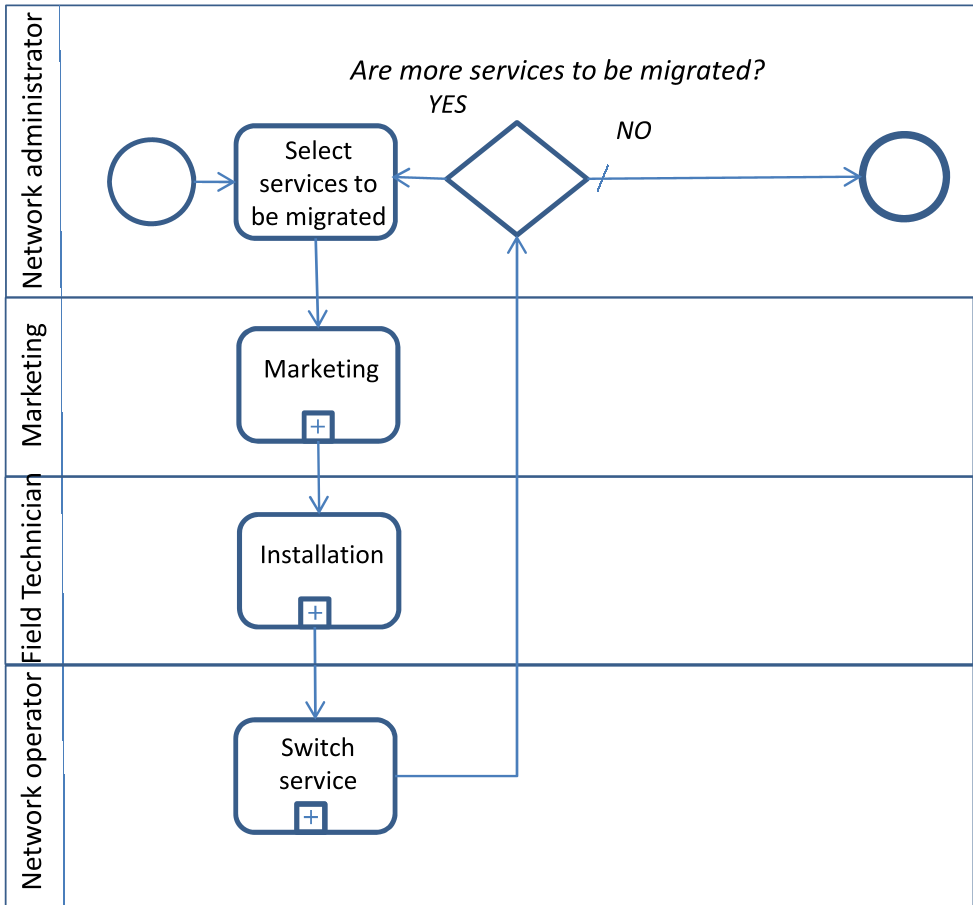 Figure 1: BPMN representation of the Migration Process phases.
2. Service Release Dynamics
The model accounts for a Gaussian distribution of service durations. If migration doesn't reach a service before its contract expires (typically 3-6 years), that service is "released" rather than "migrated," impacting the eventual maintenance savings.
Key Insights from Sensitivity Analysis
The research utilized simulations of 500,000 services to identify the most profitable strategies:
- The Cost-Duration Trade-off: Adding more staff reduces migration time, but only up to a point. Beyond a certain threshold, the cost increase is "steeper than the decrease in duration," creating a local minimum for the time-cost product.
- Migration Order Matters: Choosing a "Last-to-expire first" strategy outperformed random selection. By migrating services with the longest remaining life first, operators maximize the duration of maintenance savings on the new, more efficient platform.
- Impact of Network Dismantling: The real "payday" happens when the old platform is shut down. The authors found that migrating small locations first allows for earlier node release and dismantling, providing higher savings than tackling large locations first.
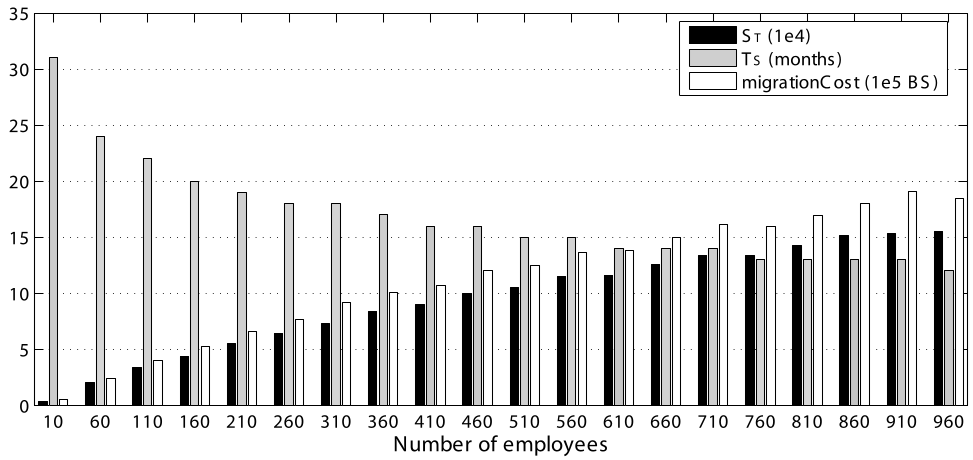 Figure 2: Impact of staff size on migration time vs. total cost.
Critical Analysis & Conclusion
Takeaways
This paper provides a rare, quantitative look at the "hidden" side of telecom operations. It shifts the focus from purely technical network performance to Business Intelligence (BI) and labor optimization. The specific insight that part-time own personnel is the most economical contracting modality provides direct actionable value for HR departments in the telecom sector.
Limitations & Future Work
While the model is robust, it assumes a deterministic processing time for migration tasks. In reality, technician travel times or customer marketing responses are stochastic. Future iterations could incorporate Stochastic Queuing Models or account for multi-platform environments where equipment from different platforms shares the same physical location, complicating the dismantling process.
By bridging the gap between engineering and economics, Shayani et al. demonstrate that in the era of NGN, the most important "bandwidth" to manage might just be the man-hours of the workforce.