
Bridging the Gap: The Techno-Economic Reality of Grid-Level Storage for Solar Integration
Techno-Economic Assessment of Grid-Level Battery Energy Storage Supporting Distributed Photovoltaic Power
This paper presents a comprehensive techno-economic assessment of grid-level Battery Energy Storage Systems (BESS) supporting distributed photovoltaic (PV) power in distribution networks. Using a multi-objective genetic algorithm and 1-minute resolution simulations of the IEEE 34-bus system, the study identifies optimal BESS siting and evaluates its impact on PV hosting capacity, network losses, and infrastructure longevity.
TL;DR
Integrating large-scale batteries into distribution grids can significantly boost solar capacity and reduce network strain. However, this paper reveals a harsh economic truth: current market structures fail to reward these local benefits, leaving centralized BESS projects financially underwater despite their clear technical advantages.
Background: The Distribution Dilemma
As distributed PV power surges, distribution networks are transforming from passive pipelines into active power hubs. This shift triggers "voltage headache" and accelerates the wear-and-tear of mechanical equipment like tap changers. While Battery Energy Storage Systems (BESS) are the logical "aspirin" for these headaches, the financial incentive for utilities or third parties to deploy them remains murky. This study provides a rigorous map of where to place these batteries and exactly how much they need to be paid to make sense.
Siting Logic: Finding the Sweet Spot
The authors don't just pick a random spot. They use a Multi-Objective Genetic Algorithm to solve the "Global Optimal Bus" problem. Their objective function (Eq. 1) balances four critical pillars:
- Revenue Maximization: Where can the battery make the most money?
- Loss Minimization: Reducing I²R heat in the wires.
- Voltage Stability: Minimizing over-voltage spikes caused by mid-day sun.
- Reverse Power Flow: Keeping energy within the local grid to avoid substation stress.
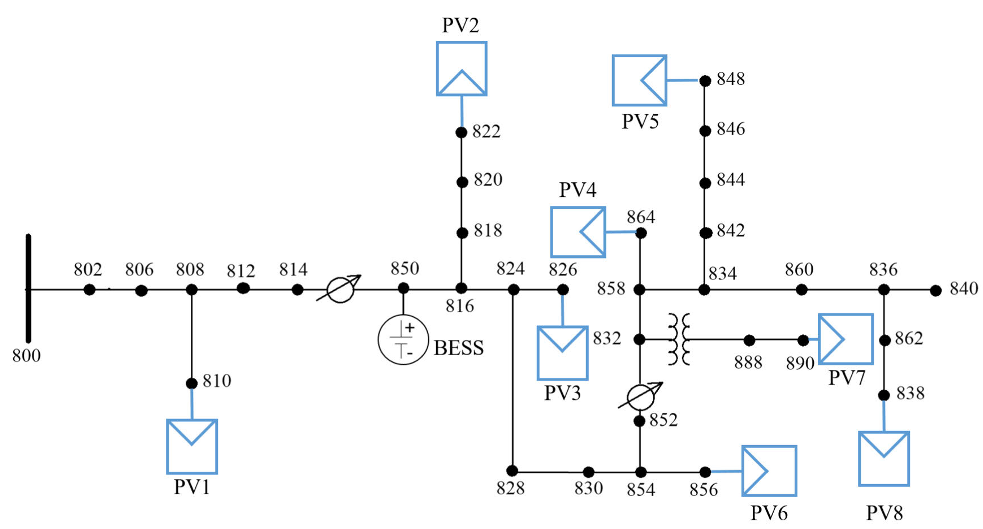 Figure: The IEEE 34-bus test feeder adapted for the Northern Ireland distribution code, showing the optimal BESS location at Bus 850.
Methodology: Synergy Between Smart Inverters and BESS
A key insight of this paper is that the battery doesn't work in a vacuum; it acts as a secondary layer to Smart PV Inverters.
- Volt-Var Control: Dynamic reactive power support from the PV inverters themselves.
- BESS Dispatch: The battery handles the "heavy lifting" of real power (Peak Shaving) and provides high-volume lagging reactive power to keep the system steady.
The Technical "Win"
The results are impressive from an engineering standpoint:
- Hosting Capacity: Combining BESS with Volt-Var inverters pushed the network's solar limit to 35%, a 5% absolute increase over standard setups.
- Loss Reduction: System losses dropped to 7.46%, a nearly 17% improvement over the base case.
- Asset Preservation: BESS reduced the duty cycle of mechanical voltage regulators, effectively extending their lifespan by up to 2 years by absorbing the "shimmer" of solar variability.
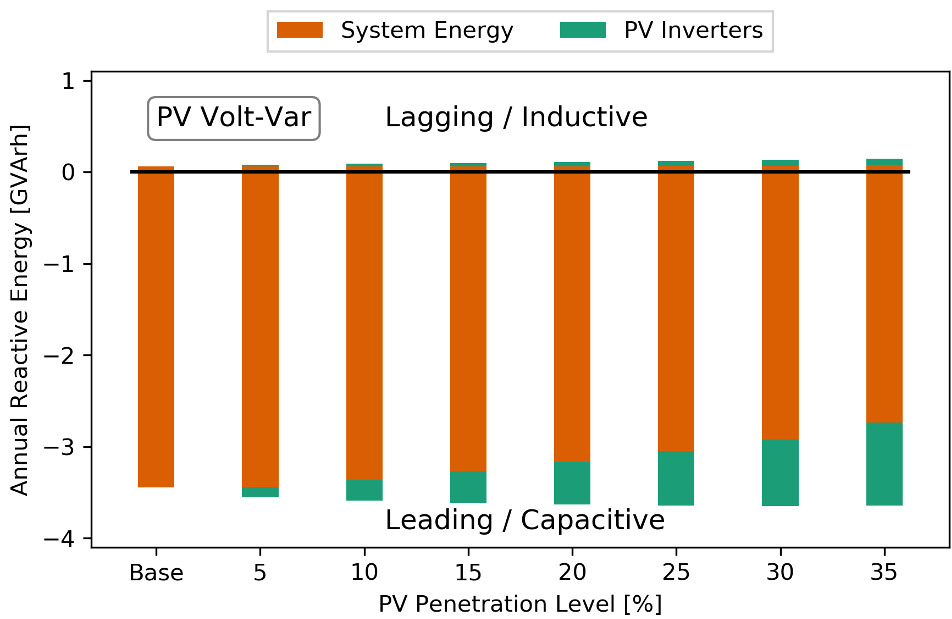 Figure: The "U-shaped" relationship of network losses vs. PV penetration. Note how the BESS + Volt-Var scenario consistently sits at the bottom of the curve.
The Economic "Wall"
Despite the technical success, the financial metrics tell a different story. Under current TSO-style (Transmission System Operator) payment rules:
- NPV: -£354,445 (Deeply negative).
- IRR: -23.9%.
- The Culprit: High CAPEX and the inevitable need to replace battery cells every 10 years (Years 10 and 20).
The authors argue that we are using the wrong yardstick. Large batteries in distribution grids add "Local Flexibility" and "Carbon Avoidance" value (up to £715k in avoided carbon credits), but they aren't currently paid for it.
Deep Insight: The Break-Even Target
The paper calculates the "Survival Rate" for distribution BESS. To hit a Profitability Index (PI) of 1.0, a project needs:
- Real Power: ~4.87 p/kWh.
- Reactive Power: ~2.88 p/kvarh.
Most current markets only pay for real power, treat reactive power as a minor ancillary service, and ignore "avoided infrastructure cost" entirely.
Conclusion and Takeaways
This work serves as a manifesto for Distribution System Operators (DSOs). To unlock the full potential of distributed renewables, we must:
- Stop treating distribution grids as "dumb pipes": Strategic BESS placement acts as a virtual grid upgrade.
- Redesign Market Incentives: Move beyond simple energy arbitrage. We need "Distribution-Specific" payments that reward batteries for preserving grid equipment and local voltage stability.
- Capitalize on Carbon: Integrating the value of avoided CO2 into the BESS revenue stream could be the final nudge needed for profitability.