
[Journal of Learning and Teaching] Technology in ELT: Bridging the Gap Between Digital Natives and Traditional Pedagogy
Technology and English Language Teaching and Learning: A Content Analysis
This paper presents a quantitative content analysis of recent trends in Educational Technology (EdTech) for English Language Teaching (ELT), surveying 50 academic articles published between 2000 and 2018. It categorizes the evolution of digital tools—ranging from social media to 3D virtual worlds like Second Life—and identifies a significant surge in research interest starting in 2012.
TL;DR
This study provides a comprehensive content analysis of how technology has transformed English Language Teaching (ELT) over nearly two decades. By analyzing 50 core academic works, the researchers highlight a shift from "theoretical" traditional classrooms to "multidimensional" student-centered environments fueled by smartphones, social media, and virtual worlds. The peak in research around 2016 signals a global consensus: technology is no longer optional; it is the new backbone of linguistics.
The "Digital Immigrant" Dilemma: Why Integration Stalls
Despite the proliferation of high-tech tools, the transition from traditional to digital instruction is far from seamless. The paper identifies a core friction point: Teacher Readiness. Many educators are "digital immigrants" who, while possessing a positive attitude toward ICT, lack the technical fluency to move beyond personal use into advanced pedagogical application.
Existing methodologies often rely on:
- Outdated textbooks that even native speakers find confusing.
- A focus on "passing exams" rather than communicative competence.
- Limited resources and a lack of manpower to maintain digital infrastructure.
Methodology: Mapping Two Decades of Innovation
The researchers utilized a quantitative content analysis to synthesize trends across various databases. They examined the "Paradigm" of research, finding a surprising balance between Quantitative and Qualitative methods, though Mixed Methods—often considered the gold standard for educational research—lagged behind.
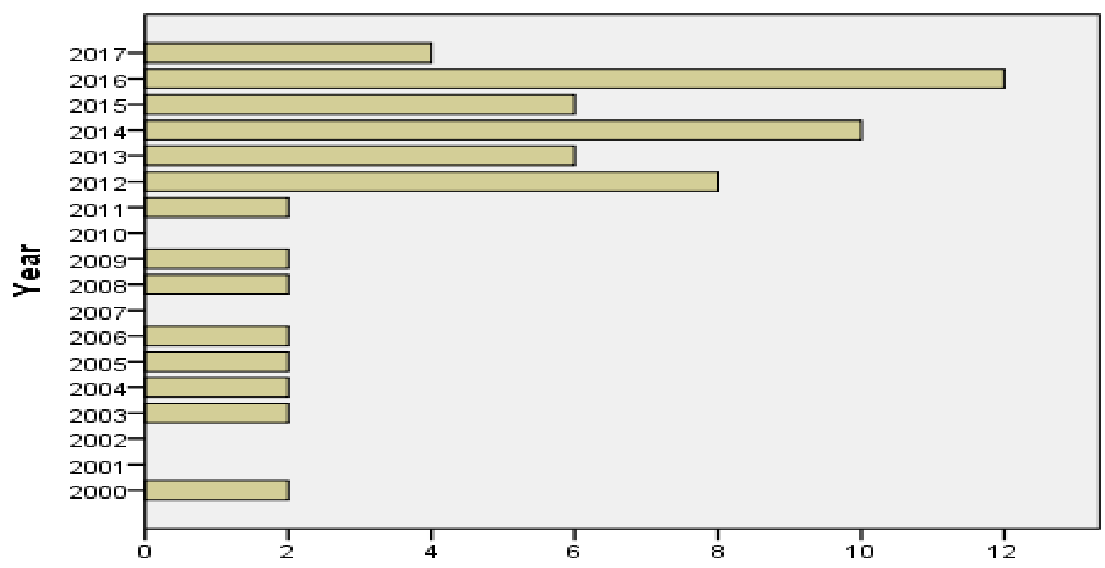 Table 1: The rise in ELT technology research, showing a massive spike post-2012, coinciding with the smartphone revolution.
Key Innovative Technologies in Focus
The study highlights several pillars of modern ELT:
- Second Life (SL): A 3D social networking platform that allows students to use avatars, reducing the "psychological barriers" and anxiety often felt in physical classrooms.
- Smartphones: With billions of users, these devices have transitioned from "distractions" to essential learning hubs, improving task accomplishment rates.
- Computer-Mediated Communication (CMC): Synchronous chats and messaging are identified as underutilized tools for developing fluency and "knowledge construction" through social interaction.
 Figure 2: Regional focus areas, showcasing Turkey's broad interest in ELT tech and the high mobile-learning focus in China and Venezuela.
Critical Results: The Tool Gap
One of the most telling findings is the reliance on Questionnaires (35.5%) as the primary data collection tool. While easy to administer, the authors hint that this might lead to "standardized" results that miss the nuance of actual classroom dynamics. Furthermore, the lack of "Achievement Tests" in the reviewed literature suggests that while we know students like technology, we need more rigorous data on how much it actually improves their testable proficiency.
Conclusion & Future Outlook
The paper concludes that while computers will never replace teachers, the role of the instructor is evolving from a "sole source of knowledge" to a "facilitator" of a multidimensional information flow.
Future Work must address:
- The Motivation Gap: What truly drives a teacher to adopt technology beyond institutional pressure?
- Long-term Retention: Does technology-aided learning lead to better long-term fluency compared to traditional drills?
- Total Adaptation: Moving from partial usage of ICT to a fully integrated digital curriculum.
As we move further into the 2020s, the "Connectivism" theory—where learning is a process of connecting nodes—will likely become the standard for ELT, leaving traditional, teacher-centered models in the history books.