
Mining the Future: Predicting Technology Emergence via Passive Crowdsourcing
8843_Technology Futures From Passive Crowdsourcing.
The paper introduces a "Passive Crowdsourcing" framework to predict emerging technologies by mining forward-looking statements from open-source web articles. Using a pipeline of NLP, topic modeling, and statistical significance testing, it extracts (technology, date) tuples to forecast innovation milestones.
TL;DR
Predicting the "Next Big Thing" is no longer a dark art reserved for elite futurists. Researchers from the Georgia Tech Research Institute have developed a pipeline to harvest "passive crowdsourced" intelligence—mining the countless predictions scattered across tech blogs and news sites. By extracting (technology, date) pairs and testing their statistical significance, they've demonstrated a method that correlates strongly with actual historical technology emergence.
Background: Beyond Patents and Papers
Historically, if you wanted to know where the world was heading, you looked at two things: Patents and Peer-reviewed papers. While these are "gold standard" data sources, they suffer from high latency and elitism. A patent might be filed years before a concept hits the public consciousness, and academic citations often reflect past prestige rather than future potential.
The authors argue that the "Passive Crowd"—journalists, bloggers, and industry enthusiasts—possesses a collective predictive ability. Unlike active crowdsourcing (like prediction markets), passive crowdsourcing requires no direct solicitation. It simply listens to what is already being said.
The Problem: Noise, Sparsity, and Language
Mining informal text for predictions is notoriously difficult because:
- Linguistic Complexity: A prediction like "Smart glasses will be on the market between 2012 and 2016" requires identifying the specific entity and the temporal window.
- Data Sparsity: Any single article might use unique phrasing (e.g., "head-mounted displays" vs. "Google Glass").
- Reliability: How do you distinguish a wild guess from a legitimate industry consensus?
Methodology: The Extraction Pipeline
The researchers proposed a multi-stage NLP pipeline to transform raw text into "Technology Forecasts":
- Phrase Tagging (CRF): Using Conditional Random Fields, the system identifies technology subjects (e.g., "1-Gb DRAMs").
- Temporal Extraction: A customized version of TempEx normalizes dates (e.g., "in five years" becomes "2029").
- Semantic Clustering (NMF): To solve the sparsity problem, they used Non-negative Matrix Factorization to group disparate terms into 15 core "Topics" (e.g., Topic 6: Drones, Topic 15: Quantum Computing).
- Significance Testing: They applied Fisher's Exact Test to see if specific Topic-Year pairs occurred more frequently than chance. A high significance implies a "crowd consensus."
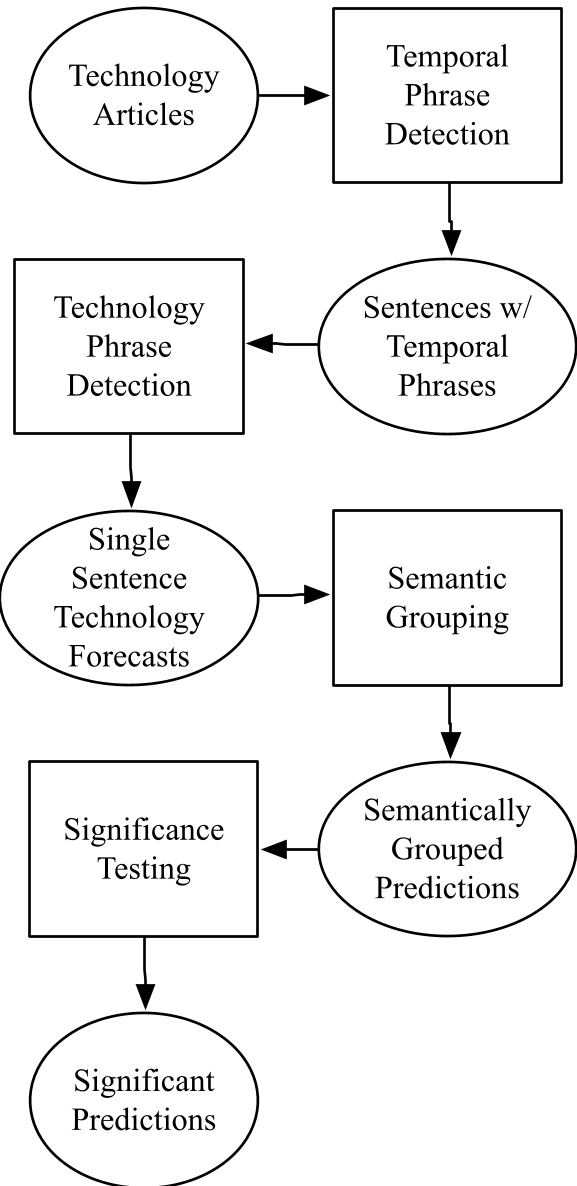 Figure 1: The multi-step pipeline for identifying technology prediction tuples.
Experiments: Validating the "Crystal Ball"
The authors validated their approach against a "Ground Truth" corpus annotated by Amazon Mechanical Turk workers.
Key Quantitative Findings:
- Tagging Performance: The CRF model reached an average precision/recall of 56.8%, climbing to 67.1% for partial matches—comparable to SOTA event extraction in specialized fields like bioinformatics.
- The "Crowd" Correlation: The most impressive result was the correlation coefficient of r = 0.607 between the system's predicted emergence years and human-verified actual emergence years.
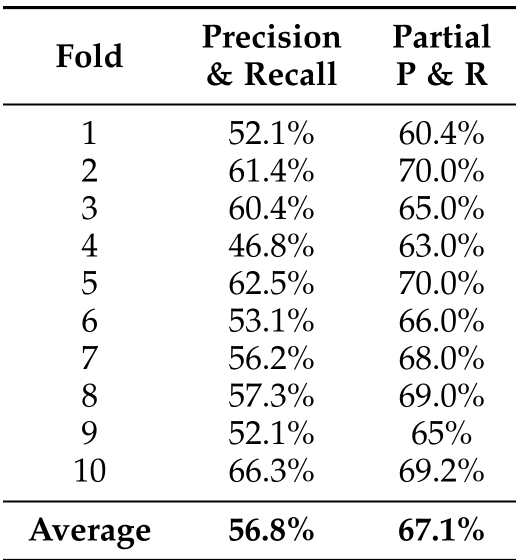 Table 1: Cross-validation results for the Technology Phrase Tagging component.
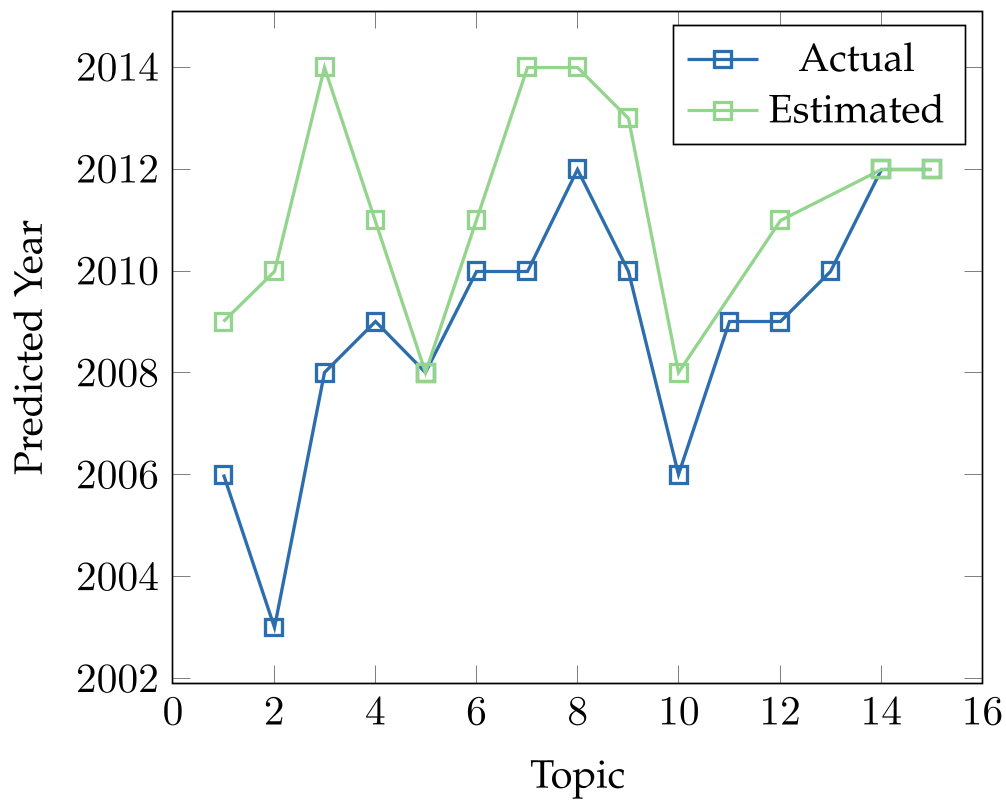 Figure 2: Plotting actual vs. estimated emergence dates—notice the tight alignment in several key tech areas.
Critical Insight: Why This Works
The success of this method implies that the media doesn't just report on technology; it forecasts it by aggregating the weak signals from the industry. The the statistical significance component is the "Filter." It separates the idiosyncratic ramblings of a single blogger from the converging narrative of the collective crowd.
Limitations and Future Work
The model currently struggles with:
- Multi-sentence Logic: It only looks at single sentences. If the technology is mentioned in paragraph one and the date in paragraph two, the link is missed.
- Availability Bias: Humans tend to predict that "hyped" technologies (like Drones or AI) are closer to fruition than they actually are.
Conclusion
This paper proves that the "Passive Crowd" is a goldmine for predictive intelligence. By treating the internet as a massive, unorganized forecasting tournament, we can identify technological breakthroughs years before they appear in formal bibliometric data. For future researchers, the next step is clearly applying the reasoning capabilities of Large Language Models to this pipeline to handle the multi-sentence coreference issues the authors identified.
Academic Takeaway: Passive crowdsourcing bridges the gap between expert intuition and dry data, offering a real-time pulse of human technological ambition.