
Technology, Growth, and Inequality: A Multi-Scale Simulation of the Economic Engine
Technology, Growth and Inequality: An agent-based model of Micro Transactional Behaviors and Meso Technology Networks for Macroeconomic Growth
This paper presents an Agent-Based Model (ABM) to simulate how micro-level human behaviors and meso-level market networks drive macro-level economic growth and income inequality. By integrating evolutionary game theory with technology diffusion models across random and preferential networks, the authors demonstrate that while technology boosts aggregate income, its impact on inequality is heavily contingent on social network structures.
TL;DR
Can we simulate the entire economy from the ground up to understand why technology makes us richer but often more unequal? This paper introduces an Agent-Based Model (ABM) that connects micro-level "transaction games" to macro-level GDP and Gini coefficients. The key finding: the structure of our social and market networks (meso-scale) determines whether technology acts as a tide that lifts all boats or a wedge that drives us apart.
Background: The Macro-Micro Gap
In traditional economics, technology is often seen as a "Total Factor Productivity" (TFP) boost—a magic number that makes every hour of labor more valuable. However, as we see in the modern world, 5G, AI, and Big Data don't benefit everyone equally. The authors argue that to understand Inequality, we must stop looking at aggregate sums and start looking at the "complexity" of human agency.
The Core Insight: The Micro-Meso-Macro Bridge
The researchers break down the economy into three distinct layers:
- Micro: Individual agents making strategic choices (Cooperate vs. Defect) in economic games.
- Meso: The "Network" where these agents meet. Are you trading in a random crowd (Random Network) or a sophisticated, highly-connected market (Preferential Network)?
- Macro: The resulting "Emergence" of total income and the Gini Index.
The Methodology: Games and Diffusion
The model uses Evolutionary Game Theory. Imagine two players:
- If both have technology, they can achieve high-efficiency "cooperative" gains.
- If only one has technology, they hold an "Asymmetric Advantage," often maximizing their own gain at the expense of the other.
This is combined with a Bass Diffusion Model, where technology isn't just "given"—it spreads through the network as agents witness the high payoffs of their tech-savvy neighbors.
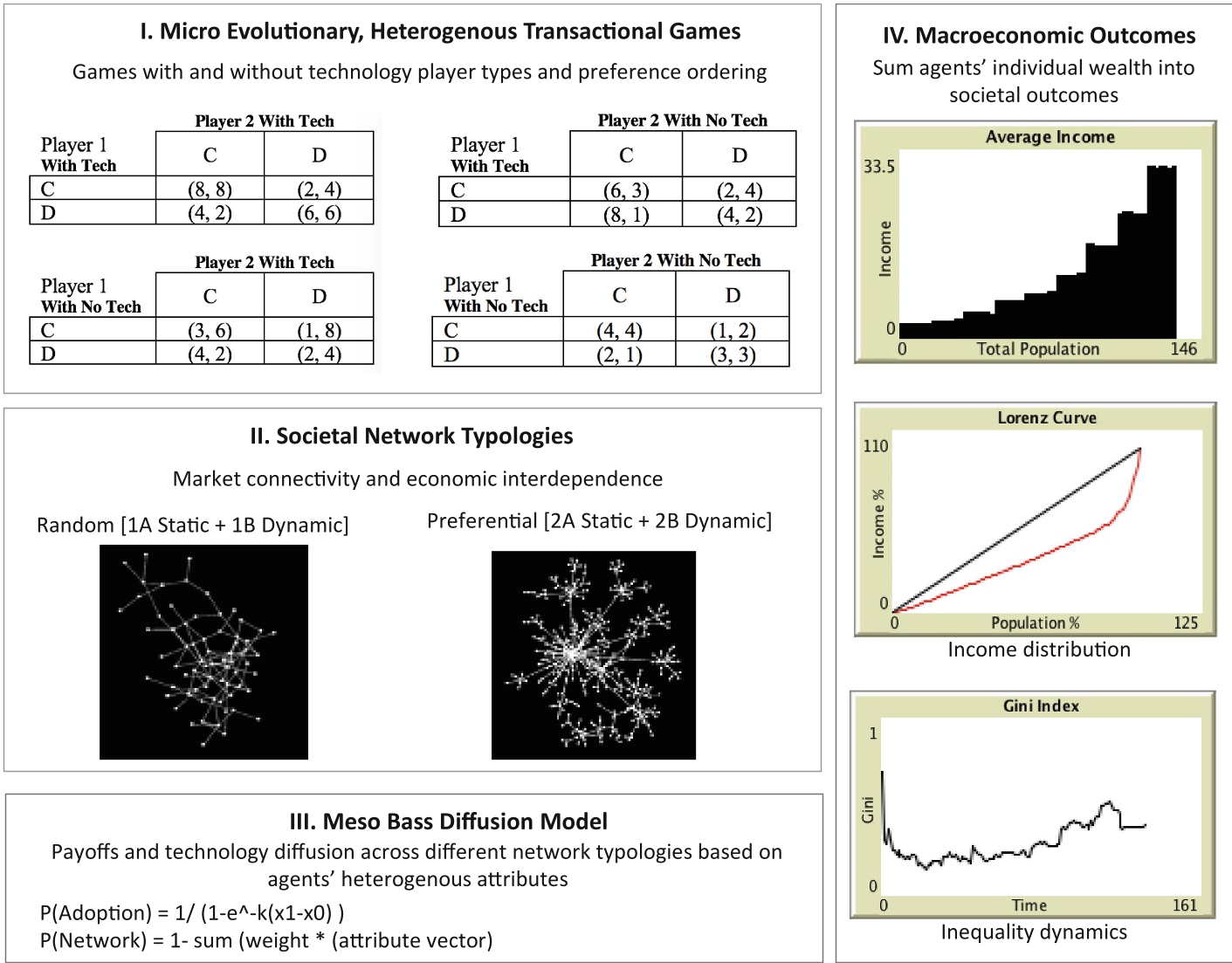 Figure 1: The operational process map showing the flow from individual attributes to macro emergence.
Experimental Results: The Network Matters
One of the most striking findings is the impact of Network Typology.
- Random Networks: These represent less organized systems. Here, "Defect" strategies often dominate, and technology leads to a rapid "separation" of wealth, creating high inequality.
- Preferential Networks: These mimic efficient, organized markets. In these environments, technology spreads more effectively, and the "penalty" for cooperation is lower, leading to better Gini index scores (lower inequality).
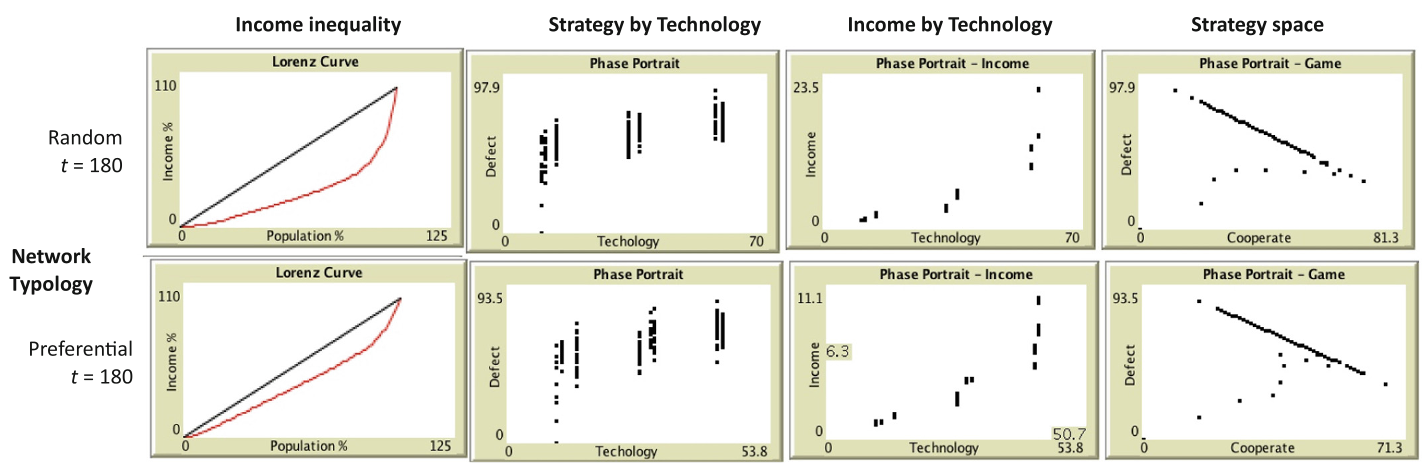 Figure 2: Lorenz curves (showing inequality) alongside phase portraits of strategy evolution.
The Growth-Inequality Tradeoff
Through "Quasi-Global Sensitivity Analysis" (running 654,000+ experiments), the authors quantified the cost of equity. While asymmetric technology usage always increases the Gini index (inequality), Dynamic Preferential Networks offer a path where technology has a larger impact on total income with a significantly smaller "inequality penalty."
Critical Analysis & Conclusion
Takeaway
The paper successfully proves that technology is not a "neutral" force. Its impact is filtered through the architecture of our society. For policymakers, the lesson is clear: focusing solely on technology adoption is insufficient. We must also focus on the Meso-layer—ensuring that market networks are structured to encourage cooperation rather than just rewarding those with an asymmetric information advantage.
Limitations & Future Work
While the model is robust, it currently relies on simulated data. The next step is Empirical Calibration—plugging in real-world socio-economic data from different countries to see if the model can predict historical shifts in inequality.
Achieving the UN's Sustainable Development Goals (SDGs) requires more than just innovation; it requires a fundamental understanding of the complex adaptive system we call the "Economy."