
Decoding Digital Ties: How Technology Mediates Human Relationships
Technology-Mediated Relationships in a Socio-technical System
This exploratory study introduces "Associograms," a novel framework for analyzing technology-mediated relationships within a large-scale online professional educator network (Tapped In). By applying a meso-level cluster analysis to dyadic associations across multiple media (Chat, Discussion, Files), the researchers identified six distinct types of relationships, ranging from "Friends" to brief "Acquaintances."
TL;DR
Researchers at the University of Hawaii at Manoa have bridged the gap between big-picture network maps and individual chat logs. By introducing the Associogram, they analyzed over 200,000 user pairs in an educator network to prove that the way we use specific tools (Chats vs. Discussions) serves as a digital fingerprint for our relationship "type"—uncovering everything from fleeting acquaintances to deep professional friendships.
Background: The Missing Middle
In the world of Social Network Analysis (SNA), we are usually good at two things: mapping the "macro" (who knows whom in a massive web) and analyzing the "micro" (the specific words used in a single message). However, there is a "neglected scale" in the middle—the meso-level.
Current models often overlook the agency of the artifact. They treat the platform as a neutral background rather than an active participant. This paper argues that a relationship isn't just a line between two people; it is a complex web of interactions mediated by specific digital objects like files, forum threads, and chat rooms.
Methodology: The Associogram
The authors move beyond the simple "Social Tie" (Sociogram) and introduce the Associogram.
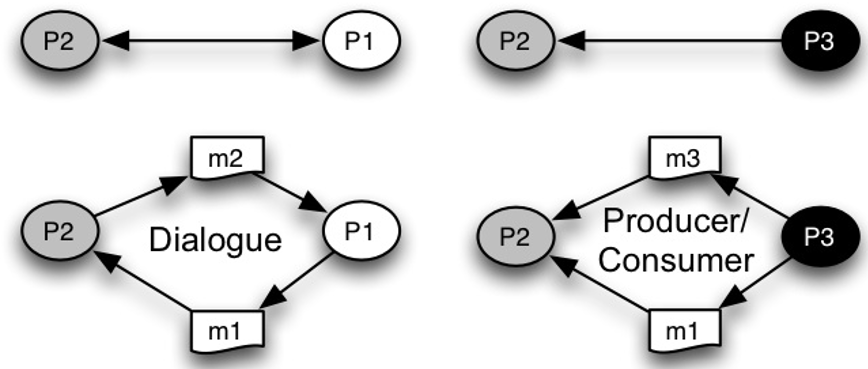 Figure 1: Traditional sociogram ties (top) vs. the unpacked Associogram (bottom), which treats media objects (m) as distinct nodes.
Key Features:
- Bipartite & Multimodal: Edges only exist between Actors and Artifacts.
- Directionality (Asymmetry): It distinguishes between creating a resource (writing) and accessing one (reading).
- Media Types: The study focused on three distinct "actants":
- Files: Symmetrical, low-frequency, highly task-oriented.
- Discussions: Asynchronous, formal, and structured.
- Chats: Synchronous, high-frequency, allowing for "connected presence" and informal digression.
Results: The Taxonomy of Online Relationships
Using a Two-Step Cluster Analysis on data from "Tapped In" (a professional network for educators), the study identified a hierarchy of user interactions.
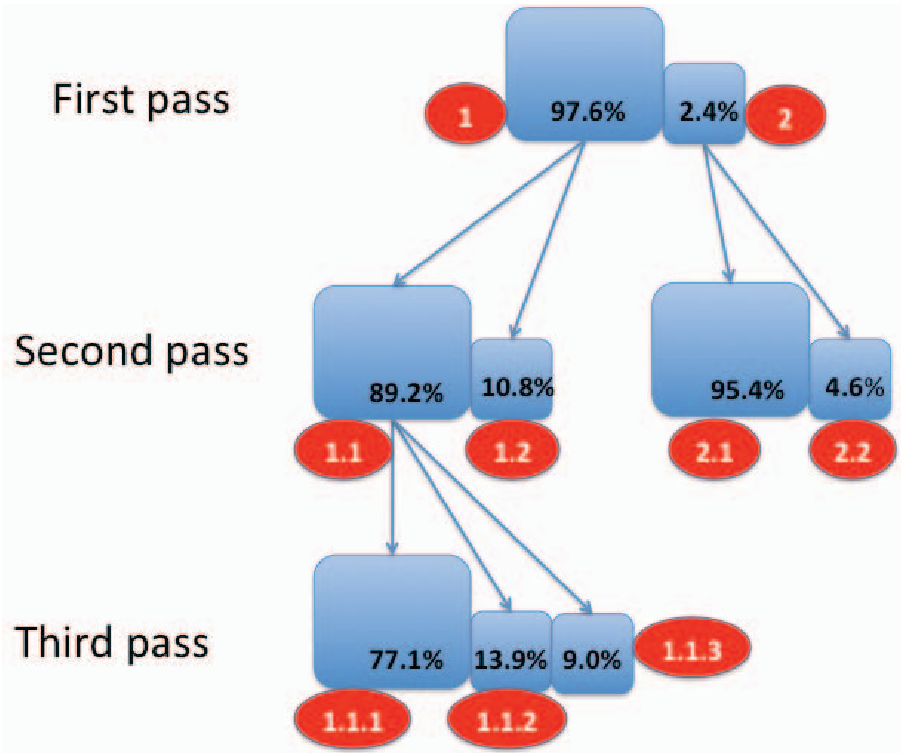 Figure 2: The hierarchical clustering of user pairs based on association patterns.
The "Super User" Archetypes:
- Cluster 2.2 (The Friends): These represent the 0.1% of "Super-Pairs." They have balanced, reciprocal chat interactions (thousands of messages) that are informal and personal. Interestingly, their forum discussions remain formal, showing that they distinguish between "private" and "public" digital spaces.
- Cluster 2.1 (Long-term Professional Peers): Highly active, but the chat is more "one-sided" (one person often facilitates). Their interactions are task-oriented and scheduled.
The "Regular" Majority:
- Cluster 1.2 (Short-term Peers): They have one intense "burst" of interaction—usually a single chat session—but no follow-up. This prevents the formation of a deep personal bond.
- Cluster 1.1.1 (Casual Encounters): The largest group (67%), characterized by very low-level, superficial chat associations.
Critical Insight: The Co-Evolution Cycle
The study highlights a reflection/reaffirmation cycle. As a relationship grows, users switch media. A professional acquaintance might start in a formal "Discussion" thread (asynchronous), but as they become "Friends," they migrate to "Chat" (synchronous) for faster, informal, and more balanced dialogue.
Conclusion & Future Outlook
This paper provides a powerful framework for developers and sociologists. By understanding that different artifacts afford different relationship types, platform designers can better foster specific types of social capital.
Limitations: The study is exploratory and relies on anonymized logs. While it can see when and where people talk, the "why" often requires deeper qualitative analysis. However, the Associogram remains a vital tool for mapping the "Technological Embedding" of our modern social lives.
Takeaway: Your digital relationship status isn't defined by a "friend" button—it's defined by the ratio of your synchronous chats to your asynchronous forum posts.