
Beyond the Map: Why Social Networks are the Secret Sauce for LBS Retention
The integration of technology, service, and social network for the continuance use of location-based services
The paper proposes an integrated theoretical framework based on Expectation-Confirmation Theory (ECT) to investigate factors driving the continuance use of Location-Based Services (LBS). It synthesizes technology (mobile device performance), service (LBS confirmation), and social network perspectives, identifying that social network effects are the primary drivers of user satisfaction in the LBS ecosystem.
TL;DR
Location-Based Services (LBS) have often struggled to move past the "novelty" phase. This paper demonstrates that the key to keeping users lies in a "Trinity of Factors": Mobile Hardware Performance, Service Utility, and most importantly, Social Network Integration. Using a sample of 332 users, the research proves that social interaction is twice as influential as the actual location service itself in driving long-term satisfaction.
The "LBS Paradox": Great Tech, Low Retention
We’ve all downloaded an app that uses our location—a local guide, a check-in tool, or a weather tracker—only to delete it weeks later. Historically, researchers blamed this "leaky bucket" problem on poor GPS accuracy or privacy fears. However, this paper argues that the missing link is the Social Network. The authors posit that LBS doesn't exist in a vacuum; it is mediated by the device in our hands and the social circles we want to impress or engage with.
Methodology: The Integrated ECT Model
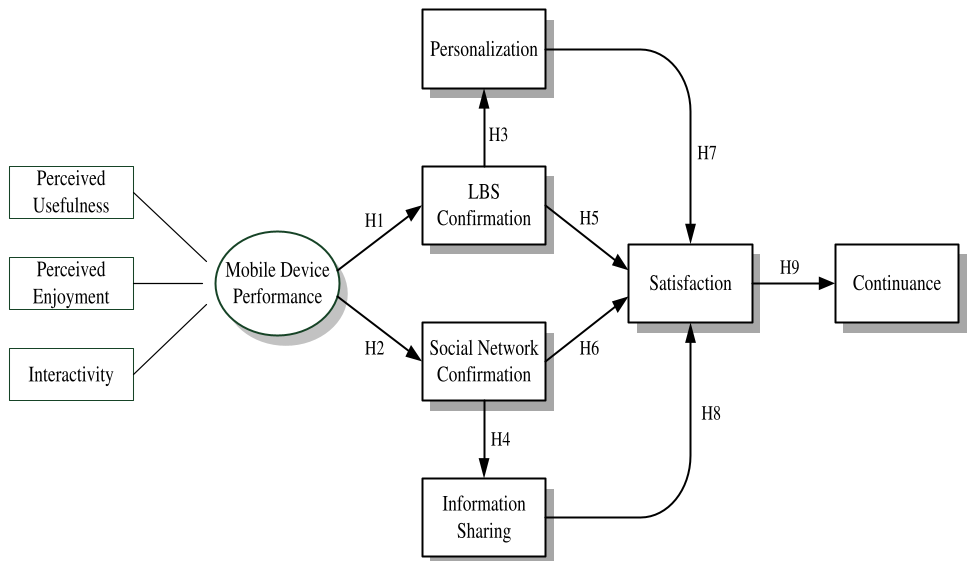
The researchers built upon the Expectation and Confirmation Theory (ECT). In simple terms, ECT suggests that if your experience (Confirmation) meets or exceeds your hype (Expectation), you are satisfied and will keep using the tech.
The authors innovated by adding two critical layers to this model:
- Mobile Device Performance: Treated as a second-order construct (Usefulness + Enjoyment + Interactivity).
- Social Perspective: Measuring how "Sharing" and "Social Network Confirmation" impact the user.
Deep Dive into the Results
The findings, derived through Partial Least Squares (PLS) modeling, provide a roadmap for the future of mobile services:
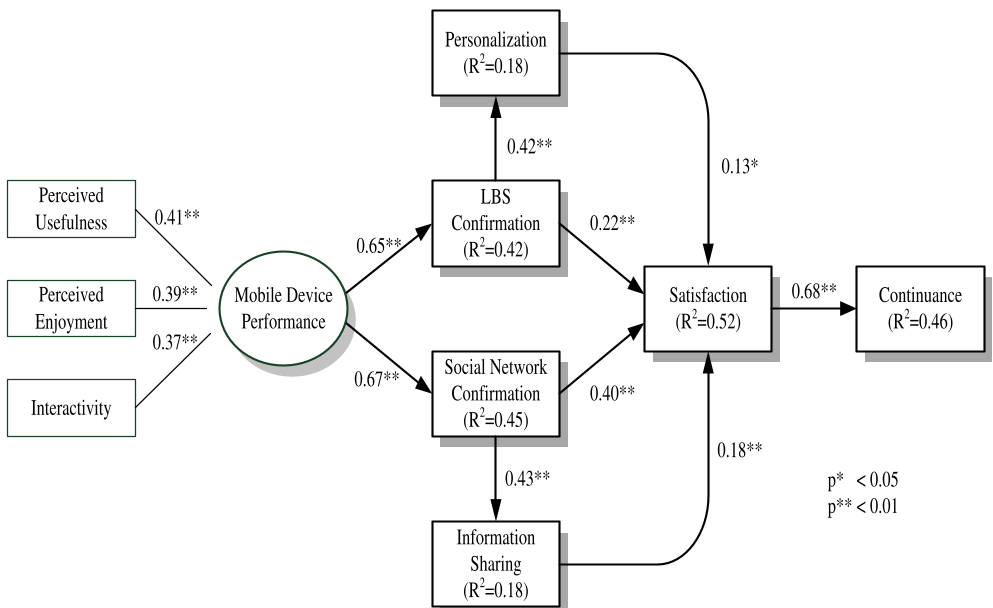
- The Power of Social: Social Network Confirmation (β=0.40) is the heaviest hitter for satisfaction. This means users don't just want to find where they are; they want to show others where they are.
- Hardware is the Foundation: Mobile device performance (β=0.65 to 0.67) directly dictates whether a user feels the service is "confirmed." If the hardware lags or the battery drains, the service fails, regardless of how good the software is.
- Satisfaction is the Bridge: Satisfaction explained a massive 46% of why people stay.
Why Social Network Effects Triumphed
The study reveals a fascinating insight: the "Feeling of Connection" is a stronger psychological reward than "Navigational Utility." When users share their location or interact with others via LBS, they receive social validation, which creates a much stronger emotional bond with the application than simply finding the nearest coffee shop.
Academic and Practical Takeaways
- For Developers: Don't just build a better map; build a better community. Features that allow seamless sharing and social feedback are not "extras"—they are the core drivers of retention.
- For Researchers: This work bridges the gap between Technology Acceptance Models (TAM) and social psychology, proving that "Mobile Performance" must be treated as a multidimensional construct (Utility + Fun + Interaction).
Conclusion
The "Continuance Use" of LBS is not just a technical challenge—it's a social one. As mobile devices become more powerful, the bottleneck for LBS success moves from the GPS chip to the "Social Graph." If you want users to stay, you must make your service a place where they can connect, not just a tool they use to navigate.
Disclaimer: This analysis is based on early research (2012) which correctly predicted the social-local-mobile (SoLoMo) trend that dominates the modern app economy today.