
Beyond Utility: How Digital "Context" Builds Media Dependency and Drives Workplace Social Media Use
How Technology Support for Contextualization Affects Enterprise Social Media Use: A Media System Dependency Perspective
This study investigates the impact of Enterprise Social Media (ESM) support for contextualization on employee media use. Leveraging Media System Dependency (MSD) theory, the research demonstrates how cognitive and affective contextual cues foster dependency relations (understanding, orientation, and play), which significantly drive both work-related and social ESM usage.
TL;DR
Why do employees use Enterprise Social Media (ESM)? It’s not just because it’s "useful." This study reveals that the secret lies in Contextualization. By providing cognitive and affective cues, ESM creates a psychological dependency (MSD) in employees—a feeling that they need the platform to understand their peers, navigate tasks, and even find joy at work.
The Problem: The "Investment-Usage" Gap
Organizations invest millions in platforms like Slack, Teams, or internal microblogs (ESM), yet many report disappointing returns. Standard models like the Technology Acceptance Model (TAM) argue that if a tool is "easy to use" and "useful," people will use it. However, this paper argues that for social technologies, ** utility isn't enough**.
The missing link is the Dependency Relation. Most studies ignore the symbiotic relationship between the medium and the individual. If an employee doesn't feel that the platform is an essential "window" into their organization’s social and task environment, they won't use it consistently.
Methodology: The Power of Context
The authors posit that ESM functions as a support system for contextualization—the explicit presentation of the "who, why, and how" behind a message. They break this down into:
- Cognitive Contextualization: Task-related information, annotations, and explicit definitions that reduce misunderstandings.
- Affective Contextualization: The "human" side—emotions, moods, personal interests, and social signals.
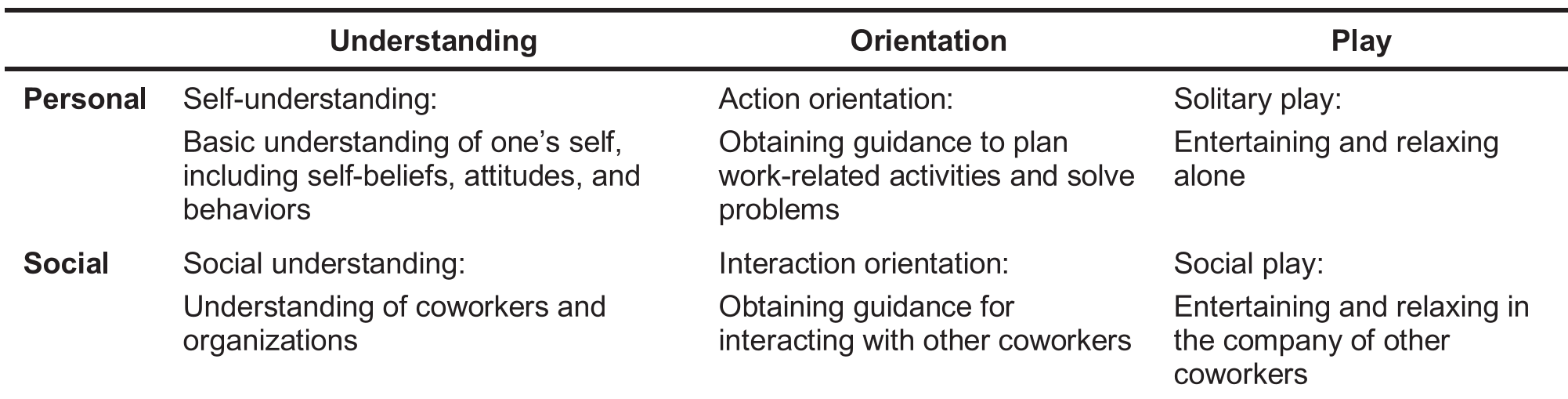
Using these cues, employees develop three types of Media System Dependency (MSD):
- Understanding: Knowing oneself and one’s colleagues.
- Orientation: Knowing how to behave and interact.
- Play: Finding entertainment and stress relief.
Key Insights: Why "Affect" Trumps "Logic"
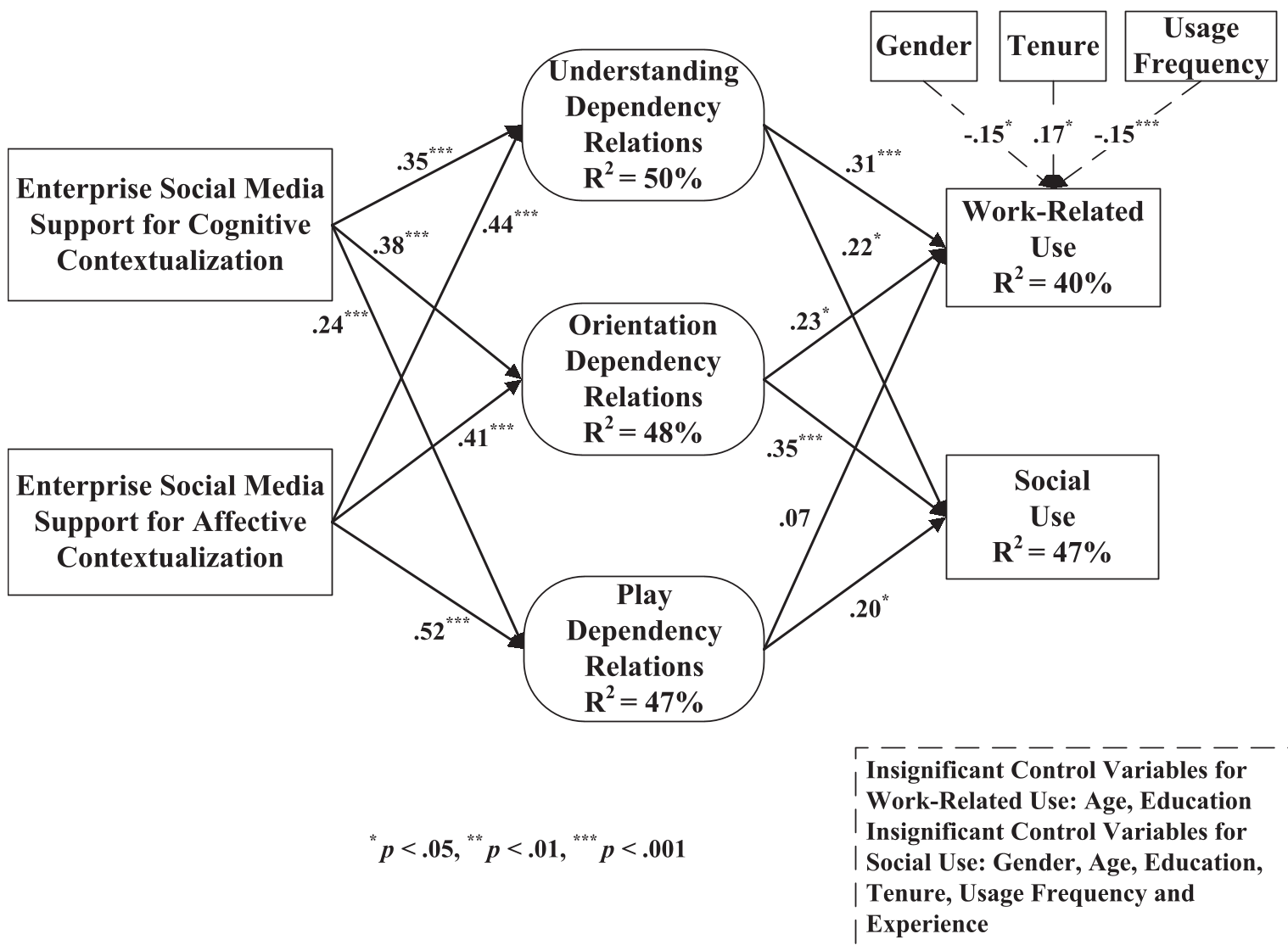
The study’s most striking find is that Affective Support is actually more powerful than Cognitive Support in building dependency.
- The Copresence Effect: Features that share personal likes, backgrounds, and moods reduce "psychological distance" more effectively than simple task clarifications.
- The Mediation Path: The impact of technology on behavior is almost entirely mediated by these dependency relations. You can't force ESM use; you must foster a state where the employee depends on the tool to navigate their social work-life.
- The "Play" Paradox: While feeling a "Play Dependency" drives social use, it showed no significant effect on work-related use. The takeaway? If employees only depend on ESM for "fun," they may tune out the work-related broadcasts entirely.
Experimental Analysis
The researchers surveyed 258 employees at a large Chinese software firm using "Circle" (an internal ESM). Using PLS-SEM, they confirmed:
- Cognitive contextualization Understanding ().
- Affective contextualization Play ().
- Orientation dependency Social Use ().
The model explained 47% of the variance in social use, proving that the MSD framework is a robust predictor of digital behavior in organizations.
Critical Insight & Practical Application
For Management:
Don't just train employees on "how to upload files." Instead, focus on recommendation algorithms that surface "interesting" and "personally relevant" social content to build Understanding Dependency.
For Technical Communicators:
The study highlights that technical writers should use ESM to bridge the gap between different roles. By seeing the "context" and "affect" behind developer logs or manager briefs, writers can create documentation that is more user-centric.
Limitations:
The data is cross-sectional and limited to a single Chinese firm. Cultural factors (like high-context communication in China) might amplify the value of affective cues compared to more low-context Western work environments.
Conclusion
This research shifts the focus from what a tool does to how a tool makes an employee feel connected. By prioritizing affective contextualization, organizations can transform ESM from a "optional digital bulletin board" into an "indispensable social nervous system."