
The Digital Exposure: Analyzing Greek Teenagers' Privacy Paradox in Social Networks
Teenagers' Use of Social Network Websites and Privacy Concerns: A Survey
This paper presents a targeted survey study on Greek high school students' engagement with Social Network Sites (SNS), focusing on Facebook, MySpace, and Hi5. It utilizes empirical data from 144 teenagers to establish correlations between gender, siblings, and usage frequency with online privacy behaviors.
TL;DR
Is more time on social media making our kids more tech-savvy about their privacy? According to this study of Greek high schoolers, the opposite might be true. While nearly every teenager is active on sites like Facebook, those who spend the most time online are actually the least likely to secure their personal data.
Positioning: This is a foundational empirical study that bridges the gap between general internet usage statistics and specific sociodemographic influences on digital privacy behaviors among European adolescents.
Privacy vs. Popularity: The Core Conflict
The research highlights a troubling trend: social networking sites (SNS) have become the primary utility of the internet for students, often eclipsing all other web activities. However, the motivation for use—connecting with friends or sharing music—frequently overrides the instinct for self-protection.
The authors identify three critical failure points in the current digital ecosystem:
- Oversharing: Adolescents reveal too much (real names, photos, and even relationship statuses).
- Platform Negligence: Sites often default to "public" or "everyone" visibility.
- Third-party Interest: The commercial value of this data makes teenagers a prime target.
Methodology: Beyond the Screen
Unlike many studies that use online surveys (which bias toward the most active users), this research utilized paper questionnaires in three distinct regions of Greece (urban, semi-urban, and rural). This provided a more grounded, representative snapshot of 16-17-year-olds in 2010.
Research Demographics

Deep Dive: How Teenagers Use the Social Web
The study reveals a distinct gender split in how the social web is utilized:
- Boys: Use SNS primarily to find new people and connect with friends. They spend significantly more time on these platforms during weekends.
- Girls: Use SNS as a creative outlet—sharing music, uploading photos, and commenting on others' content.
Interestingly, family structure plays a role. "Only children" were found to spend significantly more time on social media (over 3 hours) during weekends compared to those with siblings, suggesting the social web acts as a primary surrogate for domestic peer interaction.
Weekly Publication Frequency (Boys vs. Girls)

The "Wisdom" Gap in Privacy
The most striking finding of the paper is the inverse correlation between usage frequency and privacy protection.
We often assume that "Digital Natives" who spend hours online become experts at managing their digital footprint. The data suggests the "Wisdom of Use" theory:
- Light Users (0-1 hr/day): 63% have adjusted settings to ensure only "Friends" see their info.
- Heavy Users (>3 hrs/day): Only 29% have secured their profiles, and a staggering 38% do not even know who can see their information.
Privacy Settings Knowledge vs. Reality
While 86% of students claim to have touched their privacy settings, the visibility table tells a different story:
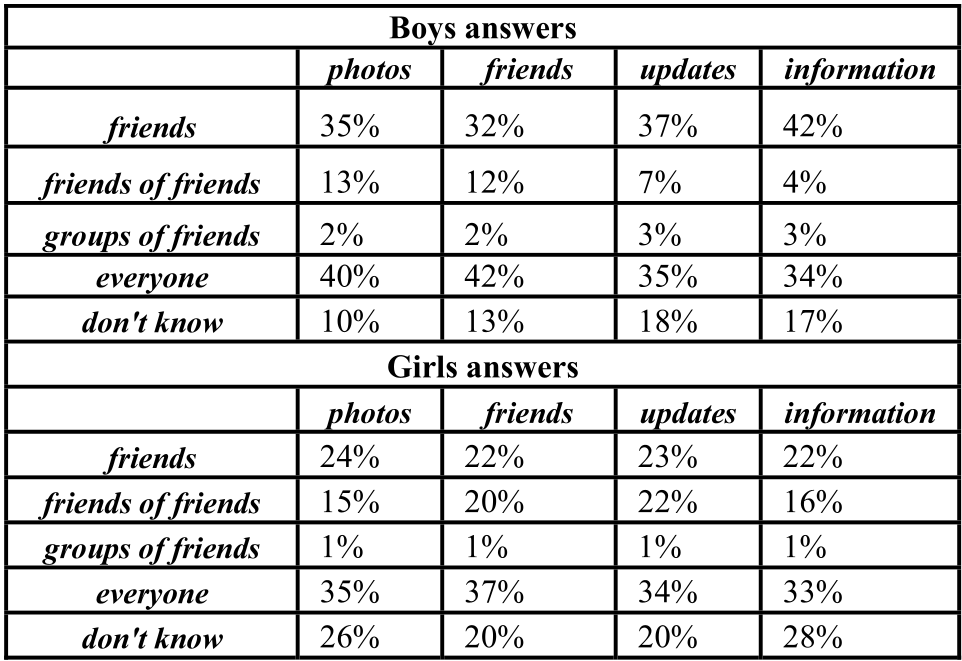
Critical Insights & Conclusion
Takeaway
High frequency of use breeds a sense of complacency. Teenagers who live their lives online begin to view the public nature of the web as "normal," leading them to ignore the granular controls (like friend groups or visibility tiers) that protect them from external threats.
Limitations
- Platform Specificity: The study was conducted when Facebook and MySpace dominated; the rise of ephemeral (Snapchat) or video-centric (TikTok) apps may have shifted these privacy mentalities.
- Self-Reporting Bias: Students might overstate their "knowledge" of settings to avoid appearing tech-illiterate.
Future Outlook
This work serves as a warning that digital literacy is not a byproduct of screen time. As we move deeper into the era of AI and data harvesting, the need for schools to implement formal privacy education—teaching students to be "wise" rather than just "active"—is more urgent than ever.